The first Trump-Biden debate

Finally, I had a break to write something about it.

What a trainwreck... At half time I already decided not to watch the next debates. It was so terrible. My only consolation was, based on the press, that half the world felt the same.

Trump was, and I don't find any better word to describe him, aberrant. At this point, whether he is mentally ill or just a pathetic, repulsive moron is a distinction without a difference.

Chris Wallace, the moderator, has been heavily criticized for his performance, I think fully undeservedly. A debate requires that the contestants have at least a modicum of dignity and sense of fair play. The only way to rein Trump in would have been the threat of physical violence. Wallace did as well as anyone could have in his place.

Biden was neither sharp, nor particularly dull. It was a mediocre performance, and the viewers didn't get the chance to see how he would perform in a normal world. I personally expected more. Apart from his intensity, Trump said nothing surprising, nor did he act in any novel way. The topics were known to everyone before the event: economy, COVID, race, the family, etc. If I had been Biden's trainer, I would have had him memorize catchy soundbites dripping with mockery, ready to shoot from the hip. Something like "You want to talk about 'smart', Donald? You (in a voice mixing contempt and amusement)? The rich man's idiot son, who inherited hundreds of millions from daddy and squandered it all? You are a joke." Or "have you made up your mind about the pandemic yet? What's the best way to defeat it? Drinking disinfectants or shouting your name in each others' faces in one of your rallies? You know, on the ones where people actually turn up. Not the Tulsa one." Maybe not everyone would find it funny, but hey, I'm not a stand-up comedian. 

On Trump's performance, I almost agree with Jerry Coyne.

"There are those who will vote for Trump, and now I see nearly all of them as deplorables. I didn’t like Hillary Clinton using that word four years ago, but that was before we’d seen Trump’s performance as President. If you want him for another four years, then I think you’re either delusional or in love with tyrants (or both), and lack all political judgment."

Almost. Not everyone voting for Trump is deplorable. But who are not, they do lack all political judgment. That is, they don't deserve to be asked for their opinion. Ever.

Who won the debate? The consensus is that everyone lost. But I just can't believe anyone came away from it feeling a stronger commitment to Trump. His only, extremely narrow way to power may be to double-down and charge ahead. But on Tuesday I think it cost him voters.

Telling neo-fascists to "stand by"? Flat-out refusing to accept the election result beforehand? I just can't believe it's happening. 

,

R.I.P. Ruth Bader Ginsburg

The game is turned upside again. Ruth Bader Ginsburg, a liberal Justice and a heroine of female empowerment died on Friday. Which is, for Republicans, who preach the sanctity of life above of all, is just a side note next to the event of real importance: a Supreme Court seat has just freed up. Mitch McConnell didn't miss a beat and vowed to fill the vacancy with a conservative judge. In 2016 McConnel denied Obama the nomination of a new Justice, nine months before the election on the grounds that it's improper to fill up a Supreme Court seat in an election year. Lindsay Graham said it on tape that it's a matter of principle, and the Democrats can use his own words against him if they shoe ever gets on the other foot. Today it did,  and the flagship of the moderate Right, the National Review, argues that those words don't count, because the 2016 explanation was only the second most important argument against the nomination. Or maybe because it was the second Tuesday of the month.

No one is surprised, but it's hard to suppress the gag-reflex.

How does it affect the coming elections and what does it say about the GOP? First of all, I think there are two, seemingly competing, agendas in the GOP. One is Trump's, who obviously wants reelection. The other is of the Republican leadership, most notably Mitch McConnell - whose job description has always been delivering judges and being a sanctimonious prick. If they kept the nomination open until after the election, that could be used to force the reluctant Republicans to vote again for Trump. This is what Trump would want, I think. On the other hand, the fact the McConnell and Graham acted so quickly and firmly suggests that they don't trust in their chances to be around after 2021 January. They want to cement their legacy while they still can.

What particularly irks me is that if the GOP gets their third Justice, they will use it in decades to come as a justification for the 4-year whoring for Trump. Yeah, it was ugly, but we did it for the higher good. Gag-reflex again.

As for how it affects the election, I think no one knows. It can energize Republican voters who can feel redeemed. It can also give them the excuse to sit out this election - we got 3 Justices, that was worth it, but it's enough. It can fill Democrat voters with noble rage and drive them to the voting booths. Or, maybe most probably, it won't have an effect at all. Maybe the Supreme Court is only relevant for the top 5% of informed voters.


Can Trump win?

It might be a sign of addiction, but few things concern me as much nowadays, personal life included, as the result of the 2020 American presidential election. I honestly think a Trump-reelection would be a genuine disaster for America and for the world as well. The damage to American society and the world order would take a generation to heal, if ever. But the topic of this article is not doom-mongering or melodrama, but looking at the odds of a Trump-reelection. I can't resist the thrill of taking whatever I have learned in the last four years and putting it all on the red. Well, blue - I root for a Trump-defeat.

I expect Biden to win, and with very good chances, by a large margin. But I'm not sure, and neither are most of the those who root for him. Almost every pundit and expert was burnt by the combination of Trump and Brexit in 2016, and as a result, everyone is very cautious and risk-averse in predictions. 

So, with as much dispassion as I can muster, I make an attempt to list the pros and cons for the probability of a Trump-reelection. First I examine the facts that herald a Biden-victory, then those which strengthen Trump's case, and finally the factors that can push the outcome both ways.

Judging by the conventional, time-proven metrics, Trump has almost no chance of winning. It's the economy, stupid. Due to the mismanagement of the pandemic, the economy is in tatters. Unemployment is through the roof. People generally don't feel very well. They are irritated by the lockdowns, afraid of getting sick, have to deal with closed schools and dubious career-expectations, plus tired of the past four years. As far as I heard, no American president has ever won re-election under these circumstances.

Second, at almost every single poll, Biden is leading by a large, and almost unprecedently stable, margin. His lead is much stronger than Hillary's was. Whatever the fears of his opponents and the beliefs of his fans, Trump is not a wizard. He defined all expectations then, but still lost the popular vote. He snowballed to the victory thanks to a string of lucky coincidences - general discontent with the state of affairs, a widely unpopular opponent, a very divided field of Republican primaries, the last-minute announcement from the FBI to re-open the investigation into Hillary's, etc. The battle now is much more uphill for him.

In correlation with the election forecasts, his approval ratings are very bad. There is just no way to interpret his handling of the pandemic other than shockingly incompetent. By election-day, almost a quarter of a million Americans will have died in COVID. The Woodward-tapes revealed that he willfully downplayed the danger, which really is just a euphemism for the fact, that he repeatedly lied to the people and put their lives in danger. That will cost him votes, especially with the elderly.

Next point. In 2016 Trump faced an opponent the majority of the voters loathed. Biden is generally a likable character, and whatever his faults are, he just doesn't generate as much animous as Hillary did even from his detractors. In 2016 a substantial part of the voters didn't know much about Trump. Now they do more than they ever wanted. He is not a fresh new voice, the "let bring some change in"-candidate.  Plus, 4 years have passed and a new cohort of voters arrived at the scene. Among young voters, Trump was way behind Hillary. I'm not sure how many extra votes it means, but it is clearly in Biden's favor.

The final point I borrowed from Stuart Stevens, a former life-long Republican campaign strategist, who now is part of the Lincoln-project and, as a form of atonement for a life of sin, works for a Biden victory. He made the observation that Trump could win in 2016 only because of the non-white turnout was at a historical low. That certainly won't happen now, and this is the single most important decisive factor in 2020 (and by the way, for every future election as well - as more than half of the 15-year olds in America are non-white).

Now let's iterate through the facts that work for Trump. 

One of them could be if things start to get better by November. People are sensitive to the relative instead of the absolute. Even if unemployment is high, if it is moving down, and there is a hope for a soon-coming vaccine, the raising optimism will favor him.

But the only firm and reliable leverage he has is his inerodable base. It seems to be that whatever the man does (as he put it in a rare moment of honesty back in 2016, he could shoot someone on the Fifth Avenue), he wouldn't lose any voters. Blatantly obvious corruption, the pandering to white supremacists and the craziest conspiracy theories, extremely poor character, catastrophic incompetence - none of these disheartens his base. On the contrary, for many voters, he is appealing exactly because of his ugliest traits.

From here, each item in the list below can tip the scales on both sides, but each of them is much more likely to help Trump than Biden.

The riots. They are a godsend to Trump, the only reason why he can still hope for re-election. His team does everything they can to depict Sleepy Joe as secret Che Guevarra hellbent on destructing America. I honestly have no idea how it will work out. Riots and lootings never help the incumbent, but the Democrats are vulnerable to this attack, because of the far-left loonies associated to them. Biden, I think, have handled the situation well. He condemned the looting and wanton destruction swiftly, and in no uncertain terms. The jury is out.

The debates. This will be an extremely asymmetrical playing field with the odds stacked against Biden. Whatever idiotic string of word-salads Trump will blurt out on stage, he will be judged as Trump is simply being Trump. Nothing to see here. On the other hand, every slip and gaffe from Biden will be picked apart mercilessly by both the Trumpists and the undecided. However, the months-long effort of Trump to depict Biden as a vegetable can backfire in his face badly. The expectations for Biden are so low now, that if he manages to stumble to the podium with his flies zipped, he will make a good impression. And his recent performance on the Democratic Convention and in some interviews was generally surprisingly good. His convention speech was regarded by many as the best of his career. Plus, Trump is actually a very poor debater and a very predictable one even for that. The Democrats had four years to come up with a debate-strategy tailored to expose him as the malignant buffoon he is. It's expectable that someone did his or her job.

That's it. To round it up quickly and lazily, I think Biden will win decisively. If he loses, Trump will go down in history, regarded by both his fans and critics, as a raw political genius. If Trump loses badly, he will be seen as the luckiest idiot riding on an improbable wave of contingencies, and everyone will express deep disbelief that it could go on as long as it did. Such is the human tendency to see inevitability in every path taken by history in hindsight.

,

Down, down, sink them all down

In the last few months, up until a couple of weeks ago, I had been wondering what the Republican strategy would look like for November. Will they try to distance themselves from Trump, so in the very likely defeat he doesn't pull them down all the way down? That seemed at least possible. Maybe switching the candidate altogether? That was no longer an option. Had they had any intention of getting rid of Trump, they were offered the chance by the impeachment. They could have even come out of that situation as principled statesmen (and women) who used the embarrassing incumbent to drive the conservative agenda (tax cuts and the like) but drew a firm line at criminal activity. They blew that chance, and I bet some of them will passionately regret it. So in the end, I was mostly expecting them to dial down, to push black Republicans forward, things like that. I wasn't expecting the fierce doubling down. I was naive, I suppose.

The economy is in the gutters. There is not a week when Trump doesn't blurt out something idiotic and vile that harms him. The pandemic still kills a thousand people a day. So Trump and his party decided that the only way to victory is a desperate, no holds barred attack on Biden. Let's do everything we can to make people believe that Biden is a blood-thirsty anarchist hell-bent on destroying America as we know it!

That's an uphill battle, mostly against their own former efforts. The Trump team has been laboring for a year now to depict Biden as a doddering old fool. "Sleepy Joe" is not the moniker that was meant to put the fear of God in the law-abiding citizens. Second, urging people to believe that riots will rule the streets in Biden's America and Trump is the way to restore law and order, asks for suspending one's rational faculties to an extreme degree. Riots are ruling the streets now, in this very moment, in Trump's America. Not to mention voters put Trump in the White House exactly to destroy the established order, to shake up things, to disregard the norms. He was the chaos candidate then and he is the chaos president now. 

Nevertheless, this is their plan. The crazier the riots, the better for Trump. Let's stoke racial tensions and hatred. The GOP is an almost openly racist party now. Not that their members are racists, I think most of them are not, but they behave like one. The moment Kamala Harris was announced to be Biden's running mate, Trump launched an ugly warmed-up birther attack. In a not-very-coded language, they try to scare suburban voters with the invasion of low-income (that is, black or Hispanic) neighbors. To press the point, they attach Cory Booker's name to it for the only reason that Booker is black. They are trying to make a national hero of a 17-year old white vigilante, who shot and killed two protesters in Kenosha. The half-witted couple who pointed guns at BLM protesters were invited speakers at the Republican Convention.

The Convention was, by the way, in the White House, which is literally illegal. Breaking the law was combined with breaking norms, too. Secretaries of the state have traditionally kept themselves out of party politics, but it didn't stop Pompeo from giving a heartfelt love-speech to Trump. As a flagrant show of unapologetic nepotism, every member of the Trump family and their dogs (or rabid girlfriends) presented themselves. The naturalization ceremony was just a part of the show. Republicans decided to not even have a platform now. We simply want what the dear leader wants. Half of the speeches were about praising Trump, some even went so far as describing him as a most empathic and caring person. 

The convention wasn't particularly outrageous in the context of the past four years, but the gestures were still striking because they were so small time. Showing off by breaking a minor law, shameless ass-licking, pandering to the far-right. All for basically one reason - to please Trump. Apart from politics aficionados, no one watches the conventions, and those have already made up their mind.

For the public, though, the line of communication is shocking. Trump publicly and repeatedly encourages voter fraud by telling his supporters to vote twice, by mail and by person. He threatens to defund the postal service to make voting by mail harder. He refuses to denounce, and his sons openly embrace, QAnon, a crackpot conspiracy-theory movement. His team put doctored videos of Biden on social media. And he, whenever he can, encourages and escalates violence. Nothing like this has ever happened in living memory. I think we can't even register the scale of the waste Trump lays on America and the world as well.

As for the moderate conservative media, anodyne reprimands are the most the National Review is capable of churning out, in the vein of "[...] it’d be even better if the president didn’t purport to have powers that he doesn’t." The rest of their time they half-heartedly spend on trying to see Biden as the vessel of the far-left or musing on the dangers of socialism. Or on the moral degeneration of abortion-supporters. In. Every. Single. Issue. Bunch of cowards and pretentious dicks. I've [expletive] stopped reading them.

, ,

To lock down or not to lock down?

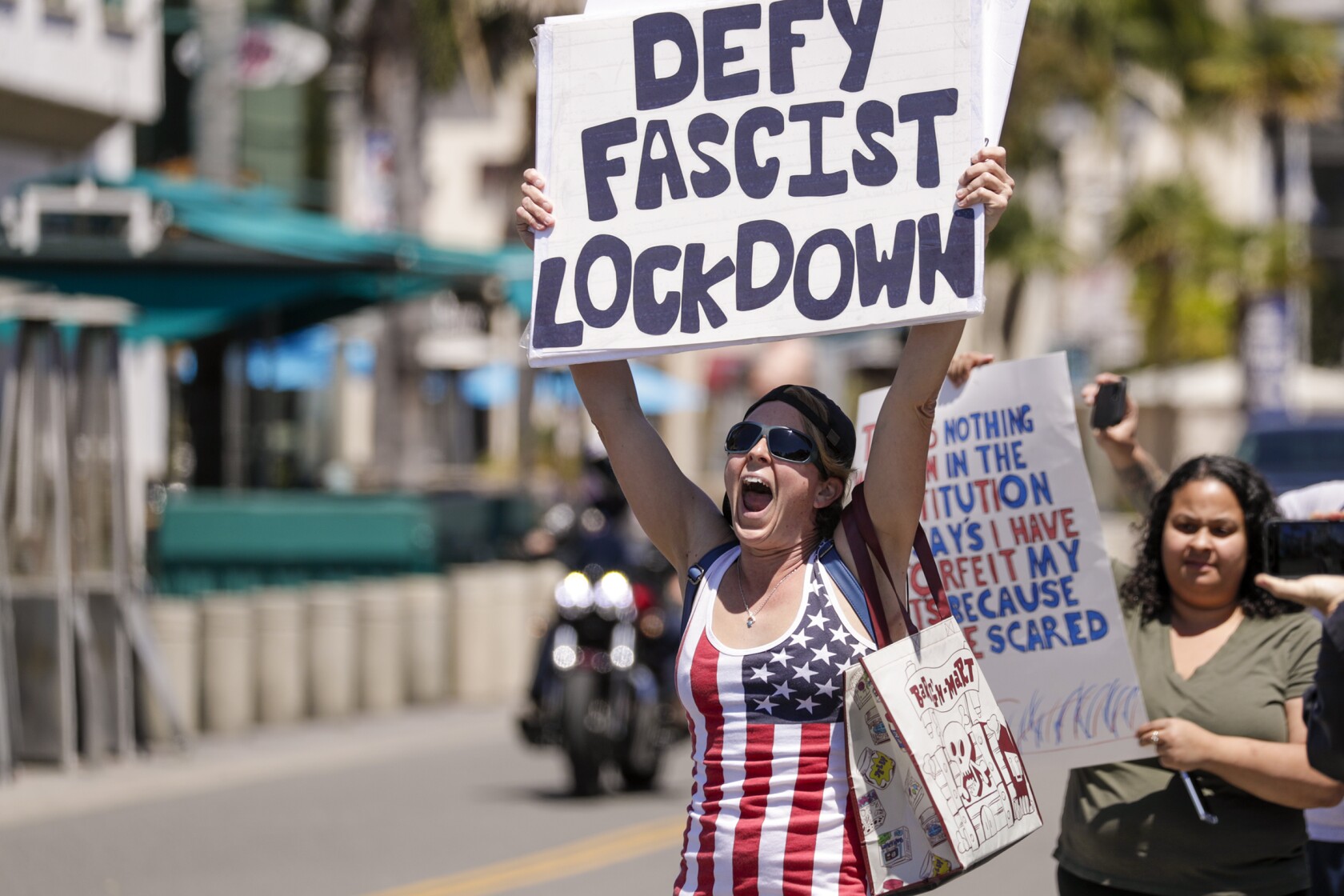
Since the start of the pandemic, I have been a supporter of lockdowns. It's a certain sign of the intellectual bubble I live in that for long I had thought it's just common wisdom. The bubble consists of mostly liberal news sources, but due to the lockdown itself, not many human contacts. Later when I had real conversations, I realized that whenever the topic came up, almost no one I was talking to shared my view completely. So I decided to sit down and try and articulate why I think lockdowns was a good idea and why the counter-arguments are wrong or unpersuasive.

My stance rests on three legs. Common sense, referring to experts, and caution. 

Let's start with common sense. Viruses spread from person to person. The less people mingle, the slower the spread is. Even if eventually everyone gets infected at some point, by slowing down the spread we can flatten the curve and prevent unbearable pressure on the health-care system. 

Referring to experts is a nice name for appealing to authority. This is admittedly the worst way to support an opinion, but it's also one we have to do every day. No one can be informed about everything, so you have to outsource your belief verifications to experts in almost every field of life. If epidemiologists and economists say lockdowns are a necessary evil, then I, being none of them, accept their word at face value.

Call me naive, but I also believe that politicians listen to experts. Call me cynical, but I also believe that they always keep their own interest in mind. Almost all Western governments have implemented some form of lockdown, and I don't think it can be fully ascribed to groupthink. Lockdowns cause severe economic damage which always hurts political leaders. If they chose to shut down their economies, they did it because they thought the alternative for them would be even worse. Groupthink is not a satisfying explanation for that, especially considering that no country followed the same pattern. Sweden has chosen not to implement lockdowns at all. Russia made a panicky U-turn after the short and typical strong-man stunt of disparaging the Western panic. Israel, whose people are not prone to public anxiety of imaginary dangers, locked down, too.

To address the caution part, every public measure either under- or overaddresses the problem it aims to solve. Shutting down the economy might be an overreaction, but with an unknown and deadly virus, that's exactly what I'd want the government to choose over the opposite. I prefer unnecessary economic damage to an unnecessary death toll. When the world-wide lockdowns were introduced, the mortality rate was estimated in the range of 0.5 and 6%. Italy had around 10%. It wasn't known which age groups are in danger, whether kids can contract the virus or spread it, what's the reproduction number, and many other factors. Today, as far as I know, the mortality rate is generally thought to be around 0.6% - which is still 6 times deadlier than the common flu -, and kids are not really at risk. These are good news, but they could have turned out very differently. If the mortality rate were around 10% among children and not among octogenarians, every family would live in their basement behind boarded-up windows. I would certainly do.

These are my arguments. Let's see the opposite side.

"This is an unacceptable invasion into our personal liberty"

Let's start with the libertarian argument which is the easiest to brush aside. Some oppose lockdowns on the ground of the perceived violation of personal liberty. This is nonsense. No one has the freedom to harm others, and that is exactly what a person infecting others does - even if unwittingly. If you subscribe to this reasoning, how would you make the case against anti-vaxxers?

The most common argument is that "the whole thing is blown waaay over, maaan". There are many sub-strains of this.

"This is just like a severe version of the flu"

Tens of thousands a year die in flu in America and no one thinks we should kill the economy because of it. That argument might have been worth considering months ago, but not anymore. The average yearly death toll of the seasonal flu is 10-60,000. COVID-19 has killed 180,000 so far and still counting. All of this while mandatory social distancing was put in place. The number would be much higher without it. The second wave has just started, and no one knows how long it will last or will there be another one.

"The numbers are unreliable, they count everything as COVID-death"

To invalidate the previous point, one has to put the numbers in question. So the next most popular argument is that the data are not reliable. Deaths are habitually ascribed to COVID even when the person would have died anyway from other causes (probably to serve the nefarious plans of...who actually?). That is surely true in many cases, but we have other statistics to look at that neatly eliminate the problem above. This is the number of excess deaths, that is, the increase in the number of deaths compared with the statistical average of the previous years. In America, it is over 200,000, which is even higher than the official number of COVID-related deaths. In the UK it's 65,000 against the official COVID fatalities of 40,000.

"The cure is worse than the disease"

Maybe the deaths are real. But I've heard from multiple sources that the self-inflicted economic damage leads to more misery in the long term than the virus would have done. This is something that's hard to argue both for or against. In ten years, when all the consequences have played out, we can have a pro- and con list, and even then we will need to resort to counterfactuals as the bases of comparison. As for now, many critics commit the mistake of comparing the grim reality to the normal state of affairs. The damage the shutdowns cause should be measured not against last year's GDP data, but against the alternative reality of COVID without mandatory social distancing. Sweden has shown what could happen without a lockdown. Its quarterly GDP fell by 8%. The EU average is 12%, Germany 10%, and Switzerland also 8%. They haven't avoided much of economic damage but lost 5-10 times as many lives per capita than Finland, Norway, or Denmark. Every country is unique in many relevant ways (population density, age distribution, cultural norms, international connectedness, the time and severity of the first outbreak, etc), but Sweden can't be that different from the average of its direct neighbors.

That was it. As a parting message, I offer my favorite line of reasoning, which is a kind of reversed argumentum ad verecundiam fallacy. Listening to people with a history of good judgment is a good strategy, but there is another useful one. It is listening to idiots and tyrants, and firmly taking the opposite view. Who were the loudest opponents of the mainstream reaction? First the Russians who never cared about their citizens' well-being. Then the Belarus dictator, Lukashenko, who claimed that the best cure for COVID is drinking vodka and driving tractor. The president of Turkmenistan who in his country simply banned even the discussion of the topic. The Brazil right-wing president, Bolsonaro, who said if he got infected, he would just shrug it off due to his athletic youth. Donald Trump - no explanation required. Right-wing media almost everywhere. Fox News treated it for weeks as a Democrat-hoax, then even now as the normal flu - so what's the fuss about? The UK government, which is neither malign nor completely moronic, but has shown that they prioritize their personal interests over their citizens'. 

It wouldn't survive strict scientific scrutiny, but as a rule of thumb, it is pretty reliable. When murderous dictators, crackpots, conspiracy theorists, plain morons, and well-known opportunists all tell you the same thing, it's a good sign to place your bets elsewhere.

, ,

Anne Applebaum: Twilight of Democracy

A couple of years ago I decided to write a quick summary after each good non-fiction book I read. I read a lot, but I forget a lot, too, and my attention to detail leaves much to be desired. This self-imposed exercise was meant to be a remedy of the sort. Of course, I lacked the discipline to stick to it, but time-to-time I muster the energy to carry it through. Some days ago I finished The Twilight of Democracy from Anne Applebaum, and decided this is a good place to get into practice again. So, here we go...

In her new book, the Twilight of Democracy, Anne Applebaum attempts to explain the reasons behind the authoritarian wave that has swept over the Western world in the last decade. From Hungary to the United States, history seemed to take a sudden U-turn. Even in countries where democracy has not suffered serious blows, nationalists (and sometimes their mirror-images on the far left) have gained territory to an extent that was unimaginable ten years ago.

Applebaum is a renowned historian of the Soviet Union, but her new book is not a heavy tome. It's more like an essay of the length of a short book, in which she makes an attempt to explain how and why the zeitgeist has changed so much and so rapidly. She examines in detail how the events unfolded in Poland, Hungary, Spain, the UK, and the USA. 

There is no real common theme that underlies the changes everywhere. There are some commonalities, but every country has had its own way in the race to the bottom. Poland and Hungary went straight down the rabbit hole. Both the Polish Law and Justice Party and Orban's Fidesz have invented imaginary enemies - migrants, Soros, Brussel -, and managed to keep their base in a constant frenzy of them. The USA and Spain have developed the twin forces of Right and Left-wing extremism that mutually fuel each other. Britain hasn't sunk that low (my way to put it, not Applebaum's), and it's an outlier in this story in many ways, but a bunch of nostalgia-driven zealots and opportunists has taken over the country.

The usual explanations for the general decline in support for centrist politics find the blame mostly in globalism and growing inequality. Applebaum barely mentions them and instead makes two observations. One is about democracy and the other is about the role a special cadre of the elite - she calls them 'clerks' - plays in the political turns and the maintenance of the new regimes.

Liberal democracy has two unappealing features, at least unappealing for a large number of the electorate, especially those who reached adulthood in one-party systems. One is complexity. After decades of socialism, the chaos of democracy with its constant debates, changes, and uncertainties were too much for many people. They needed a simpler narrative. And once someone offered the truth, why would we need pluralistic views? Secondly, liberal democracy is a meritocratic system. That is great for talented and lucky people, but it can be a source of resentment for others. For those, a one-party system where loyalty and not talent is rewarded is often much more desirable.

The other crucial element in these political movements is the existence of the clerks. The bureaucrats, intellectuals, journalists, and politicians who, for various reasons and rewards, decided to serve the regime. They spread the center's lies, explain away contradictions, stoke nativism, present a measured and civilized face to the outside world - while railing their base against it. In Eastern-Europe they largely came of age in the socialist era and the main reason to turn against liberalism was personal resentment. Many of them felt that in the new system they weren't given the status and recognition they deserved, but realized that they could have them in exchange for loyalty.

In England, the Brexiters subscribed to a special form of nostalgia. Being a middle-sized power in the shadow of the USA, China, and the EU is not a glamourous role for a country that ruled over a quarter of the Earth just a century ago. They long for a world where England could make the rules again, and shameless lying, sycophancy, and economical and political damage are a small price to pay for it.

What happened in the West in general, particularly in the US, is an unexpected break-up among former comrades-in-arms. A generation ago, the Soviet threat herded very different characters into the same camp. Christians opposed the Communists on the basis of their atheism and religious persecution. Nationalists hated the idea of Soviet dominance and the Marxist interpretation of history. People of realpolitik were concerned about Soviet influence and threat. Idealists thought that fighting for freedom and human rights is a duty. Free-market advocates hated collectivism. When the Soviet Union collapsed, the cohesive force disappeared with it and the differences become obvious. In the span of two decades, intellectuals drifted into two opposing camps, with no bridge between. 

On one side are (or stayed) the believers of democracy and freedom. Not every one of them is an unabashed pro-market and free-trade supporter, but the latter all belong to this camp. On the other side are the ones to whom democracy turned out to be only secondary to something else. National greatness, or religion, or tradition. Many such people, even staunch Cold War warriors, have found an unlikely lodestar. - Russia, as the defender of tradition, religion, and conservative values. It looks like it doesn't matter how many journalists and human right lawyers Putin kills, politician opponents poisons, or war crimes he commits, or how much he and his cronies steal from his own people, simple claiming to be a defender of Christianity (and not even trying very hard at that) absolves all the sins. Applebaum is incredulous how people can fall for such an obvious lie, and so am I.

The book also addresses the role social media has played in the surge of populism. It doesn't make any novel observations but summarizes the topic neatly. First of all, social media offered the fringes a platform to coalesce. Conspiracy theorists, anti-semites, nazi-sympathizers, and general nutjobs used to have few venues to vent their anger. In the pub, on football-matches, or at family gatherings. The mainstream media slammed the door firmly in their faces. Now they can find and connect to each other as easily as never before. They can live in a social bubble sealed from alternative voices. Additionally, expressing some extreme opinions or insulting people used to come with the danger of retaliation. Anonymity on the net eliminates that.

Even for sane people, social media changed the perception of the world. The traditional ways of exerting political influence - voting, campaigning, international efforts - seem extremely slow and ineffective ways of bringing about change, and that frustrates people.

The world changed in another way, too, which is only partly related to technology, but like that, it's unlikely to go away soon. Apart from the mandatory anti-semitism, far-right parties across the world used to have little to agree on. Just being neighbors logically led to animosity. It has changed, very recently, probably as a backlash against the radical leftward-shift of the mainstream. From Russia to the United States, the right-wingers share a common fear and hatred for gay-rights, feminism, Muslims, immigrants, globalism, environmentalism, and technology (and still the Jews, which, of course, will never change). But they also share a vague ideal as well. The socially conservative, Christian family.

The book, unfortunately, doesn't offer solutions. Applebaum's farewell message is that these are darker days, and the liberal world order might turn out to be a mere blip in history, not the end of it. Let's hope and work against that.


Robert Wright: Why Buddhism Is True Book (2017)

Earlier I admitted that, although I'm generally, albeit moderately, interested in Buddhism, I can only really appreciate books on the topic from Western authors. Since then, my snobbism has raised to new heights (or sunk to new lows), as nowadays I can only digest the rare Buddhist books from Western scientists. I think the reason is that with something both so subjective and abstract, even very smart people can get carried away by wishful thinking, confirmation bias, or just insufficient training in critical thinking. A scientist is trained to avoid logical fallacies, to think in probabilities rather than certainties, and to distrust even beautiful theories until they are confirmed by data. They are not infallible, but at least more immune to self-deception...