Showing posts with label geopolitics. Show all posts
, , , ,

Steven Bonnell aka Destiny

Steven Bonnell aka Destiny is probably the most interesting online political commentator who broke into the mainstream in the last couple of years. I stumbled into him in 2021, in the dark days of lockdowns, when he was still relatively little known outside the circle of fervent Youtubers. On that occasion, he debated Richard Wolff, a well-known Marxist professor of economy on the topic of socialism vs capitalism and I think he won the encounter decisively. Bonnell was composed, well-informed, asked the right questions, and above all, was generally curious about what the other side had to say. Even Wolff's fans admitted that the prof didn't come out too well and I quickly became hooked onto Destiny's channel. I find that he is rather unique in origin story, style, and skills in a realm filled with hundreds of online pundits, and one of the best things that this cesspool space has produced in years.

Unlike most established political gurus, Bonnell has no academic background (not even a college degree) and no experience in journalism, or writing, or business and is not affiliated with any political party or ideology. In a field completely dominated by high-pedigree individuals, he is as blue-collar as it gets. A college drop-out who worked in a casino and a carpet laundry before taking up professional gaming as a full-time occupation under the name "Destiny". Soon, he started to engage in debates on various topics while simultaneously playing video games on the screen. That was in the early 2010s. Gamergate triggered the emergence of a large number of streamer-commentators among whom Destiny stood out as a left-leaning (in the American sense) personality in a crowd that largely stretches from conservatives to the far-right, but he really started to gain recognition in tandem with the rising of Trump.

The video-gaming part has been dropped by now, but Destiny is as present as ever, with his 24/7 14-hours daily online presence making Lex Friedman look like a slouch. He debates anyone and everyone on current issues and general topics in politics and economy (and sometimes in philosophy and science) from Nick Fuentes-like neo-nazis to die-hard communists, radical feminists and Andrew Tate fanboys, Hamas-sympathizers and Zionists, social justice warriors and election deniers, anti-vaxxers, radical libertarians, and anyone in- or wildly outside the Overton-window. 

Regarding his own views, he began as a "pull up yourself by your own bootstraps"-type conservative and over the years evolved into what he describes as a social democrat. I'd rather call him a centrist, but in the States, the political categories don't exactly mean the same as in Europe (as almost all Americans misuse the words "liberal" and "socialist"). In a nutshell, he is a social liberal and an economic centrist. To draw the general contours: he believes in liberal values (rule of law, democratic institutions, individual freedom) and in free markets buttressed by a welfare state. He is absolutely pro-Ukraine, pro-vaccine, strongly pro-Israel, strongly pro-Biden (and anti-Trump), left-of-center on trans issues, and regards the US as an altogether positive geopolitical force.

He is also unideological in a refreshing way, who tries to build his argument on empirical data instead of on some moral basis. As he once put it, if the evidence showed that central planning is superior to free markets, he would be open to be convinced by it, as opposed to most rightwing commentators for whom it's not so much a question of economics, but of identity. 

His atypical background aside, his views - which are fairly aligned with the mainstream - wouldn't make him stand out from the crowd. His uniqueness lies in his personality, skills, and content-incontinence. But most of all, his personality. He has one skill few people possess in sufficient amount and which is indispensable if one wants to stay in this business long. His skin is not so much thick as literally impenetrable. Destiny is impossible to be triggered by personal insults or condescension. In one on-premise debate, the right-wing degenerate Milo Yiannopoulos tried to crawl under his skin by telling the audience how Destiny parades his wife around as the town-whore (until his recent divorce, Destiny lived in an open relationship), then went a step further and made remarks on his 9-year old son. All this in the context of arguing for 12th-century Christian values. Destiny simply ignored him then offhandedly shot back with a joke Milo did not get. He came across as the piece of shit he is, and that was the end of his desired career comeback effort.

The source of this resilience is the result of both nature and nurture. At the core is something Destiny must have been born with instead of having learned because in an interview with Alex O'Connor (formerly known as Cosmic Skeptic), he admitted that he sometimes doesn't understand the emotional state of others. As a side note, he also doesn't think animals are anything more than consciousness-less biological machines, and repeated attempts from Alex failed to disabuse him of this disturbing view. The nurture part comes from growing up in the gamer culture where depraved talk (in his words) is the norm and people think it's funny because it's so bad and not taken seriously at the same time. Anyone who stays long there will grow insensitive to the most graphic death threats and obscene verbal abuses that are thrown around all the time. In the world of normal human beings, Destiny is just impossible to rattle. It doesn't mean that he is some Spock-like character who is immune to emotions. He loses his temper quite often and tells his opinion in a very vulgar manner if he runs out of patience with what he perceives as stupidity. 

Another thing he must have been born with is the obsession with which he dives into any topic that piqued his interest. When learning about a new thing - let's say the history of the Israeli-Palestinian conflict he started studying after Oct 7 - he famously starts from Wikipedia (which was mocked recently by Joe Rogan, which is funny, regarding how much time Rogan spends spreading misinformation about things he knows little about), then follows the links all the way to reading history books and UN resolutions if needed. A good observation he often makes is that if you actually read full articles instead of just their headlines, regardless of the source (let it be Fox News or CNN), you will be better informed than 90% of the people. Taking it a step further, Destiny often demonstrates the surprising fact that if you start from the level of a layman but completely dedicate yourself to studying a political/historical topic for a couple of months and you know how to discern the most important facts from the details, your judgment on major points can be as well-informed as the judgment of any expert of the topic.

On top of his natural abilities, Destiny has 10+ years behind him as an online debater. He is just superb at what he does. He has a very quick wit, can think on his feet, and adapt to his opponent's style on the fly. He knows how to let buffoons like Milo undermine themselves while appearing professional and polite, can be extremely confrontative and engage in a shouting match if needed, but can also shine in a good-faith argument with very smart but ideologically blinkered opponents. But to be frank, he is the best when he loses his patience: he still doesn't respond to ad hominems in kind, but instead dials up the speech speed and launches barrages of perfectly reasonable arguments laden with expletives (a must-watch). 

He knows his limits as well and how much skills can matter over logical arguments. Once he said that the smartest flat-earther in the world would probably wipe the floor with him in a debate.

The quality is matched by the quantity. His output is inhuman. Despite having become a millionaire, he still spends 14 hours a day online, jumping from one debate to another, with no signs of exhaustion. When not, he goes to campuses to debate libertarians and trans-activists, and Trump rallies to interview those who turn up there. And still in a T-shirt, hoody, or tracksuit like a 20-year-old Gamer. It's an unusual way to spend your life. 

Even with all those attributes working in his favor, as recently as a year ago, I was sure that he would never break into the mainstream. The people he is associated with contain Marxist hardliners, white supremacists, Andrew Tate-worshipping misogynists, and some of the lowest scum the space can produce. If you'd like to venture into the dark underbelly of American political forums in any direction, you'll hardly find a better guide than Destiny. You can also be genuinely surprised by the difference in human quality between individuals even there. If I was forced to have a chat with a Nazi, I would choose Richard Spencer over Nick Fuentes without hesitation. 

The content is dicey, but the style isn't helpful either, to put it mildly. As mentioned above, Destiny comes from the gamer culture. Old habits linger on, and he can still be extremely vulgar, either on purpose or just for fun. Once he was discussing the concept of marginal utility in an online conversation and said something like "$10,000 could be a life-changing for someone in the bottom 10 percentile, but I would probably spend it in a couple of days just by fucking your mother a thousand times." There are thousands of hours of videos of him to cut out 10 seconds from to make him look like anything from a serial killer to a pedophile. In 2022, he got banned from Twitch for "hateful conduct". 

Nevertheless, on his eternal C-league status, I am happy to have been proven wrong. In the past year, he has appeared on debate panels, was invited to give speeches at universities, appeared on Lex Friedman's podcast, then on Within Reason with Alex O'Connor, and finally, on Piers Morgan. He sat across the table with Alex Jones, Ben Shapiro, Norman Finkelstein, Jordan Peterson from the "real world", and basically debated everyone in the Youtube sphere. He worked his way up from the sewers and made his entry to the top tier. Until he gets bored with it, I think he is there to stay.


, , ,

Thoughts on the Arab-Israeli conflict

In this post, I want to summarize my thoughts about the Arab-Israeli conflict. What follows below will be not a comprehensive historical overview, although it will contain historical facts, nor an opinion piece, although it will be partially, and inescapably subjective. Instead, I want to gather the facts that in my judgment weigh heaviest in the debate and the questions that cut most to the core of the issue.

, ,

The most useful idiot

Noam Chomsky is one of the most famous living linguists in the world and perhaps one of the most cited scholars in modern history. If the MIT professor emeritus had done nothing else in his life but stuck to linguistics, he would have a place in history books as a giant in his field. He would also be little known outside of it. What makes Chomsky a household name for people even marginally interested in world politics is his unrelenting seven-decade (and counting) crusade to uncover the US's misdoings. Chomsky has been active as a political activist since the fifties and even today he continues to write books which now number over one hundred.

His work ethic is legendary. Besides being an incredibly prolific author, and world-class scholar in a field completely unrelated to his political activism, he reputedly replies to every email he receives regardless of the sender's status or importance.

It's nigh impossible to list all the events Chomsky has written about, but one can be sure that whatever geopolitical affairs the US had been involved in since its foundation, Chomsky commented on them all. And his interpretations were damning to America, to a fault. Which is not necessarily a bad thing on its face. The US is now the sole superpower on Earth, and it deserves scrutiny proportional to its status. America, like every great power in history, has intervened in other nations' business countless times and has committed plenty of mistakes and intentional crimes along the way. Especially its general Cold War conduct in South America, which involved supporting murderous regimes by direct intervention or explicitly encouraging torture and bloody oppression of their opposition, is by and large a stain on the nation.

But other great powers have done the same things and much worse. Consider Nazi Germany, pre-WWII Japan, the Soviet Union, or by our modern standards, every single power in earlier history, and the US probably comes out reasonably well in comparison to either of them.

Or not, according to Chomsky who genuinely believes not only that America (and the West) is a net negative force in the world, but that it is the worst of all contenders. He called and US and UK the greatest terrorist states in the world. Comparing the US to the Soviet Union, Chomsky has claimed that the latter was morally superior, if only marginally. Considering that the Soviet Union was practically a slave empire that killed millions of its own citizens, imprisoned ten times as many, and installed similarly brutal regimes everywhere it had its way, that's quite a statement.

As logically follows, Chomsky regards NATO as the most aggressive and violent military alliance in the world. Why countries in the Soviet sphere of influence have been begging to join doesn't merit serious attention from him.

Despite his obvious ideological bias, Chomsky's encyclopedic knowledge of the facts (he copiously cites dates, names, UN resolutions, acts of Congress, ... to support his arguments) makes most of his criticism credible. But with occasionally capital misfires. Anyone opposing the US can count on some sympathy from Chomsky, even unspeakable regimes like the Khmer Rogue. Pol Pot's nightmarish rule had seen almost 1 in every 4 Cambodians killed, which puts Pot far beyond even Hitler, Mao, or Stalin, as mass-murderer dictators go, at least proportionally to population. Chomsky spent years claiming that the regime's genocidal crimes were wildly exaggerated by Western media. After the facts have become undeniable, Chomsky never apologized. On the contrary, he argued that considering the information available at the time, he was right.

Chomsky in general has a poor track record with genocides, as the US hasn't committed any in recent history, and its evil vindicates the crimes of its enemies. Virtually singularly among serious Western scholars, Chomsky denies that the Bosnian massacres during the Yugoslav wars in the nineties were ordered by Milosevic, or in some cases, that they actually took place. In his interpretation, the Serbs were provoked into mass murders by the US to provide a pretext for NATO bombing. The reason? The US could not allow a successful socialist state to exist in Europe. 

After almost thirty years, Chomsky is still the main perpetrator of the lie that the concentration camps, revealed to the world by the infamous photos of emaciated men standing behind barbed wire fences, were a fabrication of Western journalists to besmirch the Serbs. One would think that sentences handed down in The Hague that were based on witness testimonies from both victims and perpetrators would put an end to such speculations. Not for Chomsky. To this day, he is willing to appear on Serb television to be used as a tool of anti-Western propaganda. As a side note, it's worth mentioning that the current leader of Serbia, Aleksandar Vučić, served as a propaganda minister in Milosevic's bona fide fascist government. To be fair, it's not that Chomsky doesn't acknowledge the war crimes of the Serbs. He just doesn't care about them.

Considering his past stances, Chomsky's assessment of the current Ukraine-Russian war is predictable in its direction. But it's still surprising in its extent. There are many interviews with him on the war today and they generally follow the same pattern. After the mandatory and very short throat-clearing about the brutality and injustice of the Russian onslaught, Chomsky quickly moves on to clarify that it was fully provoked by the US. America refused to respect the Russian sphere of influence (like it refuses to respect the Chinese one, Chomsky adds, if already on the topic). It is a surprising dose of realpolitik from a self-proclaimed anarchist and humanitarian. And something that never appeared in Chomsky's writings vis-à-vis Western powers.

The haste in condemnation of the aggression is balanced by a lengthy and patient monologue about how the color revolutions that toppled corrupt politicians in the region were CIA-staged coups. No credit goes to the oppressed masses Chomsky claims to champion. Georgians, Belorussians, or Ukrainians do not openly challenge the brutal regimes they live under, they are just unwitting puppets in a Western ploy. Chomsky never extends this condescending attitude to people who rise up against American-friendly oppressive regimes. 

One expects similar Pavlovian sentiments from run-of-the-mill leftists, like the thousands of Jeremy Corbyns, who will never recover from the hangover from the Cold War, and will always think that reflexively defending any Russian action is a matter of principle. But Chomsky knows better and even his sympathetic audience anticipates some afterthought that would add a bit of nuance. Chomsky, as a true iconoclast, brushes aside such bourgeois expectations. He declares that the anti-Russian hysteria overtaking the West surpasses even the anti-German hysteria during the Second World War. That's some food for thought.

Although the worldwide anti-American sentiment is inexhaustible, it is also limited, and most people in Europe and the US consider America a flawed but relatively benevolent empire, at least compared to other powers. How does that square with Chomsky's own worldview? Chomsky explains this mass delusion as the result of the brainwashing of corporate media and institutions serving capitalist interests. In Chomsky's mind, liberal democracy is just a thin veneer over the ruthless, exploitative rule of the rich and powerful. Those who help maintain the facade, scholars, politicians, businessmen, and journalists, are either deceived themselves or active agents of the concerted effort to tell a false story of the world. 

To make it more concrete, if Chomsky is right, then every single politically centrist journalist in, let's say the New York Times, and every similarly inclined scholar of geopolitics in academia is either evil or a fool. US politicians of course are the worse of all. When talking about them (not Rumfelds or Dick Cheneys, but old-time Democrats like FDR, Kennedy, or Johnson), Chomsky's voice is dripping with cold contempt. In his interpretation, these people are never simply wrong on some matters or have honest but mistaken beliefs. They are evil.

Ironically, despite his hatred for his motherland, Chomsky is a quintessentially American figure. The US might be the only country in the world where someone so antagonistic to it can achieve status, fame, and respect without the fear of being silenced by administrative or more direct means. His most receptive audience is American, too. Western Marxists are usually not held in high esteem in countries that actually lived under the system they advocate. Chomsky has particularly fallen out of favor with Eastern-European anti-communist intellectuals when he went to Prague and explained to them how pampered their lives were under socialist regimes compared to the people's who rebelled against American-backed dictatorships in South America. Many of these people were imprisoned and persecuted during the socialist era and the audience understandably felt a bit disrespected on behalf of those described as cowards and opportunists by someone who only saw their countries from afar and never risked his life or livelihood.

As noted earlier, despite his advanced age, Chomsky is still very much active. He's been authored or co-authored six books since 2020, and he still makes appearances sometimes and gives interviews on a daily basis. He is astonishingly sharp for a 94-year old and time hasn't seemed to dampen his elephantine memory. Yet his interviews are often frustrating. He is wont to go off on a tangent to deliver long (but coherent) monologues of something he deems important. Chomsky has found one of the few advantages of being a thousand years old. It is the unspoken permission to simply ignore an awkward question. Just answer another one. It works all the time because it would seem very rude to call it out and seem to put verbal pressure on a frail old patriarch. In a recent interview, even Piers Morgan waited meekly every time until the grand old man finished his monologue on a question he wasn't asked. The same Piers Morgan who very rarely gives his guests the opportunity to utter even their opening sentence uninterrupted. 

There is also a pettiness in Chomsky unbecoming of a man with his fame and intellect. He is thin-skinned to the point that he takes disagreements as personal affronts. He rejected a to engage in a public debate with Sam Harris whom he simply labels "slanderer" even though Harris is anything but, and who made his challenge in as much good faith as possible. Nick Cohen, a left-wing British journalist, who called out Chomsky on his mistakes and pernicious influence on the Left, earned the qualifier "maniac".

Having made any misjudgments doesn't fit Chomsky's self-image either. A couple of weeks ago, Tyrell Cowen asked him in an interview if he has any regrets after 70 years of political activism. That's an understandable question, even a saint would make some mistakes in a lifetime. It's also a good one. The answer almost always gives nuance to the person's espoused worldview and lets fans see the human side of their hero. Not Chomsky's, though. His answer was as cringe-worthy as the proverbial job interviewee's who is asked to tell something about his negative qualities and responds with "Sometimes I just work too hard". Chomsky's rephrase was: "My only regret is that I didn't fight even harder". That's something to say after trying to whitewash the Khmer Rogue. Tyler, and others before him, also asked Chomsky to name anyone whose work he admires. Chomsky repeatedly refused to do so and instead said that he admires the young people on the street fighting for justice. No one to look up to from his vantage point, it seems. Noam Chomsky has to be peerless.

And in some respect, he truly is. Very few people in the world have his intellect and factual knowledge about world affairs. And this is what shields him from sounding like a caricature, even though his ultimate judgments often are not better than any reflexively anti-Western idiot's you read on an internet forum. With great intellectual effort - or dishonestly simply by ducking, evading, or explaining away inconvenient facts, like genocides -  he squeezes everything into his warped view of the world according to which Western countries are on the evil side of history, and there is little more to the matter.

But in some respect, he is not unique at all. The old observation about socialists - "they don't love the poor, they hate the rich" - applies to "anti-imperialists" like Chomsky perfectly. Just replace "poor" with "oppressed" and "rich"  by America, and America only. His reversed Christian credo of beams and motes in one's eyes is also common among self-hating Westerns, Chomsky's just stands out by the merit of his caliber.

For better or worse, Noam Chomsky lived in and contributed greatly to this world for 90+ years and will continue to live (and be used) in the world of his admirers and opportunistic propagandists for many decades to come.

, ,

Five Persistent Myths About China

I've been planning to write this piece for at least two years. I've thought for almost as long as that about what I should choose for the title. "On China" came so smoothly in mind, but then I realized that this is the title of Kissinger's book, which explains why it was coming up so readily. Then for a short time, I entertained the not-very-original "Will China own the 21st century?" But it was both more and less than what I wanted to say. I don't have an oracle, and I wanted to put into words a lot of what I think about China instead of concentrating on a single topic. So then came the "How to think about China?", but I dropped that too, eventually, for being too pretentious. The way I think about China is not necessarily "the way" to think about China.

Finally, a surely celestial inspiration hit me. The Chinese have a childish fascination, or rather obsession, with numbers (The Gang of Four, The Three Jewels, The Three Evils, The Four Great Inventions, The Six Harmonies, ... google them), so it's fitting to write about them in kind. Thus was born the title Five Persistent Myths About China, which are the following:

  1. China is a communist state
  2. The Chinese is a superior form of government (superior to liberal democracies, that is)
  3. China is a peaceful giant that merely wants to take its rightful place in the world and to be a good neighbor to the (geographically unfortunately located) countries around it
  4. The Chinese leadership possesses the distilled wisdom of a millennia-old empire and they plan ahead for centuries 
  5. The 21st century will be the Chinese century

All of these statements are wrong and in the following, I try to show why. But first a super-brief history of China. 

The Chinese is one of the most ancient civilizations on Earth which reached its relative zenith compared to the rest of the world around the sixteenth century. It was a technological, cultural, and military powerhouse at the time when Europe was a fragmented backwater. Yet it threw its advantages away when it chose isolation and stagnation while the rest of the world rushed through the Industrial Revolution and Enlightenment. By the nineteenth century, China was as backward as it was weak, an easy plunder for the avaricious Europeans. The tumultuous twentieth century saw the Emperor overthrown, a bloody civil war between Chiang Kai-shek's Nationalists and Mao Zedong's Communists, the Communist victory followed by thirty years of Mao's nightmarish rule, then the rise of the pragmatic China in more or less the form, if not the power, we see it today.

And now to the myths.

China is a communist state

This myth is shared by the fewest people outside of China, constituted mostly of tiny communist parties and Marxist westerners like Richard Wolf - to whom the 2008 financial crisis was a "collapse" but Soviet gulags merely a "social problem". The rest of the world realized at least two decades ago that the People's Republic of China is a hybrid state, where a single party of plutocrats rules over a more-or-less free-market economy. There is no universal healthcare or cradle-to-grave social welfare programs. No social equality, not even attempts at that. The socialist part is reduced to one-party rule, Marxist-Leninist slogans, and political oppression (to tick all the wrong boxes).

China started its meteoric rise exactly when it ceased to be a communist state. After the death of Mao, whose legacy was the killing of tens of millions of people under the flags of the Great Leap Forward and the Cultural Revolution - making him the greatest mass-murderer the world has ever seen, eclipsing even Stalin or Hitler -, a pragmatist took over the helm and slowly started to open the economy to domestic and international markets. The less communist China has become, the richer it got, and we might see the reversed course one day.


The Chinese form of government is superior to democratic governments

This notion was fueled by the average 9% annual growth of GDP in the last 30 years, not inexplicably. But the reason for the spectacular multi-decade ride wasn't that the Chinese Communist Party has turned into a group of economic savants overnight some day in the eighties. Instead, it is a combined effect of multiple factors. 

One is the international liberal order that guaranteed free and safe trade and transfer of technical and managerial know-how. By entering the international network of trade and becoming the manufacturing powerhouse of the world, China has been the greatest winner of the post-WWII order. Like it did to Taiwan, Japan, or South Korea, economic integration with the world pulled China into the community of developed countries, and hundreds of millions of its people out of poverty.

The second is the increased freedom of internal markets that allowed entrepreneurial Chinese people to create and invest with less overbearing governmental supervision. 

The third is scale. The vast size of the population enabled the government to allocate huge amounts of resources for strategically important purposes. This wouldn't have been constructive if not for the fourth point, which is that, to their credit, the Chinese leadership really proved to be competent in large-scale economic management. And large-scale management is one thing a centralized decision-making system can do really well in the case of the last but not least important factor, which was...

...the utterly miserable starting point. This might sound surprising, but in reality, it is not. Mao left China in a wretched state. If a dirt-poor country with eighteenth-century infrastructure doesn't do more than start building a modern road system, and basic agricultural and industrial infrastructure, it will multiply its GDP. And this is what happened. China entered the international trade system, copied (then stole) first-world technology and know-how, and ceased to be a nightmarish dictatorship. This is enough to rise to a middle-income country level in time if the rest of the world around you keeps pulling you up. It's not that post-1980 China has been run by geniuses. It just stopped being ruled by a madman.

Nevertheless, the scale of changes the size of China made possible has been stupifying. Hundreds of millions of people were lifted out of deep poverty in the span of mere two generations. 

Amazed the by greatest material improvement program in history, many started to see China's state-run capitalism as a model for the future. Some with naive interest, some with fear, and some with longing. Cracks in the new modern Chinese image only started to appear after 2020 when China unleashed the virus that killed around 10 million people worldwide and caused a global economic throwback. Even after that, the picture of a brutal but effective regime, that welds people in their houses if necessary, was shared with something very close to admiration. The sudden abandoning of that approach in 2023 (without a properly vaccinated population) was less awe-inspiring.


Peaceful giant

The story the CCP likes to tell about China is of a peace-loving, benevolent empire nation that strives to live in harmony with its neighbors and merely wants to occupy its natural place among the great powers. 

This is part fairy tale, part misunderstanding (the Chinese interpretation of natural place is not what liberals mean by that idea). First of all, empires have never grown peacefully. A country doesn't get to cover millions of square kilometers and host one-fifth of the world's population by gently accepting willing immigrants. China, like all its big peers, is built on past wars of conquest. Its history is marred by violent civil wars that were no less bloody that the European wars of the ancient and middle ages. With regard to the present time, China is not a conqueror, but a bully. Every single neighbor of hers seeks American protection from Chinese influence, not the way around. That the only exception is North Korea tells all.

China doves in the West often make the point that historically China has never had any ambition for world domination. This is a sloppy argument. At the height of its power, China believed itself the center of the world, the Middle Kingdom. It dominated all its surroundings and demanded tribute from its smaller neighbors. If it did not care for Africa or the Americas, it was because there were far away and had no relevance to it. But the world has shrunk since then, and decisions made on the other side of the globe influence everyone. China's position hasn't changed. It still wants to have its say in only what can affect her, but this time that means the world from the Arctic to Africa. And it's not just about natural resources or security.

When Mercedes used a quote from the Dalai Lama as an advertisement slogan, China threw a tantrum that forced the German giant to issue a cringy apology. When Australia raised the question of a deep inquiry into the origins of COVID-19, China immediately slapped tariffs on its Australian imports and its leading newspaper called Australia "gum stuck to China's shoe". When Canadian authorities arrested Huawei CFO Meng Wanzhou, China responded by arresting random Canadians (the two Michaels) on flimsy accusations, practically taking them hostage. It's worth pointing out that while Wanzhou was merely under house arrest and could move freely around with supervision (the Canadians being civilized people), the two Michaels sat in prison cells where the Canadian ambassador could visit them biweekly to bring some books.

Hysterical nationalism can manifest in curious ways. In the past years, a Chinese MMA fighter, Xu Xiaodong has gained notoriety by challenging and soundly roughing up self-proclaimed kung-fu masters. The media lambasted him for humiliating China by Western methods and the authorities lowered his social credit score (the soft arm of the CCP) to barr him from buying property or even long-distance domestic train or plane tickets.

These are not merely cherry-picked incidents. Around 2017 China announced the "Wolf Warrior diplomacy", named after a popular Chinese action movie in which the local special forces hero dispatches evil Westerners. This is not a joke (actually, it is). It is as if Americans were running around a world thumping their chest and boasting about "John Rambo"-diplomacy. And the world still likes to think of the Yanks as rednecks and the Chinese as refined Machiavellians...

The Chinese approach to engaging with the outside world is not restricted to verbal aggression. In recent years, it's been revealed that China maintains illegal "police stations" around the world to harass or sometimes kidnap its dissidents. So much for their much-touted respect for territorial integrity - which also shows in their communication over the Ukraine war.

Finally, if you want to assess how a country would behave with its neighbors if its power over them was unchecked, it's a useful proxy to look at how it behaves with its minorities. Over one million of the twelve million Uyghurs have spent time in "re-education" camps in the last five years. Stories of organ harvesting, torture, and forced sterilization are abundant. Parallel to the prisons, the CCP conducts a gentle genocide by artificial birth control. And often by something uglier. To the families where the man has been taken to re-education internment camps, the state often sends male officials to live with the family to provide them guidance and education. It doesn't require reading between the lines to recognize state-mandated rape. It is a system that is beyond disgusting. They make the Russians look good.

Maybe one more point on this, made by a Chinese leader himself. Deng Xiaoping had a motto for foreign policy: "Hide your strength, bide your time". Bide your time for what?

China is a giant. But as peace-loving as the Soviet Union was. It is an insecure, paranoid, ultranationalistic bully. Despite its constant whining about the antagonistic West and its "century of humiliation" - when other powers forced their will on her - Chinese leaders believe might is right. But only as long as they are the mighty.


Oriental wisdom: playing the long game

In common imagination, China is cloaked in some kind of Oriental mysticism. Many are prone to see her as one continuous, ancient empire whose roots reach back thousands of years. With its access to the distilled wisdom of past millennia, it's wiser, more sophisticated, and more manipulative than our puny, infantile modern states.

This is frankly the most laughable myth of all. That Westerners, who are generally credulous to the stories of the exotic, believe it, is not very surprising. But the fact that even the Chinese leadership does, it's positively hilarious.

The Chinese has a reputation of an ancient civilization whose leaders, unlike fickle Westerners, measures times in centuries. One source of this belief is an entertaining story. When the Chinese Premier Zhou Enlai in the early 1970s was asked by Henry Kissinger what he thinks of the French Revolution, his pithy answer was: "Too early to say". This conveyed the image of the Oriental statesman whose eyes are firmly focused on the grand arc of history. But this is not what happened. His translator told later that he simply misunderstood the question and thought it was referring to the 1968 Paris riots. Nevertheless, the lie was perpetuated by Kissinger, who always admired his enemies more than his allies, and who perhaps wanted to elevate his own importance by overselling the wisdom of his interlocutor.

In fact, the wisdom of long-term planning is conspicuously missing from Chinese history. China has been invaded, conquered, and ruled over by foreigners multiple times in the past millennia. In the times between foreign conquests, civil wars were more the rule than the exception. After reaching their cultural, technological, and military zenith in the sixteenth century, they chose isolation and opted out of the Industrial Revolution, leaving them in the rear-view mirror of European powers. By the 20th century, China became a poor and backward country. Then came the Japanese occupation and the civil war followed by thirty years of terror under Mao. Then Deng Xiaoping replaced the system of one-man dictatorship with the rule of the party, then Xi Jin-Pin is changing it back right now. The last hundred years were constant zig-zags and u-turns.

The latest is on demography. Mao introduced the one-child policy fifty years ago and put his country on a trajectory of halving its population by 2100. Maybe Peter Zeihan is exaggerating when he claims that China is done in ten years, but China has got onto the trajectory of becoming the most aged society on Earth in the span of two generations. This is an economic catastrophe and it's not clear how China can avoid it.

Regarding geopolitics, the image is even poorer. Instead of building up a network of allies as a path to eventually challenge the US, China has resolutely done the opposite. With the aforementioned Wolf Warrior diplomacy, it managed to alienate every single neighbor of hers. For a couple of barren rocks in seas and mountain ridges, it picked up diplomatic fights with Japan and minor but real ones with India. It reacted with extreme rudeness to the Australian request for an open inquiry. It is in constant territorial disputes with the Philippines, Taiwan, Malaysia, Vietnam, and Brunei. It achieved that the famously hostility-averse European Union in 2019 changed its reference to China from "strategic partner" to "systemic rival". It united the US's Republican and Democratic parties against itself, whose divison on every other issue is at its historical highest.

These are not the actions of cunning master strategists playing the long game but erratic and ham-fisted reactions of geopolitical autists.

The records on domestic policy don't lead to a different conclusion either. Let's look at another recent event. How did the Communist Party handle the pandemic? First, they suppressed all information about it, harassed, jailed, and "disappeared" journalists who were trying to ask questions. Then they closed down their whole economy for years. Instead of using that time to vaccinate their population, they spread lies about the Western vaccination and touted their own ineffective one. They opened up in 2022 for a short time, before closing again at the outbreak of the Omicron variant. Then after being spooked by protests, they took a complete U-turn and canceled the lockdowns overnight.

The Xi Jinping administration proved that in matters of extreme national importance, it doesn't know what it will do in two weeks let alone two centuries.

Does China own the 21st century?

From Hollywood movies and pundits alike, the general message of the early 2000s has been that America is on the decline, and China will take over its place as the biggest economy of the world, then the leading superpower in every respect. I personally know people who have had their kids learn Mandarin from an early age, I suppose to prepare them for the unfriendly future. 

As is probably obvious from the previous points, I think that it is also an unlikely one, for many reasons. Despite its incredible economic journey in the last forty years, China is still a developing country with a GDP per capita on par with Mexico. To break out of the gravitational field of the middle-income trap, it would need to maintain the escape velocity instead of its current deceleration. I think autocratic politics put a heavy brake on economic development after a certain level, and China is closing to that point while already slowing down in the process. This would be a long topic, so I just leave it with a reference to an earlier article about a great book on the subject, Why Nations Fail.

Aside from the limitations imposed by its political structure, China has enormous social challenges as well. Despite the dazzling cities, most of the population still lives in the rural countryside. As mentioned earlier, China has a very underdeveloped welfare state. This problem will only get worsened by the next problem, which is the demographic situation.

China is on the road to becoming the most aged society that ever existed. Even Chinese sources predict the halving of the population before the end of the century, and the Communist Party's attempts to reverse the course the disastrous one-child policy put China on don't seem to work. The specter of declining population looms over most other countries as well, but China is in a uniquely bad position. The US and, to a lesser extent, Europe still act as immigrant magnets. The influx of young people from less-developed countries can set off the effects of the dwindling birth rates. China doesn't have this option. Mandarin is a famously difficult language to learn, and Chinese culture is less than welcoming to foreigners. This is a country where the message of the superiority of the Han people and the maliciousness of the West (and Japanese, and ....) are constantly declared by state propaganda.

The idea that China can take over the role of the military superpower from the US is similarly lightly rooted in reality. The last war China fought (and lost) was more than forty years ago. It can churn out warships and fighter jets that equal in amount to the US's output, but it doesn't have the personnel to command them. Its military leaders own their positions to political connections, not experience. Russia is demonstrating in plain sight how effective the military of a deeply corrupt state usually is.

Countries don't have to rely only on their own resources, of course, if they have allies to support them during military or economic hardships. But instead of creating a network of them, the CCP spent the last ten years inspiring its neighbors to build alliances up against China.

The more probably future for China is a long struggle with mounting social problems and a deglobalizing world, which will turn the Communist Party ever more belligerent and xenophobic.

And with this last rebuttal, we are done. 

,

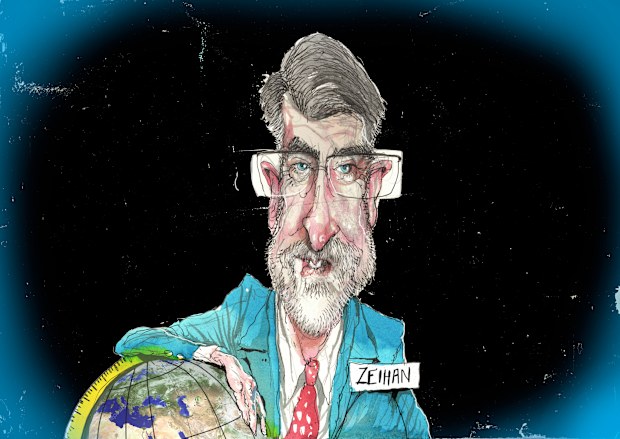
The World according to Peter Zeihan

Perhaps you have heard of Peter Zeihan. He is the newest guy trending on Youtube (or at least on my Youtube) predicting the imminent collapse of China. He offers his views not only on China but on any world issue in general. At first glance at least, he seems to be more of a geopolitical entertainer than the geopolitical analyst he claims to be. So was my initial impression. But watching him on Joe Rogan's show made me interested in the guy. So I started actively searching for Zeihan-videos on Youtube and spent a couple of hours listening to his presentations and interviews. My views have evolved.

Zeihan is an entertainer, for sure, and his mannerisms are funny but potentially off-putting for some. The lanky figure sporting a greying beard and a pony-tail has the aura of a Russian-type mystic, or at least a charming con man.

But his goofiness is combined with encyclopedical knowledge. He rattles off technical, economical, geographical, demographical, historical, and energy security details with impressing ease. He offers strong opinions (supported by crisp and convincing-sounding arguments) on virtually everything, let it be the green revolution, Russia, Mexican cartels, nuclear energy, agriculture, global food security, demographics, cryptocurrencies, you name it.

Although pretended omniscience is a realiable sign of a looney, I involuntarily caught myself agreeing with quite of a lot of what he says. I found his quip about crypto especially endearing: "I'm not gonna say it was all a fraud. Some of it was a pyramid scheme".

Below I make an attempt to summarize what I gleaned Peter Zehain's idea of the world seems to be.

The world of yesterday and of tomorrow

The current world order was born at Breton Woods, after the Second World War. The USA, which at that time had an economy bigger than the rest of the world put together, decided that it will bribe the other countries. To make them its geopolitical allies and part of its security system against the Soviet Union (and China), it guaranteed the safety of global trade and encouraged everyone to participate in the liberal world order. The guarantor of safe trade was the US Navy. You could trade with anyone anywhere on the globe without paying the cost of security - a historically novel situation.

By this, the US put politics ahead of economy. From a purely economical perspective, with its vast territory, technological edge, and dynamic population, the US would have been better off in isolation. The real beneficiary of the Pax Americana was the rest of the world. Countries have continued getting richer every decade. 

But this model reached its expiry date. The US has been visibly loosing appetite for being the world's policeman, and even it wanted to stay in the role, it is no longer capable of. The rest of the world have not only caught up with America, but as a mass, dwarfs it in economic power. The second foundation of the liberal world order is also wobbling. One of the basic assumptions of the economic model of the last seventy years is that there is a huge number of active workers and consumers who drive the economy and take care of the relatively small cadre of the elderly. This demographic pyramid is turning upside down as we speak due to the enormous advancements in prosperity, health care, and urbanization. People never lived as long as today and never had fewer children.

Zehain's conclusion is that the current world order will change drastically, for the worse for most. For America, due to its unique geographical advantages, its relatively dynamic demographics, and vibrant economy, this will be an opportunity. It will replace its the global trading partners with inter-US trade, transforming its supply chains cleaner, shorter, safer. And the gap between the US and the rest will grow. For sclerotic Europe, the changes are bad news. For Russia, catastrophic in the mid-term, and for China, catastrophy in this very decade. 

China's fate is sealed for two reasons. One is the abysmal state of its demography. Even according to official Chinese data, which always come with cosmetic uplifts, continuing the trend, the population will halve by the end of the century. No country in history has ever had to face this challenge, and we don't know of any economic model that could manage it. Even if they make U-turn on child-raising policies, which they are doing, it's too late.

China's other fatal problem is the one-man leadership Xi Jinping has built up in the last 10 years. Never in history has been so many people controlled by the single leader, who has concentrated more power in his hands than even Mao. Even if Xi was a genius, he couldn't possibly alone successfully manage something such incomparably vast and complex as the Chinese state. And if his handling of COVID and foreign policy are any signals, he is not a genius. Moreover, he has a reputiation of shooting the messenger, which means by now he is entirely surrounded by yes-men and zealots who won't call out his bad decisions. Vladimir Putin is demonstrating real-time how successful that type of leadership is.


Is Zeihan right?

Zeihan certainly seems to be very informed, and most of his predictions are at least plausible. Some are pretty far-fetched. I think what conventional scholars of geopolitics would say about him is that he draws more often than not reasonable conclusions from facts that are more or less accepted, but does it with such a level of confidence that a real academic would never do. 

Geopolitical predictions are such an elastic subject, anyway. When Zeihan claims that China will collapse in the next decade, what does he mean by it, and how can we verify in 2033 that he was right? Does 20% drop in GDP mean "collapse"? Or civil unrests involving let's say 10% of the population? Or should it be at least 30%? Or maybe we can say China has collapsed if its share of the global trade has dropped by half?

Zeihan also makes predictions about everything. Green technology, nuclear energy, Russia, the US, etc. If he turns out to be right in 70% of them in 10 years, that would be pretty impressive achievement, as much as global predictions fare.

But until then, the reliability of his predicting powers can only be judged by past predictions. Unfortunately, I haven't yet found anything on that.

In the absence of past records, I ususally look for signs of self-deprecating humor or admittance of failures. Zeihan certainly isn't lacking in humor, and recently called his initial assessment of the Ukrainian war, in which he predicted complete Russian victory in six months, "laughably wrong". Which is a good sign. He wasn't trying to explain away his error.

What to make of the Peter Zeihans of the world?

This question was the original reason of writing the post, but I still don't really know what I want to say. Something along the lines that even though charlatans make bombastic statements to impress the hoi polloi, not everyone who is bombastic is a charlatan.

If someone made the same predictons as Zeihan and published them in academic papers, no one would know about him, apart from other academics. The flair for theatre is mandatory to be a public personality.

And finally, even if Zeihan is style over substance, at least he is a refreshing exception in the long line of prophets presaging the end of the word. Instead of predicting that the West and especially the US is going to hell, he claims that everyone else will.

While we are waiting for the end of the decade to prove him right, I recommend subscribing to his podcast. Every 2-3 days he appears with a new, 3-10 minutes long episode, in which he shares his opinion of some current event, form Chinese balloons to American presidents.

, , , ,

Ukraine War - current state of affairs

I wanted to write a compact piece to provide a bird's eye view of the current state and future trajectory of the war and quickly realized that brevity and completeness are incompatible. A list of parts to mention only is long enough: the current state, the players, the short-, mid-, and long-term prospects, the military, political and economical aspects, ... So I restrict the scope to the very skeleton of all these above, with some lumps of meat here and there.

Current state

In recent weeks the Ukrainians have re-gained a huge amount of territory. Putin predictably responded to the new humiliations with some nuclear saber-rattling, which his only patron Xi Jinping demurred. Plus Putin was publicly made to wait in Samarkand at the SCO summit by his supposed allies (SCO is the poor man's NATO of world autocrats). In the West, much furor in the news, and dismissal from the military experts.

The Russians are mostly in retreat, and the Ukrainians are mostly on the advance.

The players

Let's step back and look at the major players in the War.

Ukraine. The Ukrainians have completely stunned the world (even more the Russians, I guess) with their courage, ingenuity, military skills, and national unity. If there was no real Ukrainian nation before the war, as Putin and Western useful idiots claimed (und unbeliveably still claiming), there is now. It's really hard to express what a miracle they did. Their American-trained military is superb and very far from what it was in 2014. Their skill in intelligence operations and media-savviness is at least as remarkable. The resolve to win the war seems unbreakable, but it's also a virtue out of necessity. The war is an existential question for them. Surrender would mean Russian rule, oppression of the society as a whole, and the universal threat of brutal murder and torture to anyone who took arms against the Russians.

As Ukraine became the darling of the West, Russia has become the international pariah of the world. It lost its greatest business partner Europe for good. I severed almost all ties to the high-end part of the global economy. It lost hundreds of thousands of its skilled people who have fled and been constantly fleeing the country right now. It destroyed the myths of Putin and the Russian military might. Nothing like this self-goal has been committed by any country in generations.

China is probably not very happy with the state of affairs. Instead of exposing Western weakness and further strengthening frictions, Russia forged a miraculous unity among their common enemy. And just after Xi Jinping declared Putin his eternal friend or something similar cringy expression of bromance from the old communist vocabulary. Awkward. China nominally supports Russia, but in reality, it doesn't provide much help. It buys its oil and gas at heavy discount (this is the very finite length an eternal friendship goes), and under the threat of Western sanctions it dropped most of its exports to Russia.
On the positive side (for China), it gained a new vassal. Russia is a resource-rich country with a huge potential to make trouble to the West, and it's completely at the mercy of China's goodwill and forever will be. The war might also make China rethink its plans with Taiwan. If the Russians couldn't successfully invade a neighboring country with land borders, how would trying to do that go across a 110 miles wide naval strait? 

As for America, the Biden administration's handling of the war has been superb. It combines massive political, financial, military, and intelligence support and restraint. As long as Ukraine keeps its military operations inside its borders, and the Americans are very strongly advising them to do so, it remains a defensive war and the Russian narrative remains indefensible. 
The big question is what happens after the midterm elections and especially after 2024? If the sane side of Republicans prevails, the support for Ukraine will continue. 
To be blunt and cynical, America has never been given such a geopolitical gift. Putin's fuck-up is beyond the wettest dreams of the hawkiest of American foreign policy hawks. The US received a one-in-a-century opportunity to completely wreck a historical enemy. Its reputation, its economy, its military, without a single American soldier lost, while never losing the moral highground and the support of their allies. All it needs to do is to fund Ukraine, and Ukrainians do the work for it. As H. R. McMaster, Trump's former National Security Adviser blurted out with an almost comically mad laugh in a podcast recently when asked about how America should help Putin decelerate: "Help him decelerate?? Our job is to help him accelerate toward the brick wall!"

Europe. Due to divine (or American) intervention, Europe responded to the crisis with unforeseen and quite amazing unity. Its energy sector is going to be decoupled from Russia for good. In 5 years, people will reliably have forgotten that gas and oil had ever come from Russia. It also stepped on the road to rearmament. All this is mostly thanks to America, without whom the European response to Putin would have been the usual hand-wringing and forced amnesia. Not that the US will ever be thanked for it.

In the time-proven tradition of Western-centric worldview, I lump the rest of the world together as the last actor, mostly because I don't know much about it. The big picture seems to be that Russia doesn't have friends, even among those who loathe the West. Some of these countries have an interest in Russia not losing too badly (like India, who imports half of its weapons from Russia), and some just don't have a dog in the fight. Westerners often find it astonishing how come third-world countries are not as outraged by this war as it's expected from them, but we forget that for much of the world conflicts even bloodier than this are a constant part of daily life.


Predictions

Reading the tea leaves tells me about a protracted conflict for years of varying intensity. The Ukrainian morale and support of the war are through the roof. They just don't have any incentive for giving up. Putin can't afford to give up. The Russians won't topple the regime. It's gonna be a war of attrition for all parties.

In the very long term, the situation will be something like this. Europe won't do business with Russia again. Russia will be a Chinese client. Ukraine will be part of, or an official partner to, the EU and NATO.

With relevances varying based on the length of the war, I think the following factors are decisive:

The things going for Russia

The first is manpower. It's a huge country with a lot of people for cannon fodder. They are demoralized, untrained, and led by mostly incompetent leaders. But there are many of them, and 100,000s can be thrown onto the battlefield every year.

The second hope of Putin is that Europe will suffer a cold winter and the public will force the politicians to take a U-turn, drop the sanctions and stop supporting Ukraine. It's not gonna happen. The gas reserves are 90% full. There is a lot of noise in Europe now saying that yes we are fine this winter, but the next one will be much worse. I think these people simply underestimate the adaptiveness of the world economy. Three months ago Europe was supposed to freeze this winter. We have a full year to prepare for the next. Germany and France will never again trust Russia, and even the voters in general are on the same page. 

The third is Donald Trump's return to power. If Republicans don't restrict the support to Ukraine already, a Trump administration would do it. Unfortunately, this can be a game changer.

The fourth is the implosion of the Ukrainian economy. According to some forecasts, Ukraine's GDP will shrink by 35%, while the Russian economy, which has proven much more resilient than experts had thought, will contract by maybe 5%. How much European and American money can fill in the gaps, remains to be seen.

The things going for Ukraine

The first is motivation. The Ukrainians are facing an existential threat. The Russians fight because they are forced to.

The second is ingenuity. Ukraine has taken the upper hand on the physical battlefield and massively dominates in the information war. There surely be ups and downs, but I hope their superiority will last.

The third is the bottomless chests of European and American money and weapons. Russia is a poor country that gets poorer by every month as long as it continues the war. It's depleting not only its financial resources but its weapon stocks as well, without access to technology and imported materials to replenish them. The US will never run out of money and weapons to send.

The fourth is the incompetent opponent. The Russian army reflects Russian society. Corrupt, incompetent, strong only against civilians.

Summary

The most important factor in the war is the American willingness to engage. If the US is fully behind Ukraine, it will still be a long war, but a war of continuous Russian defeats. If it pulls out, all bets are off. So eyes on the elections.

, ,

What makes Putin tick - The Myth of Russian Greatness

Time for another session for some armchair expertise. Coming to think of it, New Vac Times engages in this kind of punditry so often that it merits its own tag. Created.

Much has been said in the media and on public forums about what made Putin launch the war against Ukraine. The intellectual bottom comprised of arguments like "Ukraine used to be part of Russia, didn't it?", or "the USA started it!". One rung up on the sanity ladder came those who, just having left the pandemic behind transformed themselves from epidemiologists into geopolitical experts (but not historians) overnight, claiming confidently that what forced Putin's hand is "the aggressive encroachment of NATO".

But Russia invading its neighbors and playing the victim is nothing new. This is a recurrent pattern that existed before Putin, before NATO, and before even the Soviet Union. 

There is a long tradition of Russian thought, according to which the Russians are a chosen people. Russia is not merely a nation-state like any other, but a civilization itself, a land with a destiny. Moscow is the Third Rome, and Russia as a whole is the successor of the Roman Empire. The bulwark against the heathen hordes of the past and the Western decadence of the present. Even without the theological/cultural charge, it is a superpower rivaled only by the United States, that deserves a place in the highest decision-making circles.

This grand delusion gives the Russians a superiority complex that immediately crashes when they look beyond their borders and get confronted by the fact that Russia is inferior to the West in everything that counts. Military might, economic clout, soft power, cultural influence. 

The West dominates all major international institutions from the IMF to The Hague, American military budget and might dwarves the rest of the world combined, Western countries are the richest, most envied places on Earth. People all over the world chose English as their second language, not Russian. They watch and listen to American products, and they go for their news to the BBC, not Russia Today. Artists, scientists, and media personalities of all kinds measure their success by the extent of their breaking into the Western consciousness. The land of dreams for people from poorer countries is America and Europe, not Eurasia. Even Russians choose to school their children in Swiss or English boarding schools and send them to American universities. They park their money in London, go skiing in the Swiss Alps, and spend the summers on the French Riviera.

Russia has a GDP just below Italy's, and in the words of Barack Obama, the Russian economy "doesn't produce anything that anybody wants to buy", except oil, gas, and arms. In the even blunter words of the late John McCain, "Russia is a gas station masquerading as a country".

The gaping chasm between the grand delusions and reality yields resentment, envy, jealousy, and anger. If we are the chosen people, how come it's not us who are calling the shots here? They just start a war, and don't even bother to ask us anymore? Why do nations that used to belong to our sphere of influence choose Western alliance over us? Ukrainians, Estonians, Poles, the rest. Love us, you ungrateful scum, or else...!

When the trollish Russian Foreign Minister Sergei Lavrov publicly opined that NATO had "become a purely geopolitical project aimed at taking over territories orphaned by the collapse of the Warsaw Treaty Organization and the Soviet Union", former Polish Foreign Minister Radek Sikorski retorted, as our age demands, on Twitter: "We were not orphaned by you because you were not our daddy. More of a serial rapist. Which is why you are not missed..."

The "conversation" exposes not only the characteristic ghoulish cynicism of Russian leaders dating back to at least Stalin, but also a yearning to be seen both as a victim and great power simultaneously. A great power that has the right to "protect" its neighbors.

And like any other country with a serious inferiority complex, Russia explains away its failures by blaming them on the meddling of malign foreign powers. 

When the Soviet Union, after brutalizing every land it could lock in its sphere of influence for 40 years, fell apart - due to its own incompetence, corruption, and bankrupt ideology, it wasn't invaded by its former enemy, nor by the countries it has trampled on for decades. Nor were reparations demanded. Instead, Russia received billions of dollars worth of foreign aid. Gorbachev and Boris Yeltsin were celebrated as heroes in the West. In 1994, Russia joined the Partnership for Peace program, and in 2002 the Russia-NATO council. In 1997, Russia was invited into the G8 - despite that it didn't meet the standards required for joining, and in 2012 it gained membership in the WTO. In an effort to integrate Russia into the international order, the US has made constant gestures, London (disgracefully) offered its money-laundering services, and Germany chose to unilaterally increase its own dependence on Russian energy.

Even beyond economical and political nurturing, Russian leaders have been in constant need of ego-stroking. Tony Blair's advice to George Bush in the early 2000s was to treat the Russians as a superpower. French presidents, who seemingly fancy their country as a diplomatic superpower, have been running regularly to Moscow to ask what the West should do so the Russians feel better about themselves (ironically, France is a country that also has an inflated view of its own importance and probably not accidental that in the strength of anti-American sentiment in Europe, it is second only to Russia).

And yet, in the Russian narrative, they were disrespected and mistreated. Putin is reported to engage frequently in hour-long monologues reciting his grievances to anyone who cares to listen. The West lied to us, deceived us, bullied us, and the rest, on and on.

Even when Putin disappears eventually, I don't see how this ugly side of Russian national character would go away. The only effective salve on bruised ego is success. The structure of the Russian economy and the endemic corruption prevents an economic one, and in the absence of that, Russian leaders will only measure their accomplishments in military achievements.

, ,

Debate circle

 "We couldn't do these meetings in person in the last two years because of the pandemic", explained G. to another newcomer as I entered the room, the last word preceded by a measured pause and accompanied by scare quotes drawn into the air with his fingers. "Well, this is up for a good start", I thought.

I attended this meetup the second time, the first after the second wave of the "so-called" pandemic. That time I was invited by a former colleague and the conversation was about climate change and the role of fossil fuels in it. The speaker then, who customarily gave a presentation that was followed by a free-style debate, was a representative of the coal industry. So I was prepared to hear some controversial opinions about the Ukrainian war as well, which was tonight's topic.

G., who is the chief organizer of these events, is a fellow countryman of mine. He has lived in Switzerland long enough to lose his Australian accent which he had acquired before. Despite the decades of absence, he hasn't lost his touch with our motherland, as I learned five minutes later when the conversation with the nice Canadian lady strayed onto Hungarian politics. "Orban is a center, very center-right guy, who just refuses to go along with this woke craziness" - he explained. "Maybe I should add some nuance to that?", I wondered silently for some seconds, then decided to pass.

Slowly, people started pouring in, and at seven, the official start time, the oblong table was densely surrounded by circa twenty people. The age distribution of the participants ranged from the early twenties to late fifties, the gender ratio was 6-1 for men, and a depressing 80% of us were software developers. And this is a talk about geopolitics. I'm not sure whether there is something wrong with software engineers or maybe with everyone else.

In absence of a designated speaker, G. kicked off the meeting with a quick overview of the situation. This is a terrible tragedy. It's incomprehensible why no one in the world stood up and demanded that the warring parties stop this immediately and sit down to the negotiating table. The Swiss are equally incomprehensible, giving up their hard-earned neutrality? If they freeze the bank accounts left and right, who will keep their money in their banks in the future? The media is biased and unreliable, and this heroic picture they paint of that corrupt Zelensky is just ludicrous. Still, it's a terrible, terrible situation. And so confusing. What does Putin want? What do Ukrainian Nazis want? Just sad. 

I stopped any effort to be subtle about my facial expression halfway through the speech when it dawned on me that I made a terrible mistake. God, there is still two hours left. But luckily, the situation slowly began to improve and a real conversation started with a diversity of opinions. There were a couple of guys who were, not experts by any means, but well-informed. Some were not very well-informed but were arguing in good faith. Then the mandatory useful idiot, chewing on the Monroe-doctrine (what would the US do if Canada wanted to join a Russian military alliance? it wouldn't behave any differently, would it?) and the stealthy, creepy encroachment of NATO upon Russia (that is, the rudeness of the Baltics towards their neighbor for looking for protection). Anyway, what's been wrong with Finlandisation? A like-minded young historian kid chimed in musing on what right the West has to condemn Russia after Iraq? At that point, I was exercised enough to challenge that but someone else raised his hand quicker.

And then there was the highlight of the evening, the guy who bravely made the next step over G.'s hand-wringing lamentations. Ukrainian Nazis are indeed active in the Donbas. How much do they influence the government? Well, who knows, can you prove they don't? Euromaidan protests, orange revolution? The CIA staged them. Russian incompetence? He is not so sure about that, he read some articles. Mariupol? The Ukrainians themselves are shelling it. Bucha? You shouldn't believe the media uncritically. Nothing confrontational, just asking questions. Politely taking notes, nodding. Then the next observation (the Ukrainians were developing nuclear weapons, you know). For a while, I was genuinely puzzled by him. Is he on Russian payroll or simply enjoys being a cretin, just for the thrill of it? In the end, I decided it's the latter (judgment confirmed later in the bar when he said he knows about international banking and finance - that's why he knows it for a fact that the US is about to collapse - because...prepare...he is a software developer in a bank).

But there is was a real and pleasant surprise in the evening. A young Polish guy, A., who, unlike the rest of us, knew the topic in depth. Not my own "30-days podcast crash course on Ukraine" type of education. He was respectful, but argued forcefully, almost passionately. So passionately, that at one point his voice cracked. He had friends in Eastern Ukraine. His dismantling of the nonsense was merciless, and I leaned back and enjoyed the show. 

At 9:30, I almost felt sorry that the conversation ended, but my bladder was on the verge of explosion. I went to shake the hands of A. and joined others in the bar for an after-event beer.

The topic of the next event will be "Books vs Tik-Tok". I'll think about going.

, , ,

Is Putin a rational actor? - Part 2

The previous post left the topic off with the statement that Putin is a Russian imperialist with 19th-century values and priorities and a US-sized chip on the shoulder. He cares only about Russia's coercive power over other countries - which he equates with greatness -  and he thinks that everyone else does the same. He also believes that the West is out to destroy or at least subdue Russia. These are not mere speculations, Putin himself expressed them openly many times.

But more than that, his obsession with West's bad intentions is personal. Putin is convinced that the color revolutions in post-Soviet republics (2003, Georgia; 2004, Ukraine; 2005, Azerbaijan; 2006, Belarus) were all staged by the CIA, and he allegedly blames Hillary Clinton personally responsible for the Ukrainian one. He believes America wants a regime change in Russia itself (he just made that a self-fulfilling prophecy two weeks ago) and for him personally, Moammar Gadhafi's fate.

Gadhafi's grisly end is something that reportedly rattled Putin because he interpreted it as a cautionary tale. The Lybian dictator accepted the West's terms and gave up financing terrorism and developing weapons of mass destruction in exchange for being left alone. And then, they killed him. The moral of the story is that the more concessions one makes to the US the closer he gets to being murdered. If he believes this, that would explain why he has chosen to depend on China instead of integrating with the West, even if he is aware of the strategic dangers of China's friendship.

Based on how things look now, with the Ukrainian invasion, Putin took a gamble and lost big time. He didn't expect the reactions from either the West or the Ukrainians. He destroyed Russia's economic prospects for decades. He ensured that the EU will now do everything to rid itself of its dependency on Russian gas. He managed to revive NATO - which will likely expand even closer to Russia now - and strengthen the EU - the exact opposites he wanted to achieve.

His imperialistic drive might have made him attack Ukraine but his paranoia will dictate his actions from here. 

What makes Putin extremely dangerous is that he is very different from past Soviet leaders. He is not just the first servant of a universal ideology. Khrushchev or Brezhnev were simple figureheads of the Communist Party. Chernenko's and Andropov's names barely ring a bell to anyone anymore. Even Stalin presented himself as the face of the Party and, ensuing some political murders, was duly replaced after his death. But Putin is the regime. 

The war was his decision and his alone, and he will bear the sole responsibility for the economic collapse that at the moment looks like the most probable future for Russia. An additional military defeat would mean losing face and shattering the image that he has built up for domestic use in two decades, as the infallible hypermasculine leader. And losing the war could very well mean losing his life, too. Even before the attack on Ukraine, Putin had been long past the point when peaceful retirement was an option for him. If the opposition ever overthrows the government, he will spend the rest of his years in prison. If one of his enemies gets to the helms, he will be probably killed.

Besides this all, this is the guy who has flooded the internet with his half-naked muscleman photos. There are videos of him taking a scuba-dive and, lo and behold, emerging with two ancient Greek urns. Or of him shooting a snow leopard. Or scoring eight goals against professional hockey players. When he started showing age, he underwent cosmetic surgery (which he denies), which made his face almost unrecognizable. He sits at the end of a ridiculously long table when he meets foreign leaders, reportedly lived in isolation in the last two years, and publicly humiliated his own chief of intelligence on national television just before launching the war. What does this all tell about his mental state? 

In short, Putin is a man who ordered the killings of journalists, political opponents, schoolchildren (Beslan school siege), and tens of thousands of civilians (during the Chechen wars), perhaps even Russian civilians to create a pretext for the Chechen war. He is incredibly vain and he has cornered himself into a position, from where for him personally, victory is likely a question of life and death. Being rational from there is not reassuring for the rest of the world.


, ,

Ukraine at war

Disclaimer: unedited post.

For weeks, I was on the fence, but if I had been forced to put money on it, I would've bet Putin backs off. There is nothing to gain by occupying countries. Not anymore. As Yuval Harari put it, there are no silicon mines in Silicon Valley. But either he cornered himself in a place where backing off would have meant losing face badly, or it was his plan from the start, and now the post-Cold War era is over.

Why would Putin do this? Solution 1: he really thinks the West is out to get him. Solution 2: he is playing for the domestic audience, and a war abroad is an opportunity to boost popularity and crack down on the opposition. Solution 3: a democratic, free, less corrupt, EU-integrated country of the Slavic cousins would give the Russians bad ideas, so it has to be prevented before it's too late. 

Let's start with Solution 2. The Putin regime is ever more oppressive, living standards are stagnating, the contrast between the boss's chummies and the common citizens is outrageous. Rising petrol and gas prices have boosted the economy, but there is only so much to squeeze out of that. And Navalny and other anti-corruption activists are a huge pain in the ass. A war can dial-up patriotic feelings even in those who don't sympathize with the regime, and the disappearance of troublemakers will be the least of the people's problems. Or western journalists'.

Solution 1 is the fear of the West. According to this narrative, which, before the war started, had been echoed back even by Western voices, NATO has been encroaching upon Russia for decades. After the collapse of the Soviet Union, the Americans allegedly promised to not extend NATO and they did. In 2008, they even floated the idea of offering membership to Ukraine someday. Therefore Russia is absolutely in its right to feel threatened and take countersteps, just like America would do if one of its direct neighbors would step into a military alliance with Russia on China. Most recently, I listened to a conversation between Andrew Sullivan and Anne Applebaum, where Sullivan parrotted back all the Russian talking points one by one (even asking it whether Ukraine had ever been a sovereign state - as if the Austrians had all the right to reconquer Slovenia or Slovakia if they wanted, just because 35 years ago neither of them existed). Sullivan is an Oxford-educated British-American journalist and author, and has been a staunch conservative in his entire life. And really, and very well-respected and brilliant guy. Either the decades of smoking pot or Roman Catholicism, but something must have softened his brain. It was great to hear Applebaum counter his nonsense.
Back to the point, there are many issues with this course of logic. One is that comparing the expansion of Russosphere and that of NATO as if they were, in some abstract way, of the same nature, is abstracting away exactly from the important factors. Russia has historically expanded its sphere of influence the following way. It invaded other countries by force, set up puppet regimes, and when some time later the population raised up against their Russia-loving rulers, it sent in tanks and killed some more people. Whereas the NATO enlargements happen as follows. Countries, that are bullied by Russia for years, are practically begging for membership, because they want protection.
The other, more pragmatic issue is that Russia claims it feels threatened and encircled. Looking at the map, Russia's borders are 57 thousand km in total. From which, it is neighbored by NATO countries (Estonia and Latvia) on a couple of hundred kilometers. Poland, which is separated from Russia by Belarus, didn't even station American soldiers until Obama put them there after the annexation of Crimea. On the other hand, Russia has modernized its forces immensely in the last two decades, so the balance of military power has tipped heavily in its favor. This argument really is just bullshit. Russia is not scared by Western agression. It is annoyed by not being able to bully its neighbors. If Putin's aim had been to make Russia safe and prosperous, he would have integrated it into the West, as much as possible. Instead, he choose an allegiance of China. But China doesn't have allies, just vassals. (Great sentence, I stole it from a NYT op-ed)

Which leads to Solution 3, which Applebaum promotes. Putin is not afraid of NATO, which, as it knows well, would never attack Russia. He is afraid of the EU. Russians might be duped into thinking that the decadent West is digging its own grave. The French, German, English, and American are different and far away. But Ukrainians are fellow Slavs. If democracy works for them, and they start to be both freer and more prosperous, that sends the message that without Putin, you Russians could have this all, too. Crimea might have been a military success, but it was a political debacle. It alienated the Ukrainians forever. Keeping them under Russia's influence is now only possible by force.

So these are Putins' possible motivations, as far as I see them. Next question. What will happen now? First, let's see what is on Russia's side, then what goes against it.

Russia has accumulated huge reserves of foreign currencies, according to the latest tally, around $630 billion. Instead of using the profits of years of soaring petrol prices to raise the living standards or make structural changes, it channeled them into a war chest. It has also made steps to make it's technological and financial sector self-sufficient. Putin apparently decided that he doesn't want to go to the West in his life anymore, and built a fortress economy. Possible sanctions might hurt, but Russia can withstand isolation for long years. Or at least Putin can. And if the Russians are unhappy about that, that's their problem. There are plenty of policemen to beat some sense into people if they start to get unruly.

Russia also has the energy weapon and very good timing on its side. Thanks to the famous German Russenverstehen and idiocy (well done, Angela Merkel and the rest of German establishment), Europe gets 37% of its energy from Russia (and yes, the Germans also had the brilliant idea of not only depending on the Russian, but also closing their nuclear plants - if Greenpeace-activists really cared about the climate, they would chain themselves not to trees but to nuclear plants when politicians come to shut them down, but I digress), and lower than average reserves. If Europeans banned Russian gas imports, it would send the prices through the roof and that might even help Russia, or at least blunt the weapon and even hurt the Europeans.

Who are divided, anyway. The first set of sanctions was watered down heavily by the Germans (their clear-sightedness has been commented on above), Italians (let's exclude luxury goods exports - seriously?), and Victor Orban. The first two countries have stupidity and avarice as excuses. The Hungarians simply yearn to be the despised servant of bloodthirsty lunatics. Looking back to the past hundred years, this must be our defining national characteristic.

Finally, Russia has an army much better equipped and much larger than Ukraine. NATO won't send there soldiers because everyone is shit-scared that the situation could escalate. Apart from the Americans, the West has really lost its appetite for wars, and at the end of the day, Putin can always count on that.

Ok, so what goes against the Russians?

About the war chest. Yes, they have a huge amount money in foreign currency. However, however. Having $630 billion dollars doesn't mean the Russian Central Bank has thousands of suitcases bursting with banknotes. It has those dollars on the virtual accounts it holds in other countries' central banks. And as they say, if you owe the bank $1 million, it's your problem. If you owe the bank $10 billion, it's their problem. If the FED and the ECB start sanctioning the Russian Central Bank, they could literally destroy Russia's economy. No idea how these things work, but this is the financial equivalent of a nuclear weapon. 

About the divided EU. When really scary things start happening, the EU has proved to be way less dysfunctional as many love to portray it. Europe might have become soft and weak as far as military virtues go, but it's an economical giant. Whereas Russia's GDP is less than Italy's. And although there's been some dithering at the very beginning, after 4 days, even the Putin-lover Viktor Orban fell in line. If the EU makes up its mind on sanctions, Russia will be very badly hurt. Regarding the energy import, closing off the Russian gas would be painful. But I can't believe that in the 21st century, Europe couldn't handle this, especially with the US as the world's biggest energy-exporter at its back. And if not, perhaps wearing an extra sweater is not a price too high to pay when in the direct neighborhood people literally face bombs and bullets.

What about Russian domestic politics? I think selling the war as a patriotic cause will be much harder at home then the Kremlin imagined. The Ukrainians are not some dark-skinned Muslims living in some exotic place far away. They are literally relatives living right next to Russia. Killing slav brothers and sisters won't go do well with the public, whatever Putin says. The Ukrainian president Zelensky, unlike the Afghan leaders, didn't take the first plane out when the war started. Murdering him would make Putin an international pariah for ever. Or how will Russian citizens take to the following headline? "Boxing legend, Ukrainian national hero and Kyiv's mayor Vitaliy Klitschko killed by Russian soldiers." This would be very, very bad PR. Buy the way, the other day Putin came out and gave a speech in which he called for the Ukrainians to throw off the yokel of their drug-addicted neo-nazi leaders. This language barely falls short of the usual North-Korean way of calling dissidents pedophiles. Does Putin really think there are enough morons in Ukraine or at home who are suckers for that level of language?

And finally, what about the war itself? It's very early to say, but the Ukrainians seem to be willing to put up hell of a fight. What I most wonder about is: where are the cyberattacks? That should be the Russian speciality, and the least-bloody way of crippling Ukraine. 

That's it for now. I do have a Ukrainian colleague with two small children, working from his home country, and we can't reach him for days (probably phones are shut off for security reasons). I can't write glibly about this now.