Showing posts with label martial arts. Show all posts
,

How good Bruce Lee really was?

For anyone, who has been infatuated with martial arts (and martial art movies of course) for a considerable length of time in their life, that's the question that's been in the air in the past 50 years and it might linger on for another couple of decades still. Was Bruce really the greatest martial artist who ever lived? Was he unbeatable? Or let's leave the quasi-philosophical pretense and get down to Earth: could he beat Muhammad Ali? Or Mike Tyson? 

I like the latter formulation of the question. It appeals to a mind who likes to wonder - Ali and Tyson being perhaps the two most iconic pugilists in the popular imagination with a real track record who in their prime had an aura of invincibility - and it's something tangible at the same time. A question that could have been answered. Whereas "was he the greatest martial artist?" - meh. What does that even mean? 

Another form of the question would be, pedestrian but valid: would Bruce be a UFC champion today?

I'll give a short answer and a longer one.

Short answer: size

The short answer is that Bruce Lee weighed 145 lbs and Ali did 236. Tyson 220. Any more questions? But let's elaborate.

Not a single boxer or wrestler ever became a world champion in a weight category 80 lbs over his own. Not even close. 20 pounds extra is considered to be an advantage almost impossible to compensate for between professional fighters, no matter who we are talking about.

Perhaps, Bruce was a once-in-a-millenium type of human specimen who could have overcome an obstacle not one of the many thousands of fighters could in the era of television. But until someone points to a boxing/MMA match where a lightweight opponent won against the best of the heavyweight division, I remain proportionally skeptical.


Long answer: not only size but almost everything else, too

Giving the fight to Ali or Tyson simply on the merit of their size would be selling them short. They weren't just lumbering behemoths with sledgehammer hands. Both men were lightning fast (which was an especially scary sight in the case of the tank-like Tyson), incredibly talented, and skilled enough to tower over the rest of the world-class fighters of their respective eras. 

And at the risk of committing blasphemy in the eyes of the converted, even without the size difference, I can't imagine that Bruce Lee, who had only 4 years of formal training in an obscure Hong-Kong martial art club (where there probably was no free sparring), and perhaps a lot of streetfight experience, could have matched the technical expertise of either of these men. Tyson at 15 sparred regularly with heavy-weight champions, and Ali was Ali. They were sculpted and pushed to their limits by professional trainers. A natural genius Bruce might have been, but I'd give technical expertise to the boxers.

Furthermore, Lee never demonstrated he had the incredible stamina of a professional boxer or the capacity of them to absorb immense punishment. Occasional spectators might underappreciate the ability to be getting hit over and over again with a force of a human sledgehammer and just carrying on round after round, but it is just as essential for fighters as technical finesse. What for laymen spectators looks like a lackluster round, as boxing matches go, requires stamina way beyond the normal fitness levels of ordinary humans (just try to hit the bag for 3 minutes, and you'll know).

Yeah, but Bruce was a martial artist and Ali and Tyson were just boxers, some might say. Without going too deep into the topic, let's just state the fact that Western boxing was one of the founding blocks of Bruce's personal style. Still, it can be argued that Bruce had kicks, too. And other martial art techniques unfamiliar to boxers, like finger jabs or grappling. True, but I just don't think those would have been enough to compensate for the glaring differences in size, physique, and experience.

I think the reasoning above is unassailable. But it's also unromantic and Lee clearly deserves more. So here comes an even longer version that tries to argue for his case. The outcome will be the same, but I try to give credit to Bruce wherever possible.

Legends and facts

Bruce Lee undisputably was a physically gifted man on the high end of the spectrum. He looked like a skinny bodybuilder. Everyone who knew him is in agreement that he was incredibly strong for his weight. There are photos of him doing push-ups on one finger, and numerous stories about demonstrations where he sent his partners in the air with kicks and punches alike. If only half of that is true, he hit and kicked like a mule. His speed was even more legendary. Even Joe Lewis, one of the greatest American kickboxers of all time, who had a fall-out with Bruce and held the idea of Bruce being able to defeat him laughable, said in an interview, "I never stood in front of another human who was as quick as him".

On the other hand, he still weighed only 145 lbs. If you believe that he really could hit harder than the 220-pound Mike Tyson, probably I won't be able to convince you otherwise (neither would experts on biomechanics). Could Bruce's speed compensate for his disadvantage in strength? Unlikely, and my criterion for changing my mind is similar to the one stated earlier in earlier posts: a real-life example of just half that achievement.

It's harder to pass judgment on his actual fighting skills. Everyone seems to agree that he could 
copy any moves from other martial artists (let it be strikes, high kicks, or grappling techniques) and master them in a very short time. A former girlfriend of his, with whom Bruce used to frequent the dance floor where he invented cha-cha-cha steps on the fly, called him a "kinetic genius". But aesthetics don't equal efficiency, and making a move look good on camera is very different from being able to apply it against real opponents. Jackie Chan, Steven Seagal, or Jean-Claude Van Damme looked both lethal and beautiful on the screen. But that's only choreography. None of them had a career in professional fighting, and there is a reason for that. 

Regarding Bruce's fighting experience, apart from a single boxing bout in high school (which he won) he never competed. His skills were never pressure-tested against professional sportsmen. I don't believe that there ever was a boxing champion who didn't get better by the hard-won experience in the ring, and won the world title on exactly the same level as he had been before his first official fight. Professional MMA fighters say that doesn't matter how long you have been training, your first fight will suck. The first ten will suck. It's something you get better at, match by match. Not to elaborate any further, there is a world of difference between sparring in training and fighting against someone under immense pressure who wants to knock you out. 

On the other hand, Lee regularly trained with the multiple Karate champions of his era, among them Chuck Norris, Joe Lewis, and Mike Stone. These guys were the crème de la crème of their era, and they wouldn't have wasted their time on training with Lee unless they got something out of it. Lee definitely must have been a very good teacher or at least a very good training partner. But that doesn't necessarily mean a lot with regard to him as a fighter. Roger Feder's coach must be one of the best tennis coaches. And he certainly was never nearly as good a tennis player as Federer.

The statements on Bruce's martial art prowess made by various people in interviews or in the media are so contradictory, so full of second or third-hand accounts, that they are all but useless. They either sound like sound clips from hagiographies or at best they only add to the confusion. Many people claimed with confidence that Lee could beat any of his "students" (that covered Norris and Lewis, too) easily. But according to Norris, they never actually sparred (which is also what Lewis said). In an interview, when asked (for the thousandth time, I guess) about who was the better between them, Norris replied smiling, almost blushing. "Look, I was a professional fighter, the middleweight champion of the world. Bruce was an actor". Then he hastily added, "but he was very good!".
 
Norris gave a completely different answer to a very similar question some decades earlier, in an interview. Replying to "Is Bruce Lee your teacher?", Norris said “We are not good enough to be his students, and he is too good to be our teacher.” But this seems like a lighthearted, self-deprecating jest to evade the question, rather than an honest evaluation. The interview was also part of promoting The Way of the Dragon, thus it was certainly not the place for Norris to demean his colleague.

Another anecdote from Norris relates to the same movie. When Bruce called him in 1970 and offered him the role of the main antagonist (who loses against Bruce's character in one of the most epic martial art duels in movie history), Norris asked jokingly: "So you want to beat the world champion?". To which, in Norris's telling, Bruce replied, "No-no... I want to KILL the world champion!". This joke makes sense only if both Norris and Bruce evaluated each other the same way.

Joe Lewis, who was allegedly the first choice of Bruce to play his opponent in the movie, said he had refused the role because he found it unrealistic that a man of Bruce's size could beat him. This reason is so lame that it's almost certainly untrue, and the two men fell out because of other personal issues. But nevertheless, his version of the story makes it clear that Lewis had no doubt about the outcome of a possible fight between the two of them.

In short, personal testaments from contemporaries invariably intertwine with Hollywood legends. Memories make everything shinier, many people loved and admired Bruce (that's why they get interviewed) and many have a personal interest to make him look godlike, so part of the glow shines upon them, too.

Bruce Lee was a genius and physically a freak of nature. Probably, although you can never know, under the right trainer, he could have been a world champion. Could he beat the current UFC champion of his own weight category if he was teleported from 1972 to the octagon in 2022? No. He wouldn't have the experience, the stamina, the grappling skills. Could he be the world champion after training for 2-3 years under the best coaches? Well, why not?

In the end, perhaps it's fitting to close with another anecdote in which Bruce answers the original question directly. As the legend says, when John Saxon (one of the protagonists in Enter The Dragon) asked if he could beat Ali, Bruce replied, "Look at my hand. That's a little Chinese hand. He'd kill me."


,

Bruce Lee

My earliest memory of Bruce Lee places me in the kindergarten yard in a conversation with one of my teachers. I was explaining her how Lee died. Early childhood memories are unreliable, they are more like re-prints of memories than of real events, but this one can't be too far off reality. My father had The Big Boss on a VHS tape at home and no qualms about what I can watch (the 1984 Terminator was the cause of years of early nightmares). He also possessed a wonderfully illustrated book about Lee in English, a treasure in a child's eyes, with a removable poster of The Way of The Dragon, and even a biography. The latter I read only a couple of years later, but many then times. 

Born a decade after his death, I shared my childhood hero with millions of kids of many generations around the world. And as to many of them, I probably owe my lifelong fascination for martial arts to Lee, the most famous martial artist of all time, and one of the most iconic figures of the twentieth century pop culture. If there is anyone deserving to be in my Hall of Fame, it is him.

Who was Bruce Lee?

Bruce Lee alias Li Jun Fan was born on 27 November, 1940 in the United States where his father was on a long tour with the Cantonese Opera Company, accompanied by his wife, Bruce's mother. Thanks to her own mixed heritage, the boy who came to the world in San Francisco,  California was 5/8 Chinese, 1/4 English, and 1/8 Dutch Jew. The family went back to Hong Kong three months later, and the son, although technically an American citizen, didn't set foot in the US until 18 years later.

In Hong Kong, thanks to his father's business acumen, Bruce grew up in a well-off family. His father, an occasional actor, also helped him into the movie business. Bruce started a career as a child actor at the age of six. By his teens, if not a household name, he was a recognizable face in Hong Kong. He excelled in roles of a street urchin with a good heart or of a rebellious teenager but was generally stiff and unconvincing in other types. His thespian fortes were not accidental. As a kid, he was a hyperactive boy who only stayed put when reading comic books. He performed abysmally in school and struggled in every subject but English so much so that he was held back twice. As a teenager, he was a troublemaker with serious problems with authority. But Bruce was also funny, witty, and charismatic, a prankster and a natural gang leader. 

He got into street fights a lot. At 14 he was defeated by a boy named William Cheung who practiced Wing Chun. Bruce, to regain his dominance, decided to learn martial arts, too. He soon became passionate about it, eager to try out every new technique he learned on the street. He was also equally passionate about another physical art, dancing. After winning a dance championship, later in life Bruce has always referred to himself, stretching the truth a bit, as the cha-cha-cha champion of Hong Kong.

In high school, he participated in his first and last official combat sports event, a boxing match against a student from another high school. He won the bout but wasn't satisfied with his own performance.

Not long after that, he got expelled from the school for threatening a teacher with a knife. By then he has brought enough shame to his parents that they decided to put him on a boat to America with the warning: make something out of yourself or don't come back.

Bruce arrived in Seattle in 1959, aged 18. His father secured him a tiny lodging and a dishwasher job in the restaurant of a Chinese acquaintance. He finished high school and, to the surprise of everyone, in 1961 he even enrolled at the University of Washington as a drama major. Eager to stop washing dishes and waiting tables, he started giving cha-cha-cha lessons. In the breaks between the classes, he entertained his students with Wing Chun demonstrations. Eventually, he opened his informal kung-fu studio with a handful of students at the age of 19.

There were only a few Eastern martial arts enthusiasts in America at that time, but Bruce quickly caught the eyes of some of them. He was charismatic, fun-loving, boisterious and an incredibly gifted athlete. He gained both friends and admirers quickly, and the two groups almost perfectly overlapped. In 1963, with an American friend James Lee (not a relative) he published a book about Wing Chun kung-fu, what he later, after breaking with traditional martial arts, regretted.

In his early twenties, Bruce had two aspirations. Either getting into Hollywood or opening a chain of schools overall the US and dedicating his life to martial arts. At first, he had moderate success in the second endeavor. He opened multiple studios, but their attendance was meager and the revenue barely enough to pay the bills. 

He also quickly discovered another challenge. In America, he started to get disillusioned with traditional martial arts, even with the more practical Wing Chun style he learned. They were stiff, impractical, and put more emphasis on practicing unrealistic techniques than on real sparring excercises. The Wing Chun techniques didn't really work against the bigger and more athletic Americans. He realized that he has to move beyond what he learned in Hong Kong.

His fame among martial art practitioners grew and eventually caught the attention of Ed Parker, the father of American Kempo. Parker organized the 1964 Long Beach Karate Tournament and he invited Bruce to give a demonstration of kung-fu, which at that time was an just obscure Chinese martial art few even heard about. This was Bruce's first chance to perform in front of a large audience.

Multiple demonstrations followed, on which he often spoke about traditional martial arts in disparaging terms. In 1964, the kung-fu community of Chinatown, Oakland where Bruce opened a studio had enough. Not only was the cocky Lee badmouthing their styles, he was teaching the art to non-Chinese. A local martial artist, Wong Jack-man, decided to issue a formal challenge to Bruce, which lead to highly controversial duel. Bruce defeated Wong in a matter of minutes, but as after his boxing bout, he was extremely dissappointed with his own performance. After the short fight he was exhausted, his fists were bruised, and realized that Wing Chun's close-quarter techniques were not effective against someone who avoids direct engagement. This experience reinforced his growing dissatisfaction with kung-fu.

Eventually, becoming disgusted with its obsession of forms, rigidity and ineffectuality, he turned his back on Chinese Kung Fu completely. His personal style, what he in 1967 christened to Jeet Kune Do, was mainly based on Western boxing, fencing, and some Wing Chun techniques and principles. Even the name "the way of the intercepting fist", esoterically Oriental as it sounds, is adopted from the fencing tactic "stop-hit" that aims to intercept the opponent in mid-attack instead of a parry and counter-attack combination.

He watched boxing matches endlessly. He especially admired  Mohammad Ali, whose matches he would watch for hours, shadowing the champ's moves over and over again. His training ethos put free sparring at the center of the training session and dispensed with traditional Eastern training elements. Bruce was an early proponent of a totalitarian art encompassing all forms of stand-up fighting and grappling - Mixed Martial Arts, as it's called today.

He also become obsessed with nutrition and body-building. In his early twenties, he could still be described as slightly pudgy a young man with still some baby fat on. He explored many diets and imposed some exotic ones on himself over the years. Apart from running every morning, and the hours honing his martial art skills every day, three times a week he lifted weights. The boy with a baby fat transformed his body to that paragon of physical perfection we can see in his movies.

In 1964, he married one of his students Linda Emery and not long after they had their first baby, Brandon. Linda's family was not enamoured by the prospect of having a pennyless Chinese wanna-be-actor as a son-in-law (the racialist resentment was not unrequited when Linda visited Bruce's family in Hong Kong later), but after the marriage Bruce quickly won them over with his characteristic charm.

In 1966 came a breakthrough in his acting career when he was cast into the role of Kato, the masked Asian martial artist sidekick of the vigilante Green Hornet. The show lasted only one season but it propelled Lee into the right circles, of both Hollywood and the martial art world. Still uncertain about the future, he moved back and forth between opening schools and vying for new movie roles.

With acting, teaching, and having a family, he had no time for University. Although he silently dropped his studies in 1964, his interest for psychology and philosophy only deepened. He was a voracious reader. One of his early aspirations was to own a second-hand bookshop. By the end of his life his personal library contained over 2,500 books.

Utilizing his newfound fame as a minor Hollywood celebrity, Lee continued touring the US giving demonstrations on Karate tournaments, which were starting to become the big thing in the mid-sixties. As the guest star Kato, he demonstrated his famous one-inch punch, 2-finger push-ups, side-kicks that sent his partners flying in the air, his preternatural speed, and performed free sparring. He befriended several champions of the era. Between 1967 and 1969 Karate champions Joe Lewis, Mike Stone, and Chuck Norris, or Jhoon Rhee, father of American Teakwon-Do became not only his friends, but training partners/students as well.

Getting friends and admirers was easy for him. He was a natural showman. Witty, charming and always fun. This wasn't lost on his female acquitances either. Beyond the traits his male friends admired, Bruce was gorgeous. Despite being a loving husband and father, he often had relationships, and didn't even put too much effort in keeping them secret. This was something that his wife Linda, his always supportive and devoted wife did not deserve, but apparently didn't know about them either.

Despite all the successes and friendships of Hollywood men and elite sportmen, Bruce's teaching fees and rare movie roles barely covered his expenses and now he had a family to feed, too. In 1967, a sturdent and friend of him, Jay Sibring, the hairstylist of stars, gave him an idea. As a personal self-defense trainer, he should angle for big Hollywood names. To catch the eye of the creme, he should charge extraorbintant fees. Lee, not fully convinced, nevertheless went along, and to his surprise, soon he found among his students James Coburn, one of the biggest stars of the time, and Steve McQueen, the King of Cool, the biggest star of Hollywood. His slowly forming but eventually deep friendship with McQueen was a mixture of mutual admiration, envy and rivalry. McQeen wanted Lee's physical gifts and Lee wanted the stardom.

In 1968, Bruce and Linda purchased a house in Bel Air, Los Angeles. On the surface, Bruce achieveved the dream of every American immigrant. He married an American, made into Hollywood, befriended the stars, owned a beautiful house. But everything was built on debt. The family often lived from one paycheck to the next. Bruce was as financially irresponsible as flamboyant. Shortly after buying the house he could not afford, he spent the full 7,000 dollars he unexpectedly got from his mother who sold one of his father's buildings not to pay off some of his debts, but to buy a red 911 Porsche. His prospects were not rosy. At the time, there were not that many roles to go around for Asian characters in Hollywood. He refused to play the traditional role of the subservient Chinaman, and he spoke English with heavy accent.

Even though his career as an actor did not progress as fast as he wanted, his reputation as a martial artist wunderkind and teacher, the legends of his feats, and his circle of Hollwyood friends grew. He rubbed shoulders with Frank Sinatra and taught Roman Polanski. If not yet a successful actor, he was the most sought after martial arts instructor in Hollywood.

Too turbocharge his career, Bruce had a idea for a movie. An X-rated, allegorical martial arts epos, combining martial arts and philosophy. He named it The Silent Flute. He tried to convince first McQueen, then Coburn to partner up with him on the movie, but after some promising start on Coburn's side, he was eventually rejected by both men. That really hurt him personally and Bruce woved that one day he will show them. He will be a bigger star than McQueen.

He also had another idea of a TV-show featuring a Chinese martial artist roaming the American West, the Warrior. Unfortunately, he tshow was dropped in favour of another of a similar theme, the Kung Fu. Lee auditioned for the lead role of that, too, but he was found too intense for the character of a reluctant, contemplative dispenser of justice. The role was given to David Carradine.

In 1970, Lee suffered a debilitating back injury during a morning work out. He was forced to bed for 3 months and the doctors told him he would never kick high again. 3 months of bed-confinement would be a torture to anyone, but it was especially cruel for someone whose life revolved around his physical abilities. To make the most of it, Bruce turned his energies into writing. The sketches, notes and essays in which he tried to capture both his philosophy to martial arts and technical repertiore was collected and published after his death by his widow Linda in a book titled The Tao of Jeet Kune Do. Not unlike popular books on fencing of earlier times, the Tao covers techniques, tactics, psychology, physiology, training advices and discussions of concepts like rythm and timing. In the end, Bruce recovered completely.

By the early 70s, he temporarily gave up on Hollywood, and took up an offering of making a movie in Hong Kong, The Big Boss. Lee with his family sold their Bel Air house and moved to Hong Kong. Lee, who by then had got used to American standars was appalled by amatuerism of Hong Kong movie makers. He clashed heavily with the director and the producer. His behaviour on the set was typical Bruce Lee and the opposite of normal stereotypes. He was loyal to and gracious with the stuntsmen and the crew and rude and disrespectful for those above in the hierarchy.

To his surprise, the low budget and amateurish Big Boss which was based on 3 pages on script, terrible acting, and lousy directing turned out to be thunderous success in Hong Kong. His second movie, the Fists of Fury in 1972 was even more of a blast. The audience have never seen anything like Bruce before. Hong Kong cinema was flush with Kung-fu movies of course, but the fight scenes in them were extremly long and artificial. What Bruce Lee did seemed frighteningly real. Amazing, but at the same time something that can both work in real life and can be learned. Secondly, in both movies, a Chinese guy sticks it up to the British and the and hateful Japanese. The Hongkongers who were mostly refugees from the mainland living under their British overlords, were in a desperate need of national pride. Bruce gave it to them. Audiences raved and literally were throwing chairs in the air in the theaters. Bruce has become a superstar literally overnight.

Fame pressed hard on him. Paparazzis, constant challenges for duels, intrusion in his familiy's privacy, attacks of Hong Kong media mocking his rusty Chinese and questioning his nationality made him stressed and paranoid. He hired bodyguards from his former stuntmen friends and - the human weapon himself - even started carrying a gun. 

Bruce decided to keep total control over his next movie, The Way of The Dragon. He wrote, directed, and starred his spagetthi Eastern. He offered the role of the bad guy to the most famous American Karate fighter of the time, the then middle-weight world champion, Chuck Norris. Even though its climax is arguably one of the greatest martial art fight scenes of all time and it was a big commercial success, Lee didn't think the movie was good enough to be released in the West as a vehicle to get back into Hollywood.

In 1972, he started to shoot the Game of Death, another movie where he wanted to demonstrate his philosophy to martial arts, even more explicitly than in The Way of The Dragon. Negotiations started to have George Lazenby, the latest James Bond, as a co-star of the movie. Perhaps 20 minutes material was produced, and the movie was released only 1978, 5 years after Bruce's death.

1973 came the Enter the Dragon, Lee's first superproduction meant to conquer Hollywood for him. As one of the international cast of main characters, Bruce played an unstoppable killing machine driven by cold revenge. The movie made Lee a houshold name all over the world but he didn't live to see that. On July 20, 1973, in his mistress's flat, Bruce died of cerebral edema. The indirect cause of death is still debated. The most probable theories are that of heat stroke and medicine allergy. After his death, Enter the Dragon made the so far obscure Asian actor the Hollywood superstar he had always wanted to be. The audience loved it and even the critics had to grudgingly admit that despite its extreme violence (the threshold was lower in 1973), the movie is something they haven't seen before. Fights in Western movies still followed the John Wayne-type coreography. Lee broke the way of a new genre that was carried on later by Chuck Norris, Van Damme, Steven Seagal, and countless other actors cum martial artists ever since. But he was only followed, never replaced. Bruce Lee's name has irrevocably fused with the image of the ultimate martial artist, the unbeatable fighter.

His body was put to rest in Seattle, the city where he and Linda fell in love. Among the six men carrying his coffin on his last journey were James Coburn and Steve McQueen. 

Lee has become a superstar, far beyond anyone, even he could have imagined. He did become bigger than McQueen. Apart from the remotest corners of the world, practically there is no one over 30 who hasn't heard about Bruce Lee, a man who died fifty years ago at 32. They might not recall the titles of his movies or when he lived or they mistakenly think he was a Japanese Karate champ. But they know Bruce Lee, the icon. 

For us who watched his movies when we were kids, and take his presense in the public consciousness a given, it's almost impossible to appreciate the enormity of his achievement. Similarly nigh impossible to find any name or face that is more recognisable than his, with the possible exception of Elvis. But perhaps not even the King can push him off the throne of pop culture. Bruce Lee, after all, was invincible.

Do it with style

During our Christmas holiday in my hometown, I visited the dojo that played such a formative role in my teenage life. I don't have any intention to resume practicing Karate, but I always like to catch up with old friends whenever I'm back. Still, since I was already there, I thought I might as well join the training. It was like a trip to the past. But the reason for this post is not nostalgia, but that sometime after the training I experienced a gentle revelation. I think it just broke to me why people are attracted to traditional martial arts (never too late, eh?).

I wrote about the topic earlier, and before I get to my newfound insight, I want to briefly reiterate my previous arguments.

The main selling point of martial arts is of course is to become a self-defense expert the easy way. Everyone would be happy to be as tough as a boxer or a wrestler, but man, to get there is not a walk in the park. Years of hard training, running, skipping ropes, thousands of sit-ups, being punched in the face all the time, who likes that? And you can rarely see a small boxer beating a much bigger one, so why should I start it if I'm small in the first place? If only there was a way to be that good with tenth the effort. A more effective way, perhaps. Maybe through learning some exotic techniques developed by exotic people hundreds of years ago? Enter martial arts in Hollywood movies.

Then there is the traditions and rituals package for people who like traditions and rituals.

Then the moral code that purportedly comes with Eastern martial arts. I wrote earlier that I am skeptical of this because I think that being submitted by your training partners several times on the mat at every BJJ session teaches you more humility and the value of hard work than mandatory bowing and a strict hierarchy. But lately, thanks to a book on the history of BJJ, I had a bit of rethinking. UFC fighters have years of grappling practice behind them, and there are few more obnoxious sights than those guys (or gals) on a pre-fight press conference. From the aforementioned book, I learned that the grandmasters of the art (the whole Gracie-family, basically) were, in some respects and besides their other qualities, a bunch of thugs, who habitually bullied rival schools and provoked fights with their teachers and students on the street (it was true in both ways). Not to mention taking all the credit for developing the art by driving their juggernaut of a PR machine through BJJ's history. So, there is no silver bullet for character-building either, and I'm willing to accept that a traditional dojo can offer as much as any other institution. Even though stories like the one above are not unique to Brazilian Jiu-Jitsu.

Then, of course, the touch of the supernatural. Legends about superhuman feats of old masters, demonstrations of Shaolin monks, the application of internal energies ("chi"), the science of lethal pressure points... For those who are into those things. 

And with that detour, finally, I got back to describe my latest epiphany. From this point on, everything is armchair-psychology and it might reflect more on me than on the subject. Nevertheless. I think that traditional martial arts are appealing because people want dignity, even in physical struggles. Or, perhaps more precisely, we are afraid of losing it. Unlike gymnastics or figure skating, box, wrestling, or MMA don't possess some inherent aesthetic beauty obvious to a layman. Short spans in a fight can be beautiful in their own way, but very rarely, and only if someone really great can demonstrate his or her skills against someone who is not. Muhammad Ali could make a fistfight look amazing, a journeyman boxer can't. Full-contact brawls in general are sweaty, brutal, and chaotic. Violence is demeaning. The fighters are bleeding, sweating, panting, grimacing. Nothing like the smooth, refined choreography we are familiar with from the movies. 

So this is what traditional martial arts (and to be fair, Krav Maga and the like) promise by not actually practicing often undignifying sparring, but instead honing techniques executed either in the air against imaginary opponents, or against complying partners. Elegance and Dignity. Perhaps fencing and its etiquette emerged from medieval duels partly for similar reasons. If forced to resort to violence, which was often inevitable in bygone eras, gentlemen at least wanted to kill and even die with style.

War of styles: do traditional martial arts work?

This post intends to fill a gaping hole in the previous one and to take a hard look at traditional martial arts. Are they real? The basic assumption I made in the previous post is that if there is sort of competition where apart from extremely dangerous techniques everything is allowed, and it is open to any style, and it runs long enough to provide statistically significant results, then, in the long run, it will show which styles work in practice, and which don't. 

This series of repeated experiments is impartial, quantifiable, and requires no expertise, only common sense. The UFC satisfies the above criteria. There have been more than 500 fights so far inside the octagon in the span of three decades, featuring fighters from all kinds of martial arts and combat sports. Everything from Western boxing to Chinese kung-fu had the opportunity to prove itself.

And traditional martial arts didn't shine. No one who was proficient in traditional styles only - like Karate, Taekwondo, Wing Chun, Tai Chi, Kung fu, ... - ever got close to the middle tier, let alone the top. Which came as a surprise for most. Aren't arts developed for centuries, by masters honing even the smallest moves to perfection, supposed to be superior to mundane "sports", like box or wrestling? The defenders - those who at least recognize that the burden of proof is on them - offer many explanations, and I want to address the most frequent ones here before I attempt to come up with the reasons for why the result should have been predictable.

Explanations

But there are UFC champions using traditional arts

What about Lyoto Machida, George St-Pierre, or Stephen Thompson? These karatekas are among the very best fighters in UFC! Well, yes and no. First of all, they are not simply karatekas, they are also expert grapplers, who are additionally trained in wrestling, boxing, Muay Thai, etc. Second, although they have a recognizable background in Karate, it amounts to maybe 10% of what they are doing. It lends their fighting style a distinctive sheen, but 90% of their moves are indistinguishable from the other fighters'. Also, when talking about statistics, having a handful of counterexamples against hundreds doesn't make a case. A God-given talent can compensate for a lot.

In real life, there are no rules

Eastern martial arts have been developed for life and death situations, so goes one argument, not for playing by the rules. That is, their masters on the street would employ techniques that are too dangerous, therefore illegal even in the UFC. On the other hand, the effectiveness of combat sports in real life is hampered by the artificial rules and protective gear their practitioners are used to. 

This is a very weak argument. Lethal techniques by definition can not be sufficiently practiced. You can't learn how to crush someone's jugular with your fingers by practicing it in slow motion against an obliging partner any more than learning how to hit someone with a right hook by only imitating it many times over while your partner patiently plays the role of a sandbag. One can only master a technique by continuous and persistent trial and error. By trying to apply it hundreds of times against training partners who do their best to thwart it. The only proof of having learned anything practical is if you can successfully apply it frequently enough. If you not a single time did it for real, thinking that you'll be able to in a situation where you are in real danger is delusional.

Prizefighting is beneath the arts

The next explanation is that it is beneath a real master to participate in such a bloodsport entertainment. I'm sure that many masters share this view. But I'm also sure that not every one of them does. From the tens of thousands of students of martial arts, there must be a large number of them who don't feel the competition demeaning. Yet, they are nowhere to be seen. At least not among the winners. There is a craze nowadays about exposing fake masters, and youtube is overflowing with videos where some MMA fighter beats the crap about masters of exotic styles. Plus, in the martial arts lore, the stories of wandering masters who developed their style by accepting and actively seeking challenges are abundant. The founders of almost every style were famous for their supposedly numerous victories where they proved that their new school is better than the rest. The conveniently risk-averse high-mindedness is a recent phenomenon.

The aim is spiritual development

Then come the ones who claim that the purpose of martial arts is developing the character and keeping the body healthy - therefore the effectiveness of them as combat styles is of secondary importance. This is lame. If the aim is health and spiritual development, don't call your method a martial art. Either it is "martial", that is, it prepares its practitioners to defend themselves in violent situations, or it's just a cheap PR trick to claim that what you sell is more than it really is. 

Furthermore, the traditional arts are suboptimal by their own standards. What instills more respect and humility and the appreciation of hard work into the students: testing their progress and facing their limitations every day on the mat or practicing forms and meditating on theory?

Self-defense is more than dueling

The last explanation is that martial arts focus on self-defense, which is more general than a one-on-one fight. Situation awareness, fighting with multiple or armed opponents, etc. This argument has some merit. But still, a more holistic approach to combat doesn't explain why the practitioners tend not to excel in one-on-one fights - which is still supposed to be the center of any martial art.


These are the common arguments for the lack of evidence that traditional styles work. I tried to explain why they are all unconvincing. The simplest explanation is often the best - and the burden of proof is on the one who argues against it. The simplest explanation for the lack of evidence supporting the effectiveness of conventional martial arts is... that they are not very effective. They are tradition-bound, overcomplicated, inward-looking, and they emphasize practicing forms over sparring exercises.

The problems

Overcomplicated

By overcomplicated I mean that the Eastern styles tend to have a huge repertoire of techniques, and most of them are not very usable. Karate (and I'm sure various kung fu styles as well) for example, has a plethora of exotic strikes, such as the one using the pressed-together fingertips in form of a bird's beak (chicken-head strike) to hit the side of the neck just behind the collarbone. For one, hitting the neck with a simply clenched fist is probably much more damaging - unless one imagines that he can tear up some artery or hit a deadly pressure-point with his beak-transformed hand (watched too many movies presumably) -, and for two, good luck with hitting a small specific area on a moving opponent. Or as another example, the world is yet to see anyone in the octagon going down from a classic, back-of-the-neck-hitting, knife-hand Karate chop. It's as if the founders of most styles had wanted to incorporate every possible move that can be useful in some imaginable situation, while not giving much thought to how frequently those situations are likely to happen in real life.

The majority of defense techniques are not that versatile maybe, but equally useless. Traditional Karate blocks are practiced with opponents who stop and freeze after a strike, so the blocking hand has enough time to meet the attacker's hand helpfully held motionless in the air. The testament of their impracticality is that these blocks go unused even in Karate-competitions, where the fighters resort to simple parries, like boxers.

The unnecessary large and mostly useless repertoire also means that even if it contains reliably effective techniques, the students have much less time for practicing them than kick-boxers or Thai-boxers. 

Tradition-bound

Due to their heavy emphasis on tradition, martial arts evolve with glacier velocity. The MMA world fully adopted BJJ in the course of a few years only. It simply worked and everyone recognized its necessity. Low-kicks from Muay-Thai got integrated as well in no time. Martial art techniques evolve beyond trivial changes only when someone founds his own school and redesigns the repertoire. If the students ask about the reasons behind a certain technique, the master doesn't point to the twenty-five times Royce Gracie submitted his opponents with that particular arm lock - instead, the explanation often boils down to that "the old masters knew what they were doing, and you should believe it works".

Navel-gazing

The inward-lookingness is the inevitable consequence of the tradition-bound mentality. Since we know that ours are the best offensive techniques, learning defense only against them is sufficient. Traditional Karate or Wing Chun with their emphasis on linear moves don't have an idiomatic way to deal with circular strikes like a boxer's hook. And repeating the Wing Chun mantra of "the shortest distance between two points is a straight line" won't deflect a body shot or an uppercut. Wing Chun in particular is a style that lives inside its own bubble. The famous sticky hands practice, in which the partners keep constant hand contact to be able to react to the opponent's move, is often a spectacle of strikes and parries exchanged with almost supernatural speed when demonstrated by advanced students. But it works only if the opponent plays the same game, as the very few Wing Chun practitioners stepping in the octagon can testify.

What about Aikido and the like?

So far, I have only mentioned martial arts focusing on strikes and kicks. What about the ones using wrist locks, throws, arm-twists, like Aikido or Japanese Jiu-Jitsu? There is even less evidence in their favor, and every problem above applies to them. The simple fact is that just can't catch a wrist in the air. Sure, some can if his opponent tells him exactly what technique he will use. When the attacker can choose randomly between two pre-agreed techniques, it is much harder. When it's a choice of five, I think it's almost impossible. So what about a real fight with two dozen possibilities? What if he can also fake? Or do combinations? Boxers who practice nothing else than evading punches can only block or duck one - and often not even that. Catching one in mid-air and improvise something...good luck with that.

What about the famous "using the opponent's weight and strength against him" principle? This is even more ridiculous than the aforementioned Wing Chun aphorism. Does anyone really think that the weight categories in Judo competitions are there to protect the heavy and strong from the smaller people?
It is not to say that Aikido or Jiu-Jitsu is completely useless. They probably come in handy in self-defense situations when someone is trying to shove you around or grab your jacket, and thus expose himself to a counter-attack. But the assumption that the opponent is always less competent or can be taken by surprise is not something to reliably count on.

Emphasizing forms over sparring

The little emphasis on sparring in the training sessions is the ultimate problem with traditional martial arts and the one from which the others follow. And also a probable reason for their existence. Sparring is a force for convergence. Whatever background one has and whatever forms he practices seem to have little effect on the techniques he will use in a full-contact sparring match or in a real fight. Look at occasional videos on Youtube where kung fu masters are challenged and you'll see none of the moves you expect from movies or staged demonstrations. But it doesn't exclusively apply to people who volunteer to get disabused of their delusions in front of the whole world. To a lesser extent maybe, but it's true for professionals as well. The differences between the moves of a, let's say, Thai-boxer and a Kyokushin karateka in a full-contact match are far outweighed by the similarities. Martial arts even at their bests are guilty of the narcissism of small differences.

Infatuation with the number of techniques and the importance of perfecting every little detail  crowds out the development of the most important skills in a fight: the sense of distance and timing, the ability to read the opponent, keeping your composure after eating a heavy blow, the ability to cope with the messiness of a fight where nothing ever goes exactly how one plans it.


Caveats

Of course, my arguments above are sweeping generalizations, bound to be false here and there. There must be very combat-centric styles that, nevertheless, are not interested in competitions, or not in UFC, at least. Not every style is equally bad either, and there can be huge differences between dojos of the same style. Some dojos are competition-oriented and pay lip service only to the rest. Some traditional Karate styles, most prominently Kyokushin, are very much combat-focused - and produced great UFC champions, like Georges St-Pierre. The most decisive factor that reliably predicts a style's effectiveness is not whether the traditional label applies or not. It is how much emphasis it places on sparring.  For example, there are great Judokas in UFC, but I also know about black-belts who didn't even need to spar on their exam.


Old myths in the new world

Will traditional martial arts disappear eventually if enough people watch combat sports and read this post? I don't think so. They appeal to the human psyche in ways that down-to-the-earth sports like wrestling or box don't. Their techniques can look amazing. Demonstrations, like shows of acrobatics, are often a joy to watch. They provide not only physical education but lifestyle guidance, social structure, a feeling of belonging, and mystery. The promise of secret knowledge - who knows, some old masters perhaps really can control hidden energies or you can be lethal even in your eighties - always lingers in the back of the mind even for skeptical and reasonable students.

The myths surrounding martial arts are not in any way less fascinating and enjoyable than other kinds of fiction. Today's UFC champions are 30-some guys who mostly have bodies of Greek gods and are experts in multiple fighting styles on Olympic levels. The idea that there still are some old masters in the mountains of China that could beat them easily if they deigned to do so is a hilarious and amusing testament of human gullibility. And yet it's something that life would be poorer without. Suspending our disbelief is necessary to enjoy works of fiction. Movies of Bruce Lee, Chuck Norris, Jackie Chan, Van Damme, Seagal have been formative experiences of many kids, me among them. If some have problems with re-adjusting to reality when the film is over, it's not the end of the world. And it's not incurable either. A punch in the nose with a boxing glove usually helps.


,

War of styles: which is the best martial art style?

Which is the most effective martial art style? Every combat sports enthusiast wondered the question at one point (or rather too long), and many have thought to have found the answer. "Ninjutsu is the most lethal". "A Sumo-wrestler would simply steamroll over anyone". "Shaolin-monks are invincible". "An Aikido master would just use his opponent's energy against him". "Muay Thai is the toughest". "A real boxer would just knock the lights out of them". "A wrestler would just break those jokers in half".  "No martial art tricks would help against a body-builder". And so on. Martial arts are more than sport. They often are a part of the identity of their students, and few people are willing to say something like "yeah, I've been doing xyz for ten years, but to be frank, uvw is much better." 

The question and the answers are purely speculative unless there was a controlled experiment where fighters from any style could enter the ring to duke it out between each other - under a minimal set of rules. The rules should allow for kicks, hand strikes, throws, grappling techniques - basically everything short of eye-gauging - to give every style the opportunity to prove itself, and the winner should be the one who manages to incapacitate his opponent or force him to submit. There has to be a high number of matches to produce reliable results. One wrestler winning against a boxer doesn't mean a lot on its own. But having a hundred matches resulting in a 70-30 win-loss ratio for wrestling is a statistically significant result. If the result were an unsurprising 100-0 between Muay Thai and Tai Chi, that would really say something of the latter.

Luckily for everyone interested (and open-minded), such an experiment has been going on for almost 30 years. When the Gracie family launched the Ultimate Fighting Championship in 1993, few people noticed. Today, it's a major source of entertainment worldwide and has produced probably the best hand-to-hand prizefighters in human history.

So, what does the UFC tell us about the effectiveness of martial art styles? Or in other words, which style(s) should one learn if he or she wants to be able to handle him- or herself? The short answer is that there is no such style. Every single champion or high-level athlete in UFC is proficient in multiple ones. But there may be a priority order, and I'll try to establish a possible one below.

Submission grappling

The biggest impact on the world of martial arts in modern times was when in 1993, Royce Gracie won the first UFC with a previously almost unknown fighting style. Brazilian Jiu-jitsu, the style his family developed from Judo, concentrated solely on the ground fight. Gracie was not only the most unassuming fighter in the ring - an average built and average height guy, nothing like the default lean-body-builder-like competitors of today - but he was evidently untrained in any art of punching and kicking. Every fight of his went down the same way. He ate some punches while getting close enough to his opponent to grab him, dragged him to the ground, and finished him quickly with some choke or armbar.

Brazilian Jiu-jitsu became a phenomenon overnight, and by now it has become the fundamental building block of every fighter's skillset. Today, you can rarely win a match with BJJ only - since everyone is an expert - but you will never win many without it. BJJ is, of course, only one of several submission grappling styles, although the most famous, and it can be substituted by Sambo, Judo, and various forms of catch-wrestling.

So if there is only one martial art you want to learn, go for BJJ (or something alike). I wrote a lot about why a fight between a grappler and a striker favors the grappler in a previous post, here I just point to the historical records. If your opponent doesn't know grappling, you have a very good chance to win - as Royce Gracie demonstrated. And if he knows, by managing to get to the ground with him, you can at least neutralize his other skills.

Takedowns

Submission grappling skills can sometimes be substituted by good takedown skills combined with some striking ability. Lots of UFC matches end with one fighter taking his opponent down and pounding him into submission. The so-called "ground and pound" is not as elegant as a nice choke or a lock, but it works. The most common takedowns seen in UFC come from wrestling. Judo sweeps, trips, and throws are less frequent - maybe because they were developed against gi-wearing opponents -, but there are some very good fighters with Judo backgrounds, as well.

Western boxing

The second skillset (for the sake of simplicity, I just lumped takedowns to submission grappling) no serious UFC fighter can afford to lack is good old western-style boxing. Boxing is a marvelous and deceptively simple form of pugilism. Contrasted by e.g. the dozens of different Karate strikes (moving the hand up, or down, or sideways; hitting with the knuckles, the palm, the fingertip, the blade of the hand, backhand, elbow, ...), its whole offensive repertoire is built up from six types of punches. Jab, cross, left hook, right hook, left uppercut, right uppercut. (The dynamics of performing the same strike with the leading or the rear hand are so different that it justifies talking about two different punches). But boxing completely lacks the rigidity of traditional martial arts, and these basic punches are endlessly variable by playing with angles and distances. Additionally, the Pareto rule applies to fighting as well. An overwhelming majority of fights are won by a very small set of techniques. Boxers have taken the lesson to the heart and spent their time honing the handful of punches that always work. The only type of strikes missing from boxing, that have demonstrated utility, is elbow strikes.

Box's defensive repertoire is also simple and sophisticated at the same time. Body shots are simply blocked by the elbows and forearms kept tightly to the upper body. Instead of relying only on parries and other defense moves common in Eastern martial arts, vulnerable parts like the solar plexus, chin, or ribs are constantly covered by the arms and shoulders, to provide only small and moving targets to the opponent. Attacks to the head are bobbed, ducked, or deflected by shoulder rolls. Boxing is unique among martial arts in how it uses head and shoulder moves to evade punches, which makes defense experts almost impossible to hit. Mike Tyson was a master of this in his prime, and James Tooney was an artist. Rolling with a punch - which means absorbing the energy of the punch by simply moving with it - is another very effective technique mostly missing from other martial arts. Ultimately, the superiority of boxing over other forms of striking arts stems from two sources. One is that box has evolved as a sport unburdened by philosophy and tradition. Prizefighting hasn't left much room for theories, and what didn't work, didn't get adopted. Secondly, whereas Eastern martial arts aimed to develop techniques that work equally against armed and unarmed attacks, boxing never tried to be generalistic. Blocks and rolls would be of little use against, let's say, knife attacks.

Despite being such an effective combat style, on its own, it's clearly insufficient. Pure boxers never fared well neither in MMA, where they could be taken down and finished on the ground nor under K1 or a similar set of rules, where their superior striking skills couldn't compensate for the lack of ...

Kicks

Which is the last indispensable set of techniques. The most used kicks, like in the case of hand strikes, are the simplest ones. Front kicks, roundhouse kicks, knees. Every now and then some very good kicker finishes his opponent with a more spectacular turning back kick, hook kick, or side kick, but these are rare. These listed above are basically part of almost every martial art's repertoire, so there is no style to single out as "the ultimate kicking art". There is only one type of widely-used kick that's not ubiquitous in traditional martial arts, and that is the low-kick known from Muay Thai. Again, what is true for punches, is true for kicks as well. Taekwondo and various kungfu styles developed a huge variety of kicks, and only a fraction of them is used regularly. Eight out ten kick-KOs are the good old round kick to the head.


And from the bird's eye view, that seems to be it. If the original question is formulated as "which are the most important martial art skillsets to learn?", then the answer is that one should be competent in three distinct groups: grappling, boxing, and kicking. Of course, during this super-condensed attempt for a neat categorization, lots of things fell between the cracks. Among many things unmentioned, neither takedowns, elbow strikes, nor Muay Thai clinches fit very well in these categories, and each category encompasses many very different schools.

If the question is posed as "which styles should I learn", then the answer is: learn BJJ or some other form of submission grappling and then learn a stand-up style that emphasizes a small set of simple techniques of strikes and kicks and a sparring-oriented approach. Muay Thai, for example, ticks almost all the boxes.

Observant readers probably have noticed that apart from being brought up occasionally as references to the negative,  traditional martial arts have gone unmentioned. How come, one might wonder. Are they just not good enough? My short and unkind answer is that it is exactly the case: they are just not good enough. But the topic deserves a post of its own.


,

War of styles: BJJ vs Wrestling

After I finished putting my affection for BJJ into a love letter, my mind was still occupied with the topic for a couple of days. I realized that I had touched on a couple of things without fully exploring them, and they merit a short sequel or two.  About how grapplers fare against stand-up fighters and vice-versa has been said enough in the previous post. Now I want to focus on the question: what is the best form of grappling? 

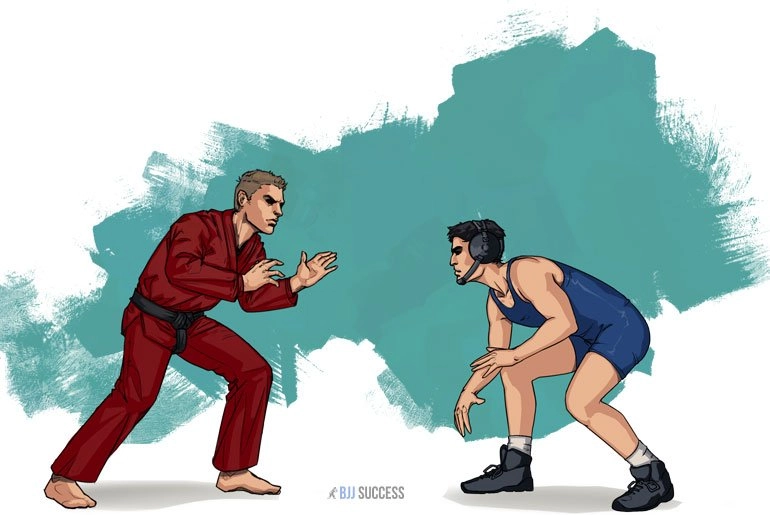
There are several contenders here, among which I only pick BJJ and the western (freestyle or Greco-Roman) style of wrestling, these being the two most prominent forms of grappling in the world of mixed-martial-arts, and probably the most extreme examples of their own wider groups (let's call those groups submission-focused group and take-down-focused group).

A good approach for answering complex questions is to start with an extreme example and draw general conclusions from it. What happens if a "pure" wrestler" (who knows no submission technique at all) faces with a pure BJJ practitioner (who only knows ground-fighting), all other things equal? The answer from the statistics (thanks to UFC and the like) is that the BJJ guy wins almost all the time. The reason is very simple. Wrestlers don't have the expertise in finishing moves. No chokes, no locks. A wrestling match ends when an average BJJ one starts - one fighter on his back on the floor. Additionally, wrestlers have to work against their natural instincts to turn their back on their opponent. In wrestling, it's a way to make it harder for your opponent to throw you. In BJJ, it's the best way to get yourself finished with a rear-naked choke.

However, when good wrestlers start learning submission techniques, they can catch up with BJJ'ers rather quickly. The reason for this is also the reason why moving from BJJ to wrestling is not that typical, and it's not easy, either. There is an asymmetry here. Wrestling filters for athleticism. Wrestlers are quick, agile, and have probably the best strength and body weight ratio among combat sports practitioners. They are unsurpassable in the foundations of grappling: the sense of balance, explosiveness, dominating the opponent, the use of body weight, ... From this base, learning BJJ requires learning how to move on the ground - which is truly a new skill -, and learning the techniques, which is simply a matter of practice. BJJers, on the other hand, can be experts - even if not world-class - of submission without being particularly athletic - it is actually one of the huge sources of BJJ's popularity. Improving your strength and agility is much, much harder, than improving on your technique. Someone can be a world champion in BJJ if he starts training at 18. No one will be a world champion wrestler starting at 18. Some very heavy work in your teenage years just can't be made up for once you passed the age. 

There is also the cost/benefit ratio. BJJers don't put much emphasis on what is at the center of wrestling: take-downs. The reason is that in a competition, a take-down is not particularly valuable. It scores 2 points, less than getting in a dominant position on the ground. If a wrestler tries to perform a take-down on a BJJer, the latter usually doesn't put much effort in fending it off. The attitude is: "You want to get me to the ground? I'm ok with that. Let's see what you do once I dragged you down with myself". On the other hand, learning to be very good at take-downs requires a lot of effort, and most BJJers think it's just not worth it.

To reiterate, in a match between pure wrestling, and pure BJJ - where the point is to incapacitate your opponent - BJJ wins, almost all the time. But take a seasoned wrestler and train him in BJJ, and he'll be a very, very hard opponent.

However, most of this above are true for wrestling as it is practiced today. In older times, before it has become a sport known today, catch-wrestling, or submission wrestling was very popular and it contained many submission techniques. One of its most famous practitioners, Ad Santel, has beaten the best students of the Kodokan school, the home of modern Judo. Which, by the way, spurred an immense interest in catch-wrestling among Judokas in Japan, many of whom traveled to Europe and America to learn wrestling.

But for now, I deliberately concentrated on the extremes. The wider world of grappling can be explored some other time.