, ,

Five Persistent Myths About China

I've been planning to write this piece for at least two years. I've thought for almost as long as that about what I should choose for the title. "On China" came so smoothly in mind, but then I realized that this is the title of Kissinger's book, which explains why it was coming up so readily. Then for a short time, I entertained the not-very-original "Will China own the 21st century?" But it was both more and less than what I wanted to say. I don't have an oracle, and I wanted to put into words a lot of what I think about China instead of concentrating on a single topic. So then came the "How to think about China?", but I dropped that too, eventually, for being too pretentious. The way I think about China is not necessarily "the way" to think about China.

Finally, a surely celestial inspiration hit me. The Chinese have a childish fascination, or rather obsession, with numbers (The Gang of Four, The Three Jewels, The Three Evils, The Four Great Inventions, The Six Harmonies, ... google them), so it's fitting to write about them in kind. Thus was born the title Five Persistent Myths About China, which are the following:

  1. China is a communist state
  2. The Chinese is a superior form of government (superior to liberal democracies, that is)
  3. China is a peaceful giant that merely wants to take its rightful place in the world and to be a good neighbor to the (geographically unfortunately located) countries around it
  4. The Chinese leadership possesses the distilled wisdom of a millennia-old empire and they plan ahead for centuries 
  5. The 21st century will be the Chinese century

All of these statements are wrong and in the following, I try to show why. But first a super-brief history of China. 

The Chinese is one of the most ancient civilizations on Earth which reached its relative zenith compared to the rest of the world around the sixteenth century. It was a technological, cultural, and military powerhouse at the time when Europe was a fragmented backwater. Yet it threw its advantages away when it chose isolation and stagnation while the rest of the world rushed through the Industrial Revolution and Enlightenment. By the nineteenth century, China was as backward as it was weak, an easy plunder for the avaricious Europeans. The tumultuous twentieth century saw the Emperor overthrown, a bloody civil war between Chiang Kai-shek's Nationalists and Mao Zedong's Communists, the Communist victory followed by thirty years of Mao's nightmarish rule, then the rise of the pragmatic China in more or less the form, if not the power, we see it today.

And now to the myths.

China is a communist state

This myth is shared by the fewest people outside of China, constituted mostly of tiny communist parties and Marxist westerners like Richard Wolf - to whom the 2008 financial crisis was a "collapse" but Soviet gulags merely a "social problem". The rest of the world realized at least two decades ago that the People's Republic of China is a hybrid state, where a single party of plutocrats rules over a more-or-less free-market economy. There is no universal healthcare or cradle-to-grave social welfare programs. No social equality, not even attempts at that. The socialist part is reduced to one-party rule, Marxist-Leninist slogans, and political oppression (to tick all the wrong boxes).

China started its meteoric rise exactly when it ceased to be a communist state. After the death of Mao, whose legacy was the killing of tens of millions of people under the flags of the Great Leap Forward and the Cultural Revolution - making him the greatest mass-murderer the world has ever seen, eclipsing even Stalin or Hitler -, a pragmatist took over the helm and slowly started to open the economy to domestic and international markets. The less communist China has become, the richer it got, and we might see the reversed course one day.


The Chinese form of government is superior to democratic governments

This notion was fueled by the average 9% annual growth of GDP in the last 30 years, not inexplicably. But the reason for the spectacular multi-decade ride wasn't that the Chinese Communist Party has turned into a group of economic savants overnight some day in the eighties. Instead, it is a combined effect of multiple factors. 

One is the international liberal order that guaranteed free and safe trade and transfer of technical and managerial know-how. By entering the international network of trade and becoming the manufacturing powerhouse of the world, China has been the greatest winner of the post-WWII order. Like it did to Taiwan, Japan, or South Korea, economic integration with the world pulled China into the community of developed countries, and hundreds of millions of its people out of poverty.

The second is the increased freedom of internal markets that allowed entrepreneurial Chinese people to create and invest with less overbearing governmental supervision. 

The third is scale. The vast size of the population enabled the government to allocate huge amounts of resources for strategically important purposes. This wouldn't have been constructive if not for the fourth point, which is that, to their credit, the Chinese leadership really proved to be competent in large-scale economic management. And large-scale management is one thing a centralized decision-making system can do really well in the case of the last but not least important factor, which was...

...the utterly miserable starting point. This might sound surprising, but in reality, it is not. Mao left China in a wretched state. If a dirt-poor country with eighteenth-century infrastructure doesn't do more than start building a modern road system, and basic agricultural and industrial infrastructure, it will multiply its GDP. And this is what happened. China entered the international trade system, copied (then stole) first-world technology and know-how, and ceased to be a nightmarish dictatorship. This is enough to rise to a middle-income country level in time if the rest of the world around you keeps pulling you up. It's not that post-1980 China has been run by geniuses. It just stopped being ruled by a madman.

Nevertheless, the scale of changes the size of China made possible has been stupifying. Hundreds of millions of people were lifted out of deep poverty in the span of mere two generations. 

Amazed the by greatest material improvement program in history, many started to see China's state-run capitalism as a model for the future. Some with naive interest, some with fear, and some with longing. Cracks in the new modern Chinese image only started to appear after 2020 when China unleashed the virus that killed around 10 million people worldwide and caused a global economic throwback. Even after that, the picture of a brutal but effective regime, that welds people in their houses if necessary, was shared with something very close to admiration. The sudden abandoning of that approach in 2023 (without a properly vaccinated population) was less awe-inspiring.


Peaceful giant

The story the CCP likes to tell about China is of a peace-loving, benevolent empire nation that strives to live in harmony with its neighbors and merely wants to occupy its natural place among the great powers. 

This is part fairy tale, part misunderstanding (the Chinese interpretation of natural place is not what liberals mean by that idea). First of all, empires have never grown peacefully. A country doesn't get to cover millions of square kilometers and host one-fifth of the world's population by gently accepting willing immigrants. China, like all its big peers, is built on past wars of conquest. Its history is marred by violent civil wars that were no less bloody that the European wars of the ancient and middle ages. With regard to the present time, China is not a conqueror, but a bully. Every single neighbor of hers seeks American protection from Chinese influence, not the way around. That the only exception is North Korea tells all.

China doves in the West often make the point that historically China has never had any ambition for world domination. This is a sloppy argument. At the height of its power, China believed itself the center of the world, the Middle Kingdom. It dominated all its surroundings and demanded tribute from its smaller neighbors. If it did not care for Africa or the Americas, it was because there were far away and had no relevance to it. But the world has shrunk since then, and decisions made on the other side of the globe influence everyone. China's position hasn't changed. It still wants to have its say in only what can affect her, but this time that means the world from the Arctic to Africa. And it's not just about natural resources or security.

When Mercedes used a quote from the Dalai Lama as an advertisement slogan, China threw a tantrum that forced the German giant to issue a cringy apology. When Australia raised the question of a deep inquiry into the origins of COVID-19, China immediately slapped tariffs on its Australian imports and its leading newspaper called Australia "gum stuck to China's shoe". When Canadian authorities arrested Huawei CFO Meng Wanzhou, China responded by arresting random Canadians (the two Michaels) on flimsy accusations, practically taking them hostage. It's worth pointing out that while Wanzhou was merely under house arrest and could move freely around with supervision (the Canadians being civilized people), the two Michaels sat in prison cells where the Canadian ambassador could visit them biweekly to bring some books.

Hysterical nationalism can manifest in curious ways. In the past years, a Chinese MMA fighter, Xu Xiaodong has gained notoriety by challenging and soundly roughing up self-proclaimed kung-fu masters. The media lambasted him for humiliating China by Western methods and the authorities lowered his social credit score (the soft arm of the CCP) to barr him from buying property or even long-distance domestic train or plane tickets.

These are not merely cherry-picked incidents. Around 2017 China announced the "Wolf Warrior diplomacy", named after a popular Chinese action movie in which the local special forces hero dispatches evil Westerners. This is not a joke (actually, it is). It is as if Americans were running around a world thumping their chest and boasting about "John Rambo"-diplomacy. And the world still likes to think of the Yanks as rednecks and the Chinese as refined Machiavellians...

The Chinese approach to engaging with the outside world is not restricted to verbal aggression. In recent years, it's been revealed that China maintains illegal "police stations" around the world to harass or sometimes kidnap its dissidents. So much for their much-touted respect for territorial integrity - which also shows in their communication over the Ukraine war.

Finally, if you want to assess how a country would behave with its neighbors if its power over them was unchecked, it's a useful proxy to look at how it behaves with its minorities. Over one million of the twelve million Uyghurs have spent time in "re-education" camps in the last five years. Stories of organ harvesting, torture, and forced sterilization are abundant. Parallel to the prisons, the CCP conducts a gentle genocide by artificial birth control. And often by something uglier. To the families where the man has been taken to re-education internment camps, the state often sends male officials to live with the family to provide them guidance and education. It doesn't require reading between the lines to recognize state-mandated rape. It is a system that is beyond disgusting. They make the Russians look good.

Maybe one more point on this, made by a Chinese leader himself. Deng Xiaoping had a motto for foreign policy: "Hide your strength, bide your time". Bide your time for what?

China is a giant. But as peace-loving as the Soviet Union was. It is an insecure, paranoid, ultranationalistic bully. Despite its constant whining about the antagonistic West and its "century of humiliation" - when other powers forced their will on her - Chinese leaders believe might is right. But only as long as they are the mighty.


Oriental wisdom: playing the long game

In common imagination, China is cloaked in some kind of Oriental mysticism. Many are prone to see her as one continuous, ancient empire whose roots reach back thousands of years. With its access to the distilled wisdom of past millennia, it's wiser, more sophisticated, and more manipulative than our puny, infantile modern states.

This is frankly the most laughable myth of all. That Westerners, who are generally credulous to the stories of the exotic, believe it, is not very surprising. But the fact that even the Chinese leadership does, it's positively hilarious.

The Chinese has a reputation of an ancient civilization whose leaders, unlike fickle Westerners, measures times in centuries. One source of this belief is an entertaining story. When the Chinese Premier Zhou Enlai in the early 1970s was asked by Henry Kissinger what he thinks of the French Revolution, his pithy answer was: "Too early to say". This conveyed the image of the Oriental statesman whose eyes are firmly focused on the grand arc of history. But this is not what happened. His translator told later that he simply misunderstood the question and thought it was referring to the 1968 Paris riots. Nevertheless, the lie was perpetuated by Kissinger, who always admired his enemies more than his allies, and who perhaps wanted to elevate his own importance by overselling the wisdom of his interlocutor.

In fact, the wisdom of long-term planning is conspicuously missing from Chinese history. China has been invaded, conquered, and ruled over by foreigners multiple times in the past millennia. In the times between foreign conquests, civil wars were more the rule than the exception. After reaching their cultural, technological, and military zenith in the sixteenth century, they chose isolation and opted out of the Industrial Revolution, leaving them in the rear-view mirror of European powers. By the 20th century, China became a poor and backward country. Then came the Japanese occupation and the civil war followed by thirty years of terror under Mao. Then Deng Xiaoping replaced the system of one-man dictatorship with the rule of the party, then Xi Jin-Pin is changing it back right now. The last hundred years were constant zig-zags and u-turns.

The latest is on demography. Mao introduced the one-child policy fifty years ago and put his country on a trajectory of halving its population by 2100. Maybe Peter Zeihan is exaggerating when he claims that China is done in ten years, but China has got onto the trajectory of becoming the most aged society on Earth in the span of two generations. This is an economic catastrophe and it's not clear how China can avoid it.

Regarding geopolitics, the image is even poorer. Instead of building up a network of allies as a path to eventually challenge the US, China has resolutely done the opposite. With the aforementioned Wolf Warrior diplomacy, it managed to alienate every single neighbor of hers. For a couple of barren rocks in seas and mountain ridges, it picked up diplomatic fights with Japan and minor but real ones with India. It reacted with extreme rudeness to the Australian request for an open inquiry. It is in constant territorial disputes with the Philippines, Taiwan, Malaysia, Vietnam, and Brunei. It achieved that the famously hostility-averse European Union in 2019 changed its reference to China from "strategic partner" to "systemic rival". It united the US's Republican and Democratic parties against itself, whose divison on every other issue is at its historical highest.

These are not the actions of cunning master strategists playing the long game but erratic and ham-fisted reactions of geopolitical autists.

The records on domestic policy don't lead to a different conclusion either. Let's look at another recent event. How did the Communist Party handle the pandemic? First, they suppressed all information about it, harassed, jailed, and "disappeared" journalists who were trying to ask questions. Then they closed down their whole economy for years. Instead of using that time to vaccinate their population, they spread lies about the Western vaccination and touted their own ineffective one. They opened up in 2022 for a short time, before closing again at the outbreak of the Omicron variant. Then after being spooked by protests, they took a complete U-turn and canceled the lockdowns overnight.

The Xi Jinping administration proved that in matters of extreme national importance, it doesn't know what it will do in two weeks let alone two centuries.

Does China own the 21st century?

From Hollywood movies and pundits alike, the general message of the early 2000s has been that America is on the decline, and China will take over its place as the biggest economy of the world, then the leading superpower in every respect. I personally know people who have had their kids learn Mandarin from an early age, I suppose to prepare them for the unfriendly future. 

As is probably obvious from the previous points, I think that it is also an unlikely one, for many reasons. Despite its incredible economic journey in the last forty years, China is still a developing country with a GDP per capita on par with Mexico. To break out of the gravitational field of the middle-income trap, it would need to maintain the escape velocity instead of its current deceleration. I think autocratic politics put a heavy brake on economic development after a certain level, and China is closing to that point while already slowing down in the process. This would be a long topic, so I just leave it with a reference to an earlier article about a great book on the subject, Why Nations Fail.

Aside from the limitations imposed by its political structure, China has enormous social challenges as well. Despite the dazzling cities, most of the population still lives in the rural countryside. As mentioned earlier, China has a very underdeveloped welfare state. This problem will only get worsened by the next problem, which is the demographic situation.

China is on the road to becoming the most aged society that ever existed. Even Chinese sources predict the halving of the population before the end of the century, and the Communist Party's attempts to reverse the course the disastrous one-child policy put China on don't seem to work. The specter of declining population looms over most other countries as well, but China is in a uniquely bad position. The US and, to a lesser extent, Europe still act as immigrant magnets. The influx of young people from less-developed countries can set off the effects of the dwindling birth rates. China doesn't have this option. Mandarin is a famously difficult language to learn, and Chinese culture is less than welcoming to foreigners. This is a country where the message of the superiority of the Han people and the maliciousness of the West (and Japanese, and ....) are constantly declared by state propaganda.

The idea that China can take over the role of the military superpower from the US is similarly lightly rooted in reality. The last war China fought (and lost) was more than forty years ago. It can churn out warships and fighter jets that equal in amount to the US's output, but it doesn't have the personnel to command them. Its military leaders own their positions to political connections, not experience. Russia is demonstrating in plain sight how effective the military of a deeply corrupt state usually is.

Countries don't have to rely only on their own resources, of course, if they have allies to support them during military or economic hardships. But instead of creating a network of them, the CCP spent the last ten years inspiring its neighbors to build alliances up against China.

The more probably future for China is a long struggle with mounting social problems and a deglobalizing world, which will turn the Communist Party ever more belligerent and xenophobic.

And with this last rebuttal, we are done. 

, ,

What is Stoicism?

The word "philosopher" means the lover of wisdom. Like many of the intellectual fundamentals of the modern world, the concept of philosophy came from ancient Greece, although its meaning changed over time. For the Greeks, the main purpose of philosophy was to help its students to live better. Philosophers were interested in every aspect of the universe - and before the era of modern science, almost every avenue of seeking knowledge fell under the umbrella of philosophy - but more than anything, they were expected to offer wisdom on how to live your life  - something that their modern peers are explicitly advised against.

One of the most popular philosophical schools of the ancient world was the Stoics. Their teachings haven't really been in vogue in the last couple of millennia, but at least they found their way into the common consciousness as an adjective. In popular imagination, a stoic is someone who takes the travails of life in stride, a stone statue of a human who endures pain and suffering with equanimity. Most of us have met stoic characters predominantly on the silver screen. The oriental monk, the native Indian warrior, the lone cowboy (or its more recent manifestation, the hard-boiled private detective) firing bullets and one-liners with equal skill. The picture these characters convey - that of a silent, strong, solitary figure, emotionally reserved to the extreme -  is not entirely misleading, but incomplete.

I got interested in Stoicism a couple of years ago when I stumbled into a book about it. Since then, the number of Stoicism-related podcasts, articles, and book recommendations I've come across seems to be growing slowly but steadily. In the time of custom-tailored newsfeeds and recommendation algorithms, it's hard to see if this really is a general trend in the outside world or simply my information bubble is getting tighter. But I could readily find some reasons why it would be a genuine phenomenon. In a constantly accelerating and ever less religious world many look for some practical guidance in life especially if it has the veneer of ancient wisdom.

And the Stoics are certainly ancient, and as practical as it gets as far as philosophy goes. Its founders had some theories and assumptions of and about the world as a whole, but these came secondary to the central question of their philosophy:


How to live a good life

The Stoic answer was to live a virtuous life. They defined the four cardinal virtues as Wisdom, Courage, Temperance, and Justice. Each of these covers a number of related traits, but they can be summarized as follows. 

Justice is having a moral compass. Temperance is the ability to restrain oneself and avoid excesses. Wisdom is the capacity to find the right way of dealing with life situations. And Courage, encompassing both moral and physical courage, is the strength to stand up for what is right even in the face of personal danger. 

The Stoics maintained that life visits hardships and difficulties on every one of us, and pursuing these virtues is the only thing that can help one overcome the challenges and find real and enduring happiness. Furthermore, being virtuous is both necessary and sufficient for that. Fortune, health, success, or the opposite of all these are not irrelevant but they are of secondary importance.

So far these are not earth-shattering revelations and they are not supported by evidence in a very obvious way. Everyone knows that life can be hard and courage and wisdom and the rest are important after all, and we all know people, personally or from history books, who have these traits to some degree and yet are or were unhappy. 

What made the Stoics tick and what makes them interesting is not so much their concept of virtues, but a handful of practical ideas directly applicable to life.


Recognize what is and is not under your control 

The first and most important insight of Stoic philosophy is that there are only a few things under your control in this world, and you are responsible for those and you have to accept the rest as they come. If your house burnt down, it will do you little good crying over it endlessly. Making it not happen is not in your power. What is in your power is to interpret the situation and choose your reaction to it.

Shrugging off the destruction of one's home is probably a step too far in an elevator pitch, so let's take a more mundane example. Imagine someone treating you impolitely in the supermarket. Such an event can trigger very different reactions in different people. Some would just be annoyed briefly and forget about it in a minute. Some would find it funny. Some would be enraged. Some would feel so disrespected that it would gnaw at their insecurity for the rest of the day. The Stoic insight in this situation is that the incident already happened and there is nothing you can do about that. Nothing. But you can decide how you choose to react to it. If you are working yourself up over it again and again, and ruin your day, that is your own damn fault. Instead of wallowing in self-pity, you could use the opportunity for self-improvement. To practice how to find humor or to understand yourself better in such situations. Or how to prevent them. Or how to handle them better. In short, life constantly throws stuff at you, and it's up to you to make the best of them. This is how it is.

“Man is disturbed not by things, but by the views he takes of them.” — Epictetus

The idea that the events happening to you don't directly influence you, but are filtered through personal interpretation, is a very modern one (it arguably forms the basis of Cognitive Behavioural Therapy). It also has interesting implications.


Dettachment

One of the most fundamental and radical of those implications is the realization that you can at will disengage from your current predicament. You can be happy or find tranquility even if you are poor, sick, or down on your luck. If at this point it's tempting to tell the ancient Stoics that "it's easy to say that", then keep in mind that they lived in an era when the average lifespan didn't extend beyond 30 years, and more people died of plague, war, or famine than of old age. One of the most famous of ancient Stoics, Epictetus, was a cripple and a slave. (Two thousand years ago, either of those would have been enough to ruin your day, and all your days).

The Stoics encouraged detachment not only from your life circumstances but from possessions as well, both personal and material. This point is worth elaborating on because it is easy to interpret the wrong way and therefore it is the source of the most common misunderstanding about being a stoic.

The Stoics didn't say you should not enjoy or value what the world can offer. The emotionally impoverished stoic is a misconception. They were not necessarily ascetics who despised physical pleasures. They acknowledged that being healthy is better than being sick. Beings wealthy is preferable to being poor. Having friends is better than being lonely. As the philosopher-emperor Marcus Aurelius, arguably the most famous of all ancient Stoics, put it, if you have to live in a palace, you might as well live well in a palace. You should enjoy good food, health, the company of friends. But you also should avoid becoming dependent on them. All your loved ones will die eventually. One day, at the latest on your last, you will lose everything you have. If you base your happiness on your possessions and personal circumstances, they can be taken away at any moment.

When you kiss your children good night, remind yourself that they can be dead tomorrow. Goulish as it sounds, the Stoics didn't advise it to indulge their morbid fascinations but to remind themselves of the importance of counting your blessings. Don't take your loved ones for granted and think you have all the time in the world to enjoy their presence.

Speaking of misconceptions, let's address another one. The Stoics are sometimes thought to be loners (see gunslingers and private dicks). This is not true. The Stoics recognized that man is a social animal and like good Greek citizens, they actually advocated for engagement in public life.  


Treating life as a training ground

Recognizing that your views and reactions are the only things you are really in control of is the main stoic idea. Treating your life as a training practice is the next best one. A real stoic looks at obstacles in life as challenges. Let's see what fate or the gods can throw at us. The increasing difficulties are like leveling up in a computer game. Your boss told you that you have only one day to prepare the presentation instead of a week? Let's see how much you can do in that time span. You are visiting a country and lost your passport on the day you should be flying home? That's level 2. You had eye surgery and have to live as a blind man for two weeks? At least level 3! A challenge worthy of a seasoned player. The reward is always the satisfaction you get from your accomplishment. 


Practice and self-improvement

As the previous section implies, the Stoics were also believers in another very modern notion, continuous self-improvement. They devised a number of daily practices to hone their skills for the game called Life. The fundamental ones are journaling, the end-of-day review, and the so called negative visualization.

The last one is the practice you should start your day with. Imagine the ways things go awry in the day ahead of you and mentally prepare for them. As Navy SEALS have plan A, B, and C for every mission, so should you be prepared for the most likely things to go wrong.

You should keep a journal. It is a true and trusted practice to help consolidate your thoughts and give the opportunity to see the path you've been travelling.

The evening meditation is what you should do the last time before going to bed. This is the time to reflect on the day. What went well, what went badly, what should have been done differently. Once I listened to a podcaster who rated his performance every day: wage negiotiation went reasonably well, 7/10; handling the stress of the traffic not so much, 3/10; explaining the kid why homework is important could have gone better, 4/10. You get the idea. Honestly admitting the mistakes enables you to avoid them next time, and high scores boost your confidence. 


The Appeal

The appeal of Stoicism is multifold. 

Its daily practice of journaling and of mediations to start and end the day with hammer its message home, well, every day. To be a stoic is to live like a stoic, and the presence or absence of discipline to observe the routine tells you undisputably if you are on the right track or not.

Said routine also provides a framework for life engendering a sense of stability that humans appreciate. It also creates constant opportunities for the practitioner to see her progress, which can create a virtuous cycle.

The Stoic approach of explicitly confronting difficulties and treating them as challenges combined with the clear separation between the things in and outside of our control removes a great deal of anxiety from life. Most of our anxieties come from worrying about other people's opinions, the threat of bad things happening to us, and the perceived lack of control over our own life. Stoicism addresses these problems head-on.

For some reason, the example of this I like most is that of Bryan Cranston, the lead actor in Breaking Bad. His advice to fellow actors was that you should not waste your thoughts on whether you get the role or not. Go to the audition, do the best you can, and drive satisfaction from your performance. If you gave your best, then you did all that was in your power. From that point, the decision is taken out of your hands anyway.


Summary

To summarize the most important points, Stoicism is a life philosophy that is light on theory and heavy on practice. Its concept of virtues may sound a bit anachronistic and high-brow for a modern reader, but its practical tools are as fresh as they get. A Stoic accepts whatever is out of his control without complaint, but takes full responsibility for his reactions to them. For him or her, every event in life is a subject for personal interpretation and an opportunity for self-improvement, every obstacle is a challenge to be conquered. The fleeting nature of life and all things material makes the good things even more precious. Therefore, they are to be enjoyed but not to be dependent on.


Is it just Zen for Westerners?

If the description of an ideal Stoic reminds someone of a Zen Buddhist monk, it's not a coincidence. The two philosophies overlap substantially. The hands-on, no-nonsense approach to life, the constant reminders of the impermanence of things, and the aspiration for tranquility and equanimity in a chaotic world characterize both schools to a roughly equal degree. The next post will explore how these two compare to each other in detail.


, ,

The collapse of Silicon Valley Bank

If I had to choose which lesson I ever received that had to most long-lasting effect on me, I would pick my high-school physics teacher's. It went roughly like this: when you want to test if you really understood something, take a blank paper and write it down from scratch. Getting stuck or confused means that you deluded yourself and only thought you understood the subject. Go back to the textbook again, study, then take out another blank paper. Repeat the process until satisfaction or exhaustion.

I find this advice a no-brainer. It's simple and generally applicable, and I have always looked with bemusement at people who never use it (that is, most people). As a bonus, it also justifies why one would bother to write an article about a topic she is not an expert of, nor could she hope to summarize it any better than his sources.

And in the following, I give an example.

One of the most reverberating news of last week was the run on the bank of many Silicon Valley types, appropriately named Silicon Valley Bank. SVB wasn't a fancy bank investing in even fancier Silicon Valley startup high-tech products. On the contrary, it was the Silicon Valley companies that parked their money in SVB, which in turn, invested their money mostly in boring, long-term bonds. That is, like any ordinary bank does, it used the short-term loans (aka deposits) from its clients - for which it paid a small interest -  to buy long-term financial assets with higher-interest rates.

To simplify the process to the basics (using numbers conjured from thin air, as I haven't bothered to check what those numbers really were), for every dollar deposited, SVB promised to pay it back with a 3% annualized profit. From the money, it bought government bonds with a longer expiry date and 5% profit. At the end of the year, it reaped a solid 2% profit.

This worked well while the interest rates were low - which was the case in the past twenty years - but the model was completely upended when the era of high-interest rates suddenly dawned on the world. The bonds SVB bought earlier that promised 5% of profit in a year dropped their real value in the world of 10% general inflation.

Imagine that you bought government bonds for $1000 for which the said government promised you to pay another $50 at expiration, in a year's time (5% profit). It looked fine when the inflation was expected to be 3%, leaving you with a 2% real profit. It doesn't look fine at all when inflation is hovering around 10%. Your real profit will be -5%, so this bond you won't be able to sell for $1000 anymore, because your potential buyer can easily find something that safely promises 12% interest in a year (e.g. a newly issued government bond). You bought something for $1000 and it's suddenly worth only $900. 

What banks usually do is that they hedge against such turn of events. SVB did not. It actually has in the past successfully lobbied against regulations that might have forced it to be more prudent.

The second big mistake SVB made is that it has built out its clientele among the incestuous Silicon Valley start-up community where financial (and many other) decisions were often dictated by fashion and everyone is closely watching what the rest does. If someone suddenly takes all his money out of SVB, the others will learn about it in hours, and for purely rational reasons, assuming the guy knew something they did not, they will follow. A single actor could and did trigger a bank run much faster than in the case of a normal bank with a diverse clientele.

So, maybe out of sync with the Zeitgeist, SVB was not running some pyramid scheme or some bogus crypto-based fraud. Its management was simply incompetent. As one commentator put it, it was not a "bank run" by idiots. It was a bank "run by idiots".

What triggered the run and whether SVB was really insolvent or could have weathered the storm if the trust in it remains, are, as far as I know, open questions. The result is the same nonetheless, without intervention the bank would have collapsed as the panicked clients sucked it all dry. 

But the US government stepped in, took over SVB, and provided deposit insurance for all depositors, which was surprising for many. The US government guarantees deposits up to $250,000, but those deposits made up less than 2% of what the bank owed to its clients. Most accounts - which as I said belonged to Silicon Valley companies - were in the tens of millions. For some reason, the government decided that the danger of starting a contagion is a bigger problem that the moral hazard they introduced by saving the skin of super-wealthy techies who didn't bother to check how well the bank is run where they store their money.

,

The World according to Peter Zeihan

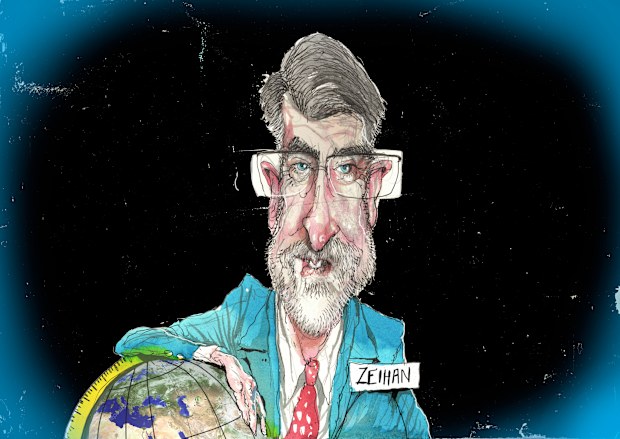
Perhaps you have heard of Peter Zeihan. He is the newest guy trending on Youtube (or at least on my Youtube) predicting the imminent collapse of China. He offers his views not only on China but on any world issue in general. At first glance at least, he seems to be more of a geopolitical entertainer than the geopolitical analyst he claims to be. So was my initial impression. But watching him on Joe Rogan's show made me interested in the guy. So I started actively searching for Zeihan-videos on Youtube and spent a couple of hours listening to his presentations and interviews. My views have evolved.

Zeihan is an entertainer, for sure, and his mannerisms are funny but potentially off-putting for some. The lanky figure sporting a greying beard and a pony-tail has the aura of a Russian-type mystic, or at least a charming con man.

But his goofiness is combined with encyclopedical knowledge. He rattles off technical, economical, geographical, demographical, historical, and energy security details with impressing ease. He offers strong opinions (supported by crisp and convincing-sounding arguments) on virtually everything, let it be the green revolution, Russia, Mexican cartels, nuclear energy, agriculture, global food security, demographics, cryptocurrencies, you name it.

Although pretended omniscience is a realiable sign of a looney, I involuntarily caught myself agreeing with quite of a lot of what he says. I found his quip about crypto especially endearing: "I'm not gonna say it was all a fraud. Some of it was a pyramid scheme".

Below I make an attempt to summarize what I gleaned Peter Zehain's idea of the world seems to be.

The world of yesterday and of tomorrow

The current world order was born at Breton Woods, after the Second World War. The USA, which at that time had an economy bigger than the rest of the world put together, decided that it will bribe the other countries. To make them its geopolitical allies and part of its security system against the Soviet Union (and China), it guaranteed the safety of global trade and encouraged everyone to participate in the liberal world order. The guarantor of safe trade was the US Navy. You could trade with anyone anywhere on the globe without paying the cost of security - a historically novel situation.

By this, the US put politics ahead of economy. From a purely economical perspective, with its vast territory, technological edge, and dynamic population, the US would have been better off in isolation. The real beneficiary of the Pax Americana was the rest of the world. Countries have continued getting richer every decade. 

But this model reached its expiry date. The US has been visibly loosing appetite for being the world's policeman, and even it wanted to stay in the role, it is no longer capable of. The rest of the world have not only caught up with America, but as a mass, dwarfs it in economic power. The second foundation of the liberal world order is also wobbling. One of the basic assumptions of the economic model of the last seventy years is that there is a huge number of active workers and consumers who drive the economy and take care of the relatively small cadre of the elderly. This demographic pyramid is turning upside down as we speak due to the enormous advancements in prosperity, health care, and urbanization. People never lived as long as today and never had fewer children.

Zehain's conclusion is that the current world order will change drastically, for the worse for most. For America, due to its unique geographical advantages, its relatively dynamic demographics, and vibrant economy, this will be an opportunity. It will replace its the global trading partners with inter-US trade, transforming its supply chains cleaner, shorter, safer. And the gap between the US and the rest will grow. For sclerotic Europe, the changes are bad news. For Russia, catastrophic in the mid-term, and for China, catastrophy in this very decade. 

China's fate is sealed for two reasons. One is the abysmal state of its demography. Even according to official Chinese data, which always come with cosmetic uplifts, continuing the trend, the population will halve by the end of the century. No country in history has ever had to face this challenge, and we don't know of any economic model that could manage it. Even if they make U-turn on child-raising policies, which they are doing, it's too late.

China's other fatal problem is the one-man leadership Xi Jinping has built up in the last 10 years. Never in history has been so many people controlled by the single leader, who has concentrated more power in his hands than even Mao. Even if Xi was a genius, he couldn't possibly alone successfully manage something such incomparably vast and complex as the Chinese state. And if his handling of COVID and foreign policy are any signals, he is not a genius. Moreover, he has a reputiation of shooting the messenger, which means by now he is entirely surrounded by yes-men and zealots who won't call out his bad decisions. Vladimir Putin is demonstrating real-time how successful that type of leadership is.


Is Zeihan right?

Zeihan certainly seems to be very informed, and most of his predictions are at least plausible. Some are pretty far-fetched. I think what conventional scholars of geopolitics would say about him is that he draws more often than not reasonable conclusions from facts that are more or less accepted, but does it with such a level of confidence that a real academic would never do. 

Geopolitical predictions are such an elastic subject, anyway. When Zeihan claims that China will collapse in the next decade, what does he mean by it, and how can we verify in 2033 that he was right? Does 20% drop in GDP mean "collapse"? Or civil unrests involving let's say 10% of the population? Or should it be at least 30%? Or maybe we can say China has collapsed if its share of the global trade has dropped by half?

Zeihan also makes predictions about everything. Green technology, nuclear energy, Russia, the US, etc. If he turns out to be right in 70% of them in 10 years, that would be pretty impressive achievement, as much as global predictions fare.

But until then, the reliability of his predicting powers can only be judged by past predictions. Unfortunately, I haven't yet found anything on that.

In the absence of past records, I ususally look for signs of self-deprecating humor or admittance of failures. Zeihan certainly isn't lacking in humor, and recently called his initial assessment of the Ukrainian war, in which he predicted complete Russian victory in six months, "laughably wrong". Which is a good sign. He wasn't trying to explain away his error.

What to make of the Peter Zeihans of the world?

This question was the original reason of writing the post, but I still don't really know what I want to say. Something along the lines that even though charlatans make bombastic statements to impress the hoi polloi, not everyone who is bombastic is a charlatan.

If someone made the same predictons as Zeihan and published them in academic papers, no one would know about him, apart from other academics. The flair for theatre is mandatory to be a public personality.

And finally, even if Zeihan is style over substance, at least he is a refreshing exception in the long line of prophets presaging the end of the word. Instead of predicting that the West and especially the US is going to hell, he claims that everyone else will.

While we are waiting for the end of the decade to prove him right, I recommend subscribing to his podcast. Every 2-3 days he appears with a new, 3-10 minutes long episode, in which he shares his opinion of some current event, form Chinese balloons to American presidents.

,

How good Bruce Lee really was?

For anyone, who has been infatuated with martial arts (and martial art movies of course) for a considerable length of time in their life, that's the question that's been in the air in the past 50 years and it might linger on for another couple of decades still. Was Bruce really the greatest martial artist who ever lived? Was he unbeatable? Or let's leave the quasi-philosophical pretense and get down to Earth: could he beat Muhammad Ali? Or Mike Tyson? 

I like the latter formulation of the question. It appeals to a mind who likes to wonder - Ali and Tyson being perhaps the two most iconic pugilists in the popular imagination with a real track record who in their prime had an aura of invincibility - and it's something tangible at the same time. A question that could have been answered. Whereas "was he the greatest martial artist?" - meh. What does that even mean? 

Another form of the question would be, pedestrian but valid: would Bruce be a UFC champion today?

I'll give a short answer and a longer one.

Short answer: size

The short answer is that Bruce Lee weighed 145 lbs and Ali did 236. Tyson 220. Any more questions? But let's elaborate.

Not a single boxer or wrestler ever became a world champion in a weight category 80 lbs over his own. Not even close. 20 pounds extra is considered to be an advantage almost impossible to compensate for between professional fighters, no matter who we are talking about.

Perhaps, Bruce was a once-in-a-millenium type of human specimen who could have overcome an obstacle not one of the many thousands of fighters could in the era of television. But until someone points to a boxing/MMA match where a lightweight opponent won against the best of the heavyweight division, I remain proportionally skeptical.


Long answer: not only size but almost everything else, too

Giving the fight to Ali or Tyson simply on the merit of their size would be selling them short. They weren't just lumbering behemoths with sledgehammer hands. Both men were lightning fast (which was an especially scary sight in the case of the tank-like Tyson), incredibly talented, and skilled enough to tower over the rest of the world-class fighters of their respective eras. 

And at the risk of committing blasphemy in the eyes of the converted, even without the size difference, I can't imagine that Bruce Lee, who had only 4 years of formal training in an obscure Hong-Kong martial art club (where there probably was no free sparring), and perhaps a lot of streetfight experience, could have matched the technical expertise of either of these men. Tyson at 15 sparred regularly with heavy-weight champions, and Ali was Ali. They were sculpted and pushed to their limits by professional trainers. A natural genius Bruce might have been, but I'd give technical expertise to the boxers.

Furthermore, Lee never demonstrated he had the incredible stamina of a professional boxer or the capacity of them to absorb immense punishment. Occasional spectators might underappreciate the ability to be getting hit over and over again with a force of a human sledgehammer and just carrying on round after round, but it is just as essential for fighters as technical finesse. What for laymen spectators looks like a lackluster round, as boxing matches go, requires stamina way beyond the normal fitness levels of ordinary humans (just try to hit the bag for 3 minutes, and you'll know).

Yeah, but Bruce was a martial artist and Ali and Tyson were just boxers, some might say. Without going too deep into the topic, let's just state the fact that Western boxing was one of the founding blocks of Bruce's personal style. Still, it can be argued that Bruce had kicks, too. And other martial art techniques unfamiliar to boxers, like finger jabs or grappling. True, but I just don't think those would have been enough to compensate for the glaring differences in size, physique, and experience.

I think the reasoning above is unassailable. But it's also unromantic and Lee clearly deserves more. So here comes an even longer version that tries to argue for his case. The outcome will be the same, but I try to give credit to Bruce wherever possible.

Legends and facts

Bruce Lee undisputably was a physically gifted man on the high end of the spectrum. He looked like a skinny bodybuilder. Everyone who knew him is in agreement that he was incredibly strong for his weight. There are photos of him doing push-ups on one finger, and numerous stories about demonstrations where he sent his partners in the air with kicks and punches alike. If only half of that is true, he hit and kicked like a mule. His speed was even more legendary. Even Joe Lewis, one of the greatest American kickboxers of all time, who had a fall-out with Bruce and held the idea of Bruce being able to defeat him laughable, said in an interview, "I never stood in front of another human who was as quick as him".

On the other hand, he still weighed only 145 lbs. If you believe that he really could hit harder than the 220-pound Mike Tyson, probably I won't be able to convince you otherwise (neither would experts on biomechanics). Could Bruce's speed compensate for his disadvantage in strength? Unlikely, and my criterion for changing my mind is similar to the one stated earlier in earlier posts: a real-life example of just half that achievement.

It's harder to pass judgment on his actual fighting skills. Everyone seems to agree that he could 
copy any moves from other martial artists (let it be strikes, high kicks, or grappling techniques) and master them in a very short time. A former girlfriend of his, with whom Bruce used to frequent the dance floor where he invented cha-cha-cha steps on the fly, called him a "kinetic genius". But aesthetics don't equal efficiency, and making a move look good on camera is very different from being able to apply it against real opponents. Jackie Chan, Steven Seagal, or Jean-Claude Van Damme looked both lethal and beautiful on the screen. But that's only choreography. None of them had a career in professional fighting, and there is a reason for that. 

Regarding Bruce's fighting experience, apart from a single boxing bout in high school (which he won) he never competed. His skills were never pressure-tested against professional sportsmen. I don't believe that there ever was a boxing champion who didn't get better by the hard-won experience in the ring, and won the world title on exactly the same level as he had been before his first official fight. Professional MMA fighters say that doesn't matter how long you have been training, your first fight will suck. The first ten will suck. It's something you get better at, match by match. Not to elaborate any further, there is a world of difference between sparring in training and fighting against someone under immense pressure who wants to knock you out. 

On the other hand, Lee regularly trained with the multiple Karate champions of his era, among them Chuck Norris, Joe Lewis, and Mike Stone. These guys were the crème de la crème of their era, and they wouldn't have wasted their time on training with Lee unless they got something out of it. Lee definitely must have been a very good teacher or at least a very good training partner. But that doesn't necessarily mean a lot with regard to him as a fighter. Roger Feder's coach must be one of the best tennis coaches. And he certainly was never nearly as good a tennis player as Federer.

The statements on Bruce's martial art prowess made by various people in interviews or in the media are so contradictory, so full of second or third-hand accounts, that they are all but useless. They either sound like sound clips from hagiographies or at best they only add to the confusion. Many people claimed with confidence that Lee could beat any of his "students" (that covered Norris and Lewis, too) easily. But according to Norris, they never actually sparred (which is also what Lewis said). In an interview, when asked (for the thousandth time, I guess) about who was the better between them, Norris replied smiling, almost blushing. "Look, I was a professional fighter, the middleweight champion of the world. Bruce was an actor". Then he hastily added, "but he was very good!".
 
Norris gave a completely different answer to a very similar question some decades earlier, in an interview. Replying to "Is Bruce Lee your teacher?", Norris said “We are not good enough to be his students, and he is too good to be our teacher.” But this seems like a lighthearted, self-deprecating jest to evade the question, rather than an honest evaluation. The interview was also part of promoting The Way of the Dragon, thus it was certainly not the place for Norris to demean his colleague.

Another anecdote from Norris relates to the same movie. When Bruce called him in 1970 and offered him the role of the main antagonist (who loses against Bruce's character in one of the most epic martial art duels in movie history), Norris asked jokingly: "So you want to beat the world champion?". To which, in Norris's telling, Bruce replied, "No-no... I want to KILL the world champion!". This joke makes sense only if both Norris and Bruce evaluated each other the same way.

Joe Lewis, who was allegedly the first choice of Bruce to play his opponent in the movie, said he had refused the role because he found it unrealistic that a man of Bruce's size could beat him. This reason is so lame that it's almost certainly untrue, and the two men fell out because of other personal issues. But nevertheless, his version of the story makes it clear that Lewis had no doubt about the outcome of a possible fight between the two of them.

In short, personal testaments from contemporaries invariably intertwine with Hollywood legends. Memories make everything shinier, many people loved and admired Bruce (that's why they get interviewed) and many have a personal interest to make him look godlike, so part of the glow shines upon them, too.

Bruce Lee was a genius and physically a freak of nature. Probably, although you can never know, under the right trainer, he could have been a world champion. Could he beat the current UFC champion of his own weight category if he was teleported from 1972 to the octagon in 2022? No. He wouldn't have the experience, the stamina, the grappling skills. Could he be the world champion after training for 2-3 years under the best coaches? Well, why not?

In the end, perhaps it's fitting to close with another anecdote in which Bruce answers the original question directly. As the legend says, when John Saxon (one of the protagonists in Enter The Dragon) asked if he could beat Ali, Bruce replied, "Look at my hand. That's a little Chinese hand. He'd kill me."


, , ,

After the Midterms

Apparently, even Trump has a half-life. We are looking ahead to a slow, ugly decay.

The rollercoaster ride after Trump's improbable victory in 2016 mostly distracted the attention from an important sequence of events. Elections. He has made every single one of them about himself and he has lost every single one as well. The 2018 midterms elections, the 2020 presidential elections (making Trump the first president in the last 30 years to be kicked out after one term, plus the first president after 1932 to lose the presidency, the House, and the Senate), 2021 Georgia Senate run-off (again costing the Republicans the Senate), and finally (so far) the 2022 midterms. In the latter, almost all of his crackpot endorsees were wiped off, making the midterms a practical Democratic victory.

I - and most other people - were wrong on Trump's prospects at least twice already. I didn't think it possible he would win in 2016, and I thought we saw the last of him after January 6, 2021. Yet he always managed to come back on top, even without his Twitter pulpit. Will he do it again?

I think not. In 2016, he eked out a narrow victory on the back of the American's craving for entertainment and rode that wave until only recently. Even after leaving the White House he could keep up the show with the incompetent coup attempt and beating the drums on the stolen election. The Republicans were in gridlock. Trump doesn't seem to be a winner anymore, but he is still the darling of enough of their voter base. 

But the midterms came, and his candidates lost the race and the Republicans lost the belief that Trump has a more special and closer relation to their voters than themselves.

There is blood in the water. Mike Pence, the most sycophant of Trump trustees (although to his credit, he refused to break the law for the dear leader), openly said that he hopes in 2024 there will be better candidates, and he didn't close out the option to be one of them. Mike Pompeo, Trump's Secretary of State, considers running himself and made disparaging remarks about former leaders whining about the past. And when even Ted Cruz seems to be hedging his bets, Trump must see that things are not going his way.

So when Trump announced his candidacy again, he did it in a very different world than the one of 2016. He is no longer the shiny new thing, he is not even much of an entertainer. He can keep repeating the stolen election mantra, but he can soon find it to be a lonely tune and a boring one. When his fellow election-denier nutjobs lost their elections, apart from Kari Lake, they just shut up and left. J.D. Vance, who won, forgot to name Trump among the 37 people he thanked after the event. Very suddenly, it just doesn't seem chic anymore.

Yet, the Republicans are still in the same gridlock. If Trump gets the nomination, they are probably sailing for another defeat in 2024. If they deny it from him, he could wreck the party in vengeance. In an era, where the voter base is so calcified that elections are decided by a percentage point or even a fraction of it, Trump can destroy the GOP's chances for at least another term by creating a new party, or just by continuing to promote the crazies.

On the top, and perhaps not independently, of that are Trump's mounting legal problems. US Attorney General Merrick Garland just named a special counsel to weigh charges against Trump over the classified documents found in Mar-a-Lago. Garland is not a partisan hack. This step against a former president and present candidate is unprecedented. Also is the hope from Trump's own party for Garland to succeed and rid them of this problem.

Just to counterbalance the above observations, let it be said that Trump has survived legal problems and political challenges, and mind-bogglingly even a failed coup. We might get surprised again. The Republicans are both stupid and coward enough to stick to him and Biden could be foolish enough to try to run again, at 82.


, , , ,

Ukraine War - current state of affairs

I wanted to write a compact piece to provide a bird's eye view of the current state and future trajectory of the war and quickly realized that brevity and completeness are incompatible. A list of parts to mention only is long enough: the current state, the players, the short-, mid-, and long-term prospects, the military, political and economical aspects, ... So I restrict the scope to the very skeleton of all these above, with some lumps of meat here and there.

Current state

In recent weeks the Ukrainians have re-gained a huge amount of territory. Putin predictably responded to the new humiliations with some nuclear saber-rattling, which his only patron Xi Jinping demurred. Plus Putin was publicly made to wait in Samarkand at the SCO summit by his supposed allies (SCO is the poor man's NATO of world autocrats). In the West, much furor in the news, and dismissal from the military experts.

The Russians are mostly in retreat, and the Ukrainians are mostly on the advance.

The players

Let's step back and look at the major players in the War.

Ukraine. The Ukrainians have completely stunned the world (even more the Russians, I guess) with their courage, ingenuity, military skills, and national unity. If there was no real Ukrainian nation before the war, as Putin and Western useful idiots claimed (und unbeliveably still claiming), there is now. It's really hard to express what a miracle they did. Their American-trained military is superb and very far from what it was in 2014. Their skill in intelligence operations and media-savviness is at least as remarkable. The resolve to win the war seems unbreakable, but it's also a virtue out of necessity. The war is an existential question for them. Surrender would mean Russian rule, oppression of the society as a whole, and the universal threat of brutal murder and torture to anyone who took arms against the Russians.

As Ukraine became the darling of the West, Russia has become the international pariah of the world. It lost its greatest business partner Europe for good. I severed almost all ties to the high-end part of the global economy. It lost hundreds of thousands of its skilled people who have fled and been constantly fleeing the country right now. It destroyed the myths of Putin and the Russian military might. Nothing like this self-goal has been committed by any country in generations.

China is probably not very happy with the state of affairs. Instead of exposing Western weakness and further strengthening frictions, Russia forged a miraculous unity among their common enemy. And just after Xi Jinping declared Putin his eternal friend or something similar cringy expression of bromance from the old communist vocabulary. Awkward. China nominally supports Russia, but in reality, it doesn't provide much help. It buys its oil and gas at heavy discount (this is the very finite length an eternal friendship goes), and under the threat of Western sanctions it dropped most of its exports to Russia.
On the positive side (for China), it gained a new vassal. Russia is a resource-rich country with a huge potential to make trouble to the West, and it's completely at the mercy of China's goodwill and forever will be. The war might also make China rethink its plans with Taiwan. If the Russians couldn't successfully invade a neighboring country with land borders, how would trying to do that go across a 110 miles wide naval strait? 

As for America, the Biden administration's handling of the war has been superb. It combines massive political, financial, military, and intelligence support and restraint. As long as Ukraine keeps its military operations inside its borders, and the Americans are very strongly advising them to do so, it remains a defensive war and the Russian narrative remains indefensible. 
The big question is what happens after the midterm elections and especially after 2024? If the sane side of Republicans prevails, the support for Ukraine will continue. 
To be blunt and cynical, America has never been given such a geopolitical gift. Putin's fuck-up is beyond the wettest dreams of the hawkiest of American foreign policy hawks. The US received a one-in-a-century opportunity to completely wreck a historical enemy. Its reputation, its economy, its military, without a single American soldier lost, while never losing the moral highground and the support of their allies. All it needs to do is to fund Ukraine, and Ukrainians do the work for it. As H. R. McMaster, Trump's former National Security Adviser blurted out with an almost comically mad laugh in a podcast recently when asked about how America should help Putin decelerate: "Help him decelerate?? Our job is to help him accelerate toward the brick wall!"

Europe. Due to divine (or American) intervention, Europe responded to the crisis with unforeseen and quite amazing unity. Its energy sector is going to be decoupled from Russia for good. In 5 years, people will reliably have forgotten that gas and oil had ever come from Russia. It also stepped on the road to rearmament. All this is mostly thanks to America, without whom the European response to Putin would have been the usual hand-wringing and forced amnesia. Not that the US will ever be thanked for it.

In the time-proven tradition of Western-centric worldview, I lump the rest of the world together as the last actor, mostly because I don't know much about it. The big picture seems to be that Russia doesn't have friends, even among those who loathe the West. Some of these countries have an interest in Russia not losing too badly (like India, who imports half of its weapons from Russia), and some just don't have a dog in the fight. Westerners often find it astonishing how come third-world countries are not as outraged by this war as it's expected from them, but we forget that for much of the world conflicts even bloodier than this are a constant part of daily life.


Predictions

Reading the tea leaves tells me about a protracted conflict for years of varying intensity. The Ukrainian morale and support of the war are through the roof. They just don't have any incentive for giving up. Putin can't afford to give up. The Russians won't topple the regime. It's gonna be a war of attrition for all parties.

In the very long term, the situation will be something like this. Europe won't do business with Russia again. Russia will be a Chinese client. Ukraine will be part of, or an official partner to, the EU and NATO.

With relevances varying based on the length of the war, I think the following factors are decisive:

The things going for Russia

The first is manpower. It's a huge country with a lot of people for cannon fodder. They are demoralized, untrained, and led by mostly incompetent leaders. But there are many of them, and 100,000s can be thrown onto the battlefield every year.

The second hope of Putin is that Europe will suffer a cold winter and the public will force the politicians to take a U-turn, drop the sanctions and stop supporting Ukraine. It's not gonna happen. The gas reserves are 90% full. There is a lot of noise in Europe now saying that yes we are fine this winter, but the next one will be much worse. I think these people simply underestimate the adaptiveness of the world economy. Three months ago Europe was supposed to freeze this winter. We have a full year to prepare for the next. Germany and France will never again trust Russia, and even the voters in general are on the same page. 

The third is Donald Trump's return to power. If Republicans don't restrict the support to Ukraine already, a Trump administration would do it. Unfortunately, this can be a game changer.

The fourth is the implosion of the Ukrainian economy. According to some forecasts, Ukraine's GDP will shrink by 35%, while the Russian economy, which has proven much more resilient than experts had thought, will contract by maybe 5%. How much European and American money can fill in the gaps, remains to be seen.

The things going for Ukraine

The first is motivation. The Ukrainians are facing an existential threat. The Russians fight because they are forced to.

The second is ingenuity. Ukraine has taken the upper hand on the physical battlefield and massively dominates in the information war. There surely be ups and downs, but I hope their superiority will last.

The third is the bottomless chests of European and American money and weapons. Russia is a poor country that gets poorer by every month as long as it continues the war. It's depleting not only its financial resources but its weapon stocks as well, without access to technology and imported materials to replenish them. The US will never run out of money and weapons to send.

The fourth is the incompetent opponent. The Russian army reflects Russian society. Corrupt, incompetent, strong only against civilians.

Summary

The most important factor in the war is the American willingness to engage. If the US is fully behind Ukraine, it will still be a long war, but a war of continuous Russian defeats. If it pulls out, all bets are off. So eyes on the elections.