The Messenger of Ancient Gods

If I was forced to name a single person who really captures the zeitgeist of our era, I don't think I would make a big mistake with the Internet celebrity-villain Jordan Peterson. He entered the public consciousness around 2015 as the main character of the infamous gender-pronoun debate, and in the course of maybe two years, he has gained almost unprecedented fame and notoriety on the Left as the transphobic proponent of the oppressive, male-chauvinistic order. For others, he has become the fearless defender of freedom of speech and thought. Since 2015 the Canadian clinical psychologist - cum - public intellectual wrote a much-publicized self-help book, appeared in and authored countless podcast episodes, engaged in public debates viewed by millions, and probably inspired more op-eds than anyone except the incumbent president of America.

If Gad Saad is an interesting supporting character in the Culture War-saga, Jordan Peterson is not merely a hero of the anti-PC side, he is the eternal champion incarnate.

And, considering the reach and interactivity of 21st-century media, he might be the man receiving the largest volume of unfair criticism in human history (I have no idea how to quantify it, and if it's possible, I might be off by orders of magnitude, but I'd be surprised).

He started with a one-man rebellion against government-imposed mandatory use of pronouns, but in the following years, he's widened his message to cover Wokeism, gender-relations, postmodernism, myths, and religion. There is a lot to like and a lot to criticize in what he says. I have a very positive view of his character and a very mixed one on his views. I find him spot-on on social issues and left-wing ideologies, questionable on the territory of myths, and dead wrong on religion.

The Peterson-story started when the professor of psychology at the University of Toronto took a public stance against Bill-16. The bill the Canadian government planned to introduce was meant to provide protection against gender-discrimination, which at first sight has little to find a problem with. According to Peterson, however, it could be used to impose a mandatory speech-code to force citizens to use arbitrary pronouns (of which there are around 70, and anyone can demand to be addressed as any of them). A failure to do so can cost one his job or can even mean prison time. Peterson likened the justification of the bill to the Marxist-ideology and claimed that it can be the first move of the rising totalitarian state. That raised some eyebrows even among Peterson-sympathizers. On the other hand, people soon started to get publicly shamed, fired, or forced out of their jobs for similar and mostly imaginary offenses (see Brett Weinstein and his wife from the Evergreen College, or Nicholas Christakis from Yale, just to name the most prominent cases). Lindsay Shepherd, a Canadian graduate student was formally censured by her university for simply presenting a public debate featuring Peterson to her class, thereby "creating a toxic atmosphere". Five years later the state of affairs reached a point when J. K. Rawling is called transphobic simply for suggesting that "people who menstruate" might be called simply "women". There is a call for censoring her books. 

At this point, Peterson is vindicated. He called attention to something which he described in hyperboles. He deserves credit for his courage and foresight, which doesn't mean he is right about where the bill leads to. Obsessive gender theorists bringing about a totalitarian government that sends rebelling citizens to Gulags? Not likely. But getting fired and shamed publicly because you don't agree with the mainstream view on race, gender, and sexuality (the mainstream that was massively different only 10 years ago)? That is happening right now with real people, every single day.

Peterson has opined on other left-wing topics as well, most famously on gender inequality, most famously in the Kathy Newman-interview. This I recommend watching in full. It features Peterson at his best. He is extremely calm, composed, articulate, and sincere but not humorless. This was a character-assassination attempt disguised as an interview, which backfired badly on Newman. Peterson was eloquent, respectful, and approachable, whereas Newman conducted the interview in such obvious bad-faith that she almost made a parody of herself. If their genders had been swapped, she (he) wouldn't get a job again at any prominent news outlet. Just imagine a male reporter posing this question to a female interviewee: "So you have written a book to help troubled young women finding their place in the world. But why should we, men, care for this?".

In a nutshell, Peterson rejects the idea that different outcomes by gender or race are the result of an oppressive, patriarchal, white society. Women and men - statistically -, have different personality traits and different preferences in life. Many more women are attracted to being a modestly paid kindergarten teacher than men, and much fewer women than men want to be petrol engineers. Achieving social status is more important to and expected from men. He also points out the men are overrepresented both at the top of society and at the bottom as well. They are the overwhelming majority among the victims of suicide, drug addiction, violent crime, mental disorders, or occupational accidents. And the fact, generally accepted as the normal state of the world, thus no one ever thinks about it, is that men do almost all the physically demanding, dangerous, or just filthy jobs from fire fighting to sewer cleaning. Without going into further elaboration, which I did elsewhere, I share his view. 

However, he has more to say about gender relations than an opinion on income inequality, and some of them are pretty controversial. At one point, addressing the #MeToo movement, he mused that maybe men and women should not work at the same workplaces, as the last 50 years is too short to draw conclusions on the experiment. That sounded one harebrained idea, that could be (and had been) interpreted as further proof of his misogyny (I was simply wondering that he might have gone nuts). But if you watch the full segment on the topic in that interview (approximately 15 minutes), the picture changes completely. Here Peterson was thinking out loud about something he admittedly didn't know the answer to. His whole body language and the context paints a very different picture as the soundbite did. It also seems to me that Peterson likes to provoke, and today it's really not tolerated.

Labelling Peterson as a misogynist requires the complete refusal to consume anything he says or writes in full context. He opines on things that are very much up for debate by our current understanding, so he is bound to be wrong in a number of cases. Like everyone else.

All things considered, I think Peterson has some very good observations on gender-relations and society, even if some of his more radical theories don't resonate with me. I find much less to agree with him once he starts talking about myths. As far as I understand, he claims that ancient myths and stories are vessels of distilled and deep human wisdom, and their mere survival through millennia is the proof of their "truth". Which sounds at least worth thinking about. But when he says that the story of Cain and Abel is so profound that an individual simply couldn't come up with it? Well...I don't think so. I'd expect to find countless stories with more insight by wandering in a random bookstore. But he is a psychologist who has spent decades thinking about these kinds of things, so maybe he has a point. But those also have a point who think that if one searches for patterns and hidden meanings hard enough, he can find them almost anywhere. During one of their public debates with Sam Harris, Peterson was talking about some ancient myth in which the hero faces his own father in the bottom of a pit, and he emphasized the tremendous significance the father-figure and the pit as a location have. Upon which Harris remarked that if it had been the mother on a mountaintop, people like Peterson would eagerly jump in to explain how profound that arrangement is.

One area related to myths where I find Peterson confused and confusing is what he calls "archetypal truth". He rejects the idea of objective truth (like 2+2=4) and instead thinks that a belief is true if it helps our survival. At least, that's my understanding. The discussion of this idea resulted in a tortuous 2-hour discussion between him and Sam Harris, to the exasperation of both Harris and the listeners. I'm sure false beliefs can be useful in certain situations (e.g. belief in a benign God and the future reward can help to endure periods of suffering), and literary geniuses (like his beloved Dostoyevsky and Nietzsche) can offer genuine insights into the nature of reality which cannot be confirmed by science, but I don't understand why Peterson insists on conflating these with "truth" in the normal sense.

Peterson reminds me of the protagonist of a novel by the 19th-century Hungarian writer, Kalman Mikszath. In Beszterce Ostroma (The Siege of Beszterce), the wayward noblemen, Count Pongracz, refuses to accept modernity and lives his life as a medieval lord in his imaginary world. In the prologue, Mikszath explains the motivation of his hero something along the following lines (which I paraphrase from memory): "The past is a bottomless well, and looking into it deeply can befuddle those who don't have a strong head. Count Pongracz didn't have a strong head, and he gazed into the well very deep indeed." I think Peterson does have a strong head, but by temperament and professional curiosity he is both susceptible to see patterns in semi-randomness and willing to go great lengths to uncover hidden meanings in obscure things - real or perceived.

Which is probably a good explanation for his infuriatingly vague attitude to religion. He's not Christian in the common sense of the world (or in any meaningful sense), but he is just unable to give a straight answer for dead simple questions like: "Do you believe in God?" or "was Jesus physically resurrected from the dead?". His answers are "it would take me 40 hours to answer this question" and "it depends what you mean by resurrection". This is just hemming and hawing that is hard to interpret another way than intellectual dishonesty, but my opinion is that Peterson tries to convince himself as much as his audience. But even self-deception is an insufficient explanation for occasional statements like "secular humanism was tried by the Soviet Union" - as he put in a debate with Matt Dillahunty. In the best interpretation, it was a poor attempt at provocation. Otherwise, it was just moronic. A similarly asinine opinion of his that ditching religion will lead to "rivers of blood". He should look up from his books of Nietzsche and take a quick look at Northern-Europe.

In 2018, Peterson published his first book intended for the general public, 12 Rules for Life: An Antidote to Chaos, in which, as the title suggests, he laid out his "rules" to live a meaningful life. It's a decent self-help book undergirded by the current understanding in cognitive science (so the scientists I listened to say). For me, it was a bit too long and too philosophical in places, but not a bad book at all. It gives some generally-accepted advices ("Set your house in order before you criticize the world"), some conservative ones ("Do not let your children do anything that makes you dislike them"), and there even are a couple of surprising items on the list ("Pet a cat when you encounter one in the street"). They are heavily supported by Biblical-stories, but this is what you'd expect from Peterson. What you don't find at all is any reference to support patriarchy, or white supremacy, or transphobia. It's a conservative book emphasizing the importance of personal responsibility, discipline, but also compassion.

The book I believe also gives a key to Peterson - which wasn't very hidden in the first place. In one of the chapters, he explicitly writes that our life exists in the thin layer of order over the depths of chaos, which is the natural state of the world. In our daily lives, we think we understand our place in the world and the rules by which events unfold in it. But a single accident or unexpected situation can push us completely out of our element into unfamiliarity and danger and suffering. We need rules to carve out a habitable space in the universe, and myths and religion contain time-proven tools and guidelines - some rare gems under their pile of rubbish - for the job.

This is the standard conservative attitude to life, which some people are probably born with, but Peterson is someone whose life almost predestines him to see the world in dark colors. As a clinical psychologist he works with people with serious issues. He has a decades long fascination with the history of totalitarian ideas. His daughter has been suffering from physical problems from her childhood, his wife has terminal cancer, and he himself is just recovering from a recent, very serious mental and physical illness - during which liberal media poured out a disgusting volume of schadenfreude.

That is one of the reasons why I find the usual criticism against him - that is, he is just a snake-oil man - unfair and unjustified. He is genuinely someone who fits the description of a tortured soul. The other reason is simply his behavior in a conversation. Peterson has always impressed me by being such an attentive listener. Even in a conversation with someone really not on his level - like with the disgraced troll, Milo Yiannopoulos - Peterson visibly concentrates on his partner's words and tries to learn from them - which is something conmen never do very convincingly. He is also very emotional, often to the point of weirdness. All in all, I think Peterson is an honest, very brave, very smart, and very articulate person. With some very serious troubles.

Having said all this above, which part explains his meteoric rise to prominence and his controversially? I think, instead of a single trait or message from him, there are multiple factors reinforcing each other - which is not a very original idea, as this is the case for most things. Nevertheless, I think the reasons for his prominance are the current cultural and political climate, Peterson's physical and intellectual charisma, the relevance of topics he engages with, and the rise of podcasts. 

We live in a highly politically polarised time, when the arguments on the Right but mostly on the Left have gone so far to the extreme, that very few people are indifferent to them. Most people are sick and tired of the idiotic overreach of political correctness, and they love to hear a fearless, charismatic, eloquent figure speaking their mind on their behalf. And Peterson is charismatic, extremely articulate, and - maybe more importantly than generally realised - telegenic. I don't say physically unattractive people can't gain followers (Hitler), but they start with a big handicap. And besides refuting things publicly that most feel need refusal, Peterson engages in other topics in a very interesting way. When he is not carried away by his own voice and the rhythm of his thoughts, he is very hard to stop listening to. 

And, most importantly, he points to a very significant issue that doesn't get the publicity it deserves, but is of interest for many - the changing role of men in society. What I have no idea about is that how many of his fans are attracted to him for his obsession with myths and religion - which seems to be the center of everything to him.

The last factor contributing to his popularity is the recent but huge interest in long-form conversations satisfied by an infinite number of excellent podcasts. I think it would be justified to recognize the notion of the "Joe Rogan number" equivalent to the "Erdős number in Academia" and "Bacon number" in the world of movie-stars. Maybe as a counterbalance to the declining attention span and constant multitasking, people crave for listening to long and deep conversations between smart people. This is a perfect medium for Peterson (he has a good voice too), and once someone made one podcast part of her daily diet, following the chain of connections, she have inevitably bumped into Peterson, or people discussing Peterson, probably many times.

Where will the Peterson-phenomenon evolve from here? It's anyone's guess and it's not a very deep insight to assume that it will mainly depend on two factors. One is the middle-term trajectory of the cultural climate, and the other is how his personal life will unfold in the future. Being treated as a guru has never improved anyone's personality, and I doubt the public hate he receives from the other side will either.  Peterson will never be a lighthearted, happy man, but I hope if things cool down a bit, the antagonism toward him abates to some extent. If that happens, more people can recognize that he is not the monster he is often portrayed, but essentially is one of the good guys. In the darker scenario, if the polarization continues, I can envision him cocooned into his bubble of obscure mysticism and becoming the liberal boogey-man for decades to come. That would be a personal tragedy and a public loss.
, ,

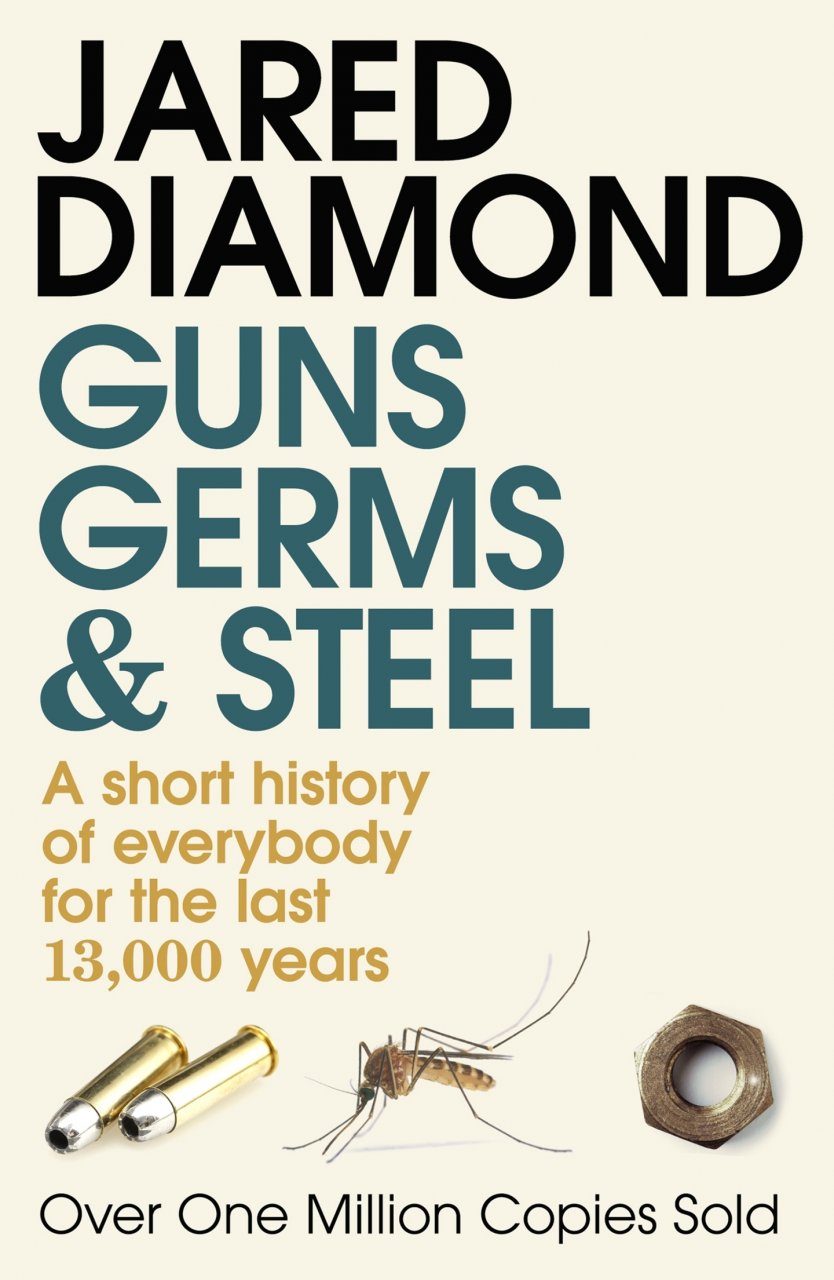
Jared Diamond: Guns, Germs and Steel (1997)

After around 300,000 years of existence, largely in our current biological state, today an ever-growing part of humanity lives in a world with so complicated economical and political structures that a single person can understand merely a fraction of it. Yet there are still tribes in remote corners of the Earth that haven't even got to inventing the wheel. Why did advanced civilization arise in few places on Earth, while in others, 10,000 years after the appearance of farming, people are still stuck in the Stone Age? That's the question Diamond set out to answer in his classic book which just reached its twenty-year anniversary. I've finally come around to read it and this is my attempt for a summary.

The popular answers to the question above include the capricious nature of historical coincidences, the role of the Great Men, the differences in geographical circumstances or between races and cultures, the effect of Judeo-Christian values and protestant work-ethic, etc. Diamond stands firmly on the side of the geographical explanation.

This is one of those books that address both scientists and the general public. Like in the case of Richard Dawkins's The Selfish Gene, the author didn't write a jargon-heavy version for experts and a simplified one for popular consumption. It's mostly for the better, although I could have continued living without knowing the detailed characteristics of several dozens of crop variants. But putting up with some heavy dose of agriculture is a fair price for a book that tries to answer the big questions. I would describe its genre as interdisciplinary world-history - but I have no idea whether it's an existing one or there are better descriptions out there.

To summarize the book in one sentence, it says: civilization could only arise among certain social conditions, which in turn couldn't have appeared without agriculture and livestock domestication, which in turn could only happen in certain places on Earth blessed with the right geographical conditions.

Scientists in general test their theories with repeatable experiments with controlled variables. This tool is not available for historical sciences, but nature sometimes offers something close enough. Diamond opens his book with one. The Polynesian islands were populated by a group of people circa 5,000 years ago. The same genetic material and culture were put to test in several, very different environments, and the millennia-long experiment produced a number of very different societies. The islands varied in climate, geological type (the predetermines the quality of soil and the material for tools), marine resources, terrain fragmentation, and isolation. In a couple of thousand years, by the time the first European explorers reached Hawaii, it was already on the brink of the political unification of several chiefdoms. But on Cathams islands, people still lived the same hunter-gatherer lifestyle as their common ancestors before the split.

After this interesting piece of history, Diamond gets to work on laying down the foundations of his theory.

Farming started to appear around 10,000 years ago. The sedentary lifestyle allowed population growth, as women could bear children with 2-year gaps (nomad women couldn't carry newborns until their previous child was big enough to walk with the tribe, which was around 4 years). Farming produced food surpluses that facilitated the division of labor. Not everyone was needed in the fields, so some had time to invent things - like metallurgy, pottery, or writing - or became craftsmen. Food surplus and the higher number of people also led to vertical fragmentation. Priests, soldiers, and chiefs appeared to organize society. The benefits came at a cost (although chiefs, priests, and soldiers appear on both sides): early farmers had a much less balanced diet than their forebears, were more at the whim of the weather, and due to population density and living next to their livestock and where they defecated, were disease-ridden. In some places, farmers in a few generations grew 15cm smaller than their ancestors and had a shorter lifespan.

Nevertheless, farming spread. Farmers were more numerous, technologically more advanced, and exhaled deadlier germs than hunter-gatherers. Plus, they occasionally had professional soldiers. Hunter-gatherers either adopted the sedentary lifestyle or were exterminated (the low genetic diversity of Homo Sapiens compared to other animals suggests the latter happened more frequently). As farmer societies grew bigger, ever more complex and stratified political structures emerged.

But why didn't farming appear everywhere? According to Diamond, very few places on Earth offered favorable conditions. Agriculture required supporting climate and domesticable crops and animals. The species of large mammals suitable to be beasts of burden or food source are not very numerous. They have to satisfy a number of conditions. They have to breed in captivity (elephants or cheetahs out), grow fast enough (gorillas out), be sufficiently docile (no brown bears), have a natural herd-like disposition (no antelopes), and can be supported on local food sources (Koalas out). There are only 14 species of large mammals that tick all the boxes, and 13 of them are from Eurasia - the fourteenth is the South-American llama.

Plant species suitable for domesticating are also rare. They have to grow fast, be nutritious enough, give high yields, be storable, and their genetic code needs to allow for breeding.

If not enough of the conditions are satisfied, changing from hunter-gatherer to farming lifestyle is, in terms of producible calories per hour of work, just not worth it. There were however a couple of places on Earth, that were suitable. The Fertile Crescent in the Middle-East, Mesoamerica, North-East America, the Sahel-zone of Africa, and South-West China. But agriculture still didn't appear in every one of them. Why?

Diamond suggests that it has something to do with continental orientation. Whereas Eurasia stretches thousands of miles from West to East, the main axis of the Americas and Africa are North-South. That means that in Eurasia domesticated plants and animals could spread thousands of miles at the same latitudes. Same latitude by and large means the same climate and day-length. Even areas not initially endowed with the right crops and animals could adopt them in the long run. In the Americas and Africa, the diffusion of plants and animals couldn't even cross a couple of thousands of miles because of the vast differences in climate. Americans couldn't plow their fields because the South-American Llama and the Mesoamerican wheel never met.

Nevertheless, the people of the Americas were approximately as numerous, if technologically less advanced, as the people of the Old World. They lived in highly centralized societies. And yet, they were almost effortlessly wiped out by the Europeans in a couple of generations. How was that possible? When the Spanish made their excursions into the native's territories, they inadvertently unleashed all the germs of Europe onto a defenseless population. Up to 95% of the native Americans were killed as a consequence of smallpox, cholera, measles, tuberculosis, influenza, whooping cough, and the like - overwhelming majority of them before they could have set their eyes on a single white man.

Why was the invisible biological war so imbalanced? Why didn't the Americans retaliate with their own arsenal of plagues (with the exception of syphilis) and devastated Europe? The answer is two-fold. First, Americans didn't live in a radically different environment from the Europeans that could produce entirely different pathogens against which the conquistadors would have had no resistance. Second, most of the European diseases are mutations of diseases in cattle. For example, pox, measles, tuberculosis originate from cows, flu from pigs. Ten thousand years of coexistence made the Old World population largely resistant to them, but the Indians were defenseless.

The first third of the book examined how geography, agriculture, and animal domestication lead to complex societies. However, not every society built on farming evolved from chiefdoms to states and developed advanced technology. Why? Here Diamond admits that geography is relegated back to be simply one of the different factors that contribute to development, although an important one. 

Writing, the most important prerequisite to technological, scientific, and bureaucratical progress, for example, was first developed in agricultural societies with a large enough population - not for the citizen to read poetry, but as tools of bureaucracy and taxation. 

Innovation is the driving force behind technological progress. But what exactly facilitates it is a matter of debate. Culture must play an important role, but not definitive. Islam culture was the vanguard of scientific inquiry until the medieval ages, but then it became a backwater and it remained that ever since. China led the world in technology and sea explorations up until 1500 A.D., and then it suddenly froze in time. Diamond's argument is that Europe's advancement happened because of its fragmented geographical landscape. Mountains, bays, peninsulas, and other geographical barriers never allowed for political unification. Therefore Europe was shared by small, constantly competing political entities. Innovation provided - among others - military advantages, which kept every kingdom constantly on its toes. Technological laggards were conquered by their neighbors. Innovations could diffuse from one land to another, and the process is autocatalytic - innovation begets more innovation. Plus, with the lack of political centralization, seafaring and scientific explorations could not have been banned by imperial decree - as it happened in China in the 16th century.

The last third of the book is a whirlwind tour around the world. From the perspective already laid down in the previous chapters, Diamond examines the history of Africa, Oceania, China, and Japan. He spends the most time on his beloved New Guinea where he worked for thirty years.

The final chapter is a musing over the future of history as a scientific discipline. Diamond argues that history is not just "one damned fact after another", but there are broad patterns in it, that are discoverable, and in a way, within accepted limits, testable.

In the end, the point Diamond makes, again and again, is that the reason for different trajectories for different peoples over millennia ultimately lies in geography. Of all the possible explanations for the varying degrees of civilization - geography, genetic or cultural differences, whims of history -, geographic determinism might be the only one that cannot have racist undertones. I suspect that Diamond's distaste for racialist explanations predisposes him to favor this view, but even if he is personally biased, he makes a good case for it. 

This is an engagingly written but heavy book. Diamond has expertise in anthropology, early-human history, geography, linguistics, botany, and a bunch of other fields, and the reader can't avoid some serious education while working his way through it. I read it end-to-end, but writing this summary required me to re-read parts of it again. Once I managed to digest the content and recuperate, I'd like to compare it with the next one from the genre.

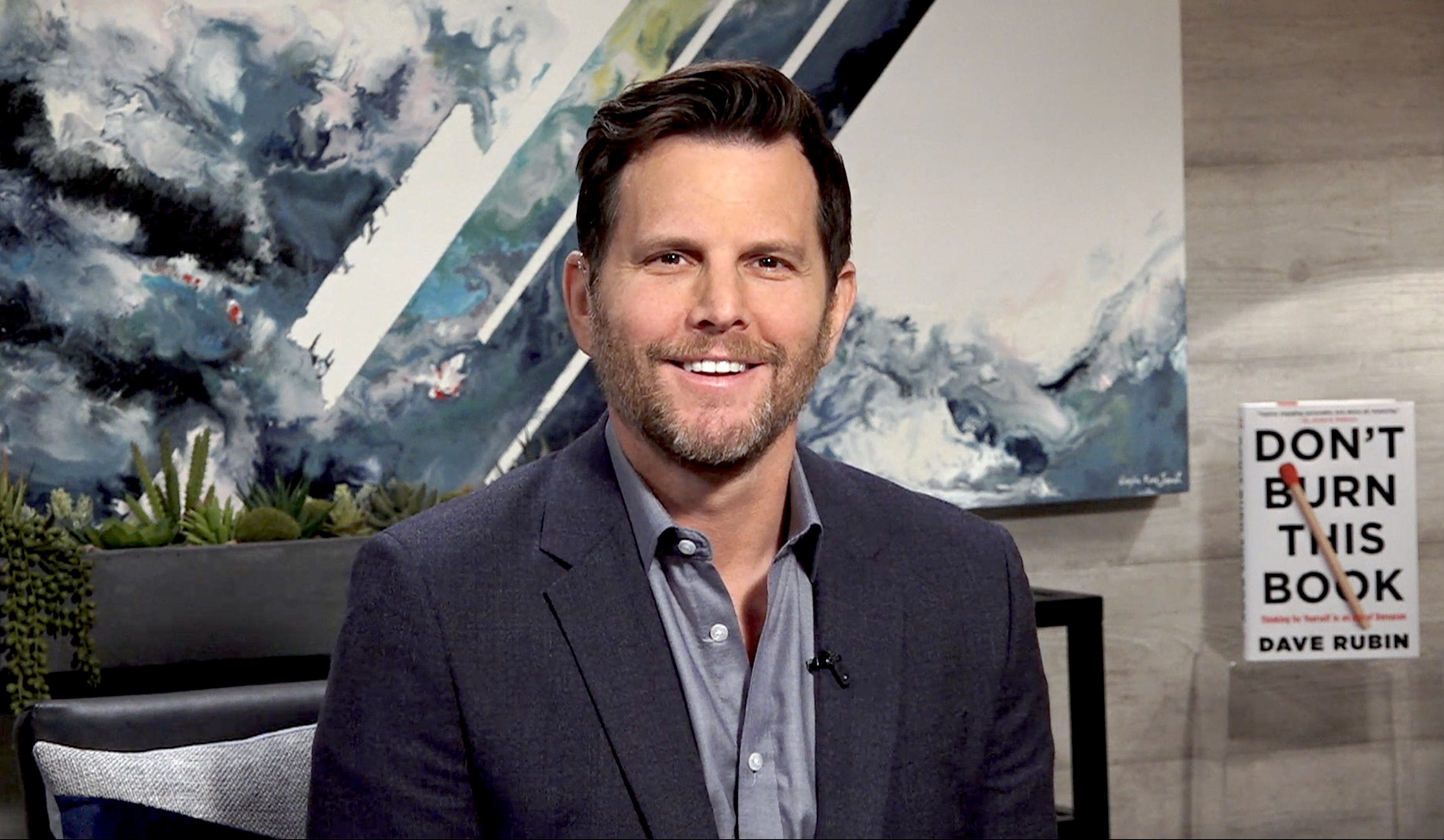
The short rise and long fall of Dave Rubin

If my memory doesn't fail me, I started watching the Rubin Report sometime in 2016 and it has quickly become part of my daily staple. Dave was a disillusioned former leftist, and since I also have a very strong opinion about the hard-left and Wokeism, his overall message resonated with me. He was an affable guy with apparently endless curiosity, who after being immersed in the left-wing culture for years, jumped headlong into...hm into what exactly? Not right-wing extremism, but rather a world with all kinds of interesting faces.

Many of his guests were people you could almost never come across in mainstream media, but they were mostly fun, irreverent, and delightfully heterodox. Gay Christians, black conservatives, disheveled academics, bow-tied libertarians, maverick scientists, stand-up comedians, Twitter-trolls, constitutional lawyers, female anti-feminists, wayward philosophers, polyamorous evolutionary biologists, transvestites, anarchists, crypto-currency evangelists, you name it. But along and among them were also a large number of very serious people, many of my favorites: Sam Harris, Jordan Peterson, Steven Pinker, Michael Shermer, Richard Dawkins. Every now and then, there were some sleazy guys, but at least of the more entertaining sort.

When Trump broke into our world, Dave didn't hold a firm opinion about him. He seemed to understand him to be a vile conman, but he was also infatuated with the idea that the mainstream media and politics are irreparably broken, and Trump might be just the right tool to wreck it, so something better can be built on the ruins.

The opinions that Trump would be a force for good in any sense, I held as a colossal error of judgment even then. And while the mainstream media has moved way too far to the left for me, burning it down along with the entire political culture seemed like an incredibly inane and simplistic thought. But people can hold many contradicting ideas in their heads at the same time, and very smart individuals sometimes have a few very stupid ones.

The other thing that has irked me a bit about the Rubin Report is Dave's instinctive eagerness to agree with his guests. But Dave wanted to facilitate conversation between the two warring tribes, and if the price for it was letting some absurd opinions go unchallenged, then so be it, I thought.

When the long-form conversation started to gain popularity, Dave Rubin was one of the main driving forces behind it, and for that, he deserves credit (and Joe Rogan deserves enormous). The phenomenon escaped from the podcast-world into the real one. Debates like the ones between Harris and Peterson could fill arenas around the world, and Rubin took part in many as the moderator.

And I think this was the pinnacle of his career, and something he can be rightly proud of. But at the same time, the guest-menu of his own show started to lose its diversity. The entrance criteria seemed to filter less and less for being novel and interesting, and instead, Dave was eager to invite basically anyone who had something bad to say about liberals, and/or something good about Trump. That was the time when I stopped watching the show. I still kept it in my news feed, and from time to time checked whether the current guest is someone worth listening to. Maybe one or two came along in the course of a year. And then, when Dave hosted Donald Trump Jr., it was the end for me.

Not for Dave, though. Starting from being a left-wing dissenter and cautious right-wing explorer, he ended up being a full-throated Trump-supporter and - to the surprise of no one - a COVID-denier. Today, after the elections, he is one of the loudest high-profile spreaders of election-stealing hoaxes and COVID-denialism. And also someone who gets denounced by an ever-growing list of former friends. Sam Harris just announced that he doesn't wish to be associated with the Intellectual Dark Web anymore (not explicitly but clearly referring to Rubin), and people in that circle have been making similar noises recently (a sigh of relief here).

This is a personal tragedy of a life having gone terribly astray, but also something that can offer some general insight. My brief opinion is that Dave Rubin is a guy with a good heart, limited intellect, good intentions, and bad company. It started well. David came away from the leftist worldview he held for many years and he had a void and the need to fill it. After spending enough time with Jordan Peterson, the former atheist started to believe in God. Talking with libertarians all the time made him denounce government as a whole. Confronting left-wing idiotism every day led him to Trump. By the time the pandemic came, he didn't even need moderate lockdown-skeptics to nudge him along the wrong way. He was already in sprint in that direction when the start pistol went off.

Dave is not dumber than the next guy, but he never had strong moral foundations or a clear perspective on politics and economics (or anything, for that matter). He went out into the dangerous world of wild ideas and magnetic personalities defenseless. Being in the company of very serious intellects clearly flattered him. He always made the impression of a starry-eyed boy who was drinking the words of charismatic adults. As one of the critics of his book (don't read it) put it, it is a coming-of-age story of someone who never grew up. Even in his better moments, he is parroting back half-digested ideas he heard from people he considers smarter than himself (he is right about that). In his worst moments, he is really at the bottom of the rabbit hole.

My take on Rubin might be naive, but I prefer the charitable interpretation. If someone presents himself already in such a bad light, what's the reason to attribute further malice to him, especially, when plain stupidity is a satisfying explanation for his choices?

,

What's wrong with Libertarianism

I have been thinking for a while about my issues with Libertarianism. For two reasons. One is that you should always challenge the beliefs you like. Two, libertarians are such a bunch of insufferably arrogant snobs, and one day I'd like to wipe the floor with one - at least in a verbal contest.

But the notion of fairness requires that before it comes to blows, the attacker should try and steelman his opponent's position. So in the following, I try to briefly summarize what I think Libertarianism is, and to put special emphasis on the ideas I like in it.

Libertarians' fundamental belief is that individual freedom should be regarded as the highest aspiration in society. Everyone should be free to do anything she likes as long as it doesn't harm others. "My freedom to swing my arm ends where the other fellow’s nose begins" - as the famous quote says. The government's sole purpose is to provide the conditions under which individual freedom can flourish. It should guarantee national security and ensure the rule of the law domestically, and with some exceptions (some libertarians are quite ok with seatbelts), that's all it should interfere with people's life. Taxation for any other purposes, like building an orphanage or funding basic research, is theft or plain extortion. Charity, like business, should be strictly voluntary.

This belief logically leads to the faith in free-market capitalism. Economy, just like any other public endeavor in society, should be organized bottom-up. Here I find the ideas and arguments of free-market advocates very persuasive. The theory behind why voluntary exchange between individuals leads to higher prosperity for the whole society than central planning is elegant, parsimonious, and powerful. It is also proven.

Let's demonstrate it with an example. If the French government tried to calculate how much a Parisian restaurant should ask for oysters, it would need to unpick a very intricated net of interactions. It would need to know how much oyster people generally wish to eat, how much oyster fishermen in Marseille can produce in a day - and their fellow fishermen elsewhere. How much compensation they deserve for the work. How much transporting the goods would cost (the best cost/benefit ratio among the alternative routes). How much is the demand in Paris for oysters and what is the fair price customers would be willing to pay for them. How much the cook would ask for preparing them.

With voluntary exchange, these calculations (and a myriad more with varying relevance, like what's producers of oyster-fishing equipment would want for their goods) happen between individuals, who know best how much value they put on their time and work.

The price of an oyster dish condenses a huge amount of information in a single number no one alone could come up with. And if the government forced the price to the half by decree, the ripple effects would wide and far-fetching and would affect more people than it could be foreseen. Most of the time, not for the better.

Accepting the supremacy of voluntary exchange, the impossible burden of knowing every detail and consequence of a financial action vanishes. And the free exchange-based system indeed rules supreme over any other economic alternative. Never before the modern times had humanity it as good as now in terms of GDP, nutrition, life-expectancy, or any other meaningful materialistic metric one can name. Capitalist countries are free and prosperous, while there is not a single self-proclaimed socialist state that didn't manage to make its people poorer and its prisons more crowded.

Libertarian thinkers, however, are rarely satisfied by stating their case not solely on economic terms. They claim that their way of doing things is not only economically more efficient than the alternatives, but it's also morally justified. Here they are not so different from socialists or even liberal democrats. Every camp believes that their political/economic ideas would yield the highest prosperity, and, conveniently, they are also morally superior.


So as far as I can see, Libertarians tend to state their case in four different ways.

1. Reaping the rewards of your work is just and it requires no further explanation.

2. (going from the other direction) although strict adherence to the first principle might be a justification for being selfish and greedy, but it's still immoral to forcefully disappropriate someone else's possession. 

3. Value is in the eyes of the beholder. No one has the right to impose her priorities on her fellow citizens.

4. Finally, life is terribly complicated. Solutions based on strictly voluntary bases might not always be the best, but it's practically impossible to build a framework of rules that would on average perform better. In the same vein, it's better to accept that the value of something is simply what people are willing to give for it than attempting to come up with some arbitrary and complicated way to measure it. It's not only futile, but it also leads to corruption and injustice.


So that is at least my interpretation of Libertarianism. My rebuttal below runs broadly along the following lines. For some problems, states sometimes have better solutions at their disposal than what free markets could provide. Ensuring that economic choices are really uncoerced sometimes requires more and not less state intervention. Libertarianism weakens social cohesion, which is in cases desirable and in others not. Finally, values are not entirely subjective, and they shouldn't be treated as such.

Let's start with a generic observation. I think every single libertarian argument above stands well on its own. Some are very convincing, but all of them are at least defendable. My problem is with the almost religious fervor Libertarians cling to them. Principles in life always have a sphere of validity. Take them too far, and they will either collide with the extreme end of another dear principle or will just lose power. Don't kill is a good guideline in life until you see a serial killer with a blood-stained axe in his hand coming at your kids and you have only one bullet left in the chamber. Being compassionate and always telling the truth are also mutually exclusive in certain situations.

Libertarians sometimes seem to think that the world is a just bunch of nails and they have found the perfect hammer  - even if it's admittedly an unfair comparison. Free-markets are such a powerful and versatile invention that they reject physical parallels. But they are not a panacea. An apter analogy could be found in engineering. Software engineers know that decentralization is a powerful technique for building simple, robust, and efficient systems. But they also know that there are no silver bullets in engineering. Sometimes centralized control is the best option. If no single approach can solve every problem in engineering, it's unlikely that one such exists in a world much more messy and complex, that is, economics.

In turning from the abstract to the concrete, I can think of at least three areas where free markets don't perform very well.

The first is that seemingly voluntary life-choices are not really voluntary. The libertarian argument for the legalization of prostitution is that as it happens between consenting adults, it's no one else's business. But neat ideology is a thin veneer on the grim reality: the large majority of prostitutes are drug-addicts. Women are often forced into selling their bodies and are abused by their pimps. Arguments for and against polygamy follow the same lines. Fundamentalist Mormon women can claim that they are happy in a polygamous relationship, but in those communities, underage girls forced to marry men 50 years their senior. It's not their free choice, and they are brainwashed into it from childhood and punished severely if they try to dissent.

The second area is the problems for which individual actions just don't provide adequate solutions. Sometimes the sum of the parts is less than the whole. Recycling your waste will make you feel better about yourself and will do nothing to solve the problem of climate change. To stop lethal viruses, a large majority of the population needs to be vaccinated. If the government refuses or unable to enforce that, the fate of the whole society stays in the hands of a small group of delusional anti-vaxxers. Another example is banning cigarettes from public places. On their own, few smokers would have followed guidelines, but even the majority of smokers are now happy to be able to spend a night in a bar without stinking the next day. The same can be said about enforcing helmets in professional cycling or ice-hockey. A hockey player would not have worn a helmet when others don't because it constraints her vision and she would have had to trade efficiency for safety. But being mandatory, it poses no disadvantage to anyone and provides higher safety for everyone.

The third area is where places where the financial incentives of individual actions are missing. Funding basic research in, let's say mathematics, is not a rational business decision anyone would make if those researches are expected to bring results in a hundred years. 

The element of libertarian ideology I take issue with the most is the definition of value. Libertarians say, if you produce movies for which people are willing to pay to see, you have exactly the same moral right to enjoy your wealth as if you had amassed it by producing medicaments for disabled children. The majority has no right to impose their system of values on individuals. After all, who has the right to claim to be the judge of other people's preferences, and second, value systems change over time. What once was regarded as the deepest depravity, like homosexuality or atheism, is today considered perfectly normal. 

And, in general, they have a point. Who is there to say how much a painting should cost? What is worth more, a computer or a motorbike? Caring for the elderly or nursing children? But even though I agree with the idea in general, I don't believe that values are purely subjective. And neither really do those who say so. Let's take the dilemma raised by Breaking Bad. If people are willing to pay much more for producers of crystal-meth than for chemistry teachers, does it mean the former deserve more? It's futile to try to align moral and material worth. But it doesn't mean they are truly independent and every attempt to reconcile them deserves scorn.

Finally, libertarianism weakens cohesion in society. This is sometimes a good thing, the world would have preferred a bit less unity in the Third Reich. But oftentimes it's not. Public and mandatory schooling, universal health care, national television, and the like do forge national unity, and the only thing that makes that hard to see is that we take them for granted. I once heard the famous American libertarian, John Stossel arguing for a privatized postal service. Stossel cited the massive losses the national postal service suffers every year, and argued, very sensibly, that private companies would do the job much better. I'm sure it's true. But they surely wouldn't be universal. Scarcely populated, remote places with old and possibly lonely people would unlikely be covered by them. I accept that there are some ideological hermits who would find infuriating that they can't get away from the overbearing state, but their well-being concerns me less than those who would rightly feel just left out in the cold by the nation. I'm not saying that receiving letters from the state would fill the gap of loneliness in people's hearts. But I think the idea that there is a community that regards you as a member comforts more people than how many it incenses. Also, what would a libertarian utopia do if its less enlightened neighbor decided to invade it? The "every man for himself" approach would bring a quick end to the glorious experiment.

In the end, although I don't want to live in a country ruled by libertarians, I want to hear their voice in opposition. Libertarianism is the best antidote against theocracy, an ossified class-system, or socialist enthusiasm in government. They have a lot to say both in the area of morality and economics. But unlike moderate liberals or conservatives, they think what they have to say is all that's out there.

It's over

That was a very long three days. After the high hopes nurtured for months, Wednesday was a bucket of cold water. Not only did the prospect of landslide victory vanish, but the slowly creeping realization set in that Trump could pull it off again. After a long night of the soul (I heard this phrase in a podcast and really like it), Thursday morning some glimmers of hope started appearing, and it had gradually grown until Friday. It was a nail-biter for two days. Since then, it's pure elation. It's good that I never wanted to be a poet.

The first thing on everyone's mind: how could the polls be so wrong again? Were they wrong? I think this is one of those "on one hand, on the other hand" topics (Truman famously asked to be sent a one-armed economist). So, on one hand, they were very wrong. They predicted a clear and decisive victory for Biden. Instead, Biden won the states he desperately needed by the skin of his teeth. He won Arizona, Pennsylvania, Wisconsin with less than 1% of the votes. Georgia, still hanging, with a tenth of a percent. This race was very, very tight, and the result could have easily gone the other way.

On the other hand, Biden won with a historical margin of more than 4 million votes. With more votes in total than any presidential candidate ever received. In America, that would be considered a landslide if not for the States' vestigial electoral system. He even flipped some states.

On the third hand, the Democrats probably won't control the Senate and even lost seats in the House. This was clearly not the repudiation of Trumpism we hoped for. It erased the hope of a soul-searching and cleansing process in the GOP, sadly.

Speaking of Trumpism, what does this result say of the American people? In 2016, low-information voters at least had the excuse (a ridiculous one, though) that they are, well, low-informed. But after 4 years of Trump, half the country still wants more of this?! This topic merits a post for itself.

Trump, of course, to the surprise of no one, continues being Trump. He is so embarrassing that even his hard-core lackeys are eager to distance themselves from his lunatic claims. Two very funny months are ahead of us. For the first time in four years, I regret that Twitter blocks Trump's most unhinged posts. Watching the public meltdown of this smalltime, cruel, vile, and pathetic wreck is just sweet. It almost makes up for the past four years.

Beyond that is anyone's guess. Trump may try to run in 2024 again. If his preternatural stamina (his only positive trait) lasts that long. He'd be 78 then. Or the GOP may decide that although the messenger was a pain in the neck, the message sold well. It may be worth trying with a younger, less erratic vehicle of Trumpism. There are so many moving parts. Trump's behavior in the next two and a half months. The possible criminal prosecutions after. The ambitions of his family. Biden's effort to reach out to the moderate Republicans (which is what I fervently hope he'll do).

As for Biden, I think he deserves some words of praise here. Instead of the doddering old geezer he seemed to be at times, he has proven to be the right man for the right time. He is decades past his prime, he is a gaffe-machine, he already failed twice in his presidential bids. But he is the antithesis of Trump. He is a decent and emphatic man, generally liked by everyone. He is a unifier and a consensus-seeker. He is who had the best chance of defeating Donald Trump and he is what America needs today. 

The opinion pieces about the still enduring problems and new mistakes, and "COVID and racism and inequality are still not over..." will start appearing soon. But now, just sit down, get a beer, turn on some right-wing media outlet, and enjoy the show.


When the race is over(?)

 The election season is about to cross the finish line, after what seemed to be ten years since spring. 

Although everyone who is rooting for Biden suffers from 2016's PTSD and Trump-supporters are eager to find hope anywhere, for someone following the polls only, this race has been a very boring and predictable one. Barring some bombshell revelation about Biden (and it's already too late for that), the end has never been in question for months. The only remaining unknown is the size of the victory. The really interesting and unpredictable part is just about to start.

If Biden wins, and there is almost no way he won't, Trump will claim that the election was rigged. The smaller the gap between him and Biden, the louder he will be. His followers will stage protests and he will encourage them. Furthermore, this will be a prolonged process. People will vote personally on November 3, but counting the mail-in-ballots can take days or even weeks. Republicans are more likely to vote in person, and Democrats are more likely than Republicans to vote early. If Trump has more votes on the evening of the election but the mail-in-ballots chip his advantage away day-by-day, he will tell his followers that the election is being stolen in front of their eyes. This will be a powder keg. But he will do it anyway, regardless of whether Biden is ahead from the beginning or not.

That's not news. The interesting new brain-teaser for political geeks is to try and predict how the GOP will react to its unhinged leader, who won't be the leader for long. On one hand, I suppose their enthusiasm to side with Trump will be inversely proportional to the size of defeat, too. On the other hand, that is where I expect high-profile Republicans to break ranks. Lindsey Graham, Mitch McConnell, Marco Rubio, or Mike Pence don't like Trump. If anything, they despise him, and certainly don't want to go to prison with him (maybe Bill Barr wants, I don't know). I've read that Biden already reached out to moderate Republicans with cabinet position offers, which is exactly what he needs to do and the country needs badly. 

As a side-note, I'm astonished by how professionally the Democrats have led their campaign from the beginning. They had the discipline of playing it low-profile during the first wave of the pandemic. They kept Biden out of Trump's way of self-immolation and ran a campaign on the promise of uniting the country instead of falling prey to their own extremists. As opposed to the Trump-campaign, which was led by the idiot son-in-law and a bunch of monkeys who wouldn't make it to team B in any other political campaign. They have burnt an incredible amount of money for nothing and let their boss wasting time on holding politically harmful rallies as personal therapy sessions. Trump is partying like it's 2016, raging about Hillary's emails and Obama's spying on his campaign. Who the fuck cares about Hillary's emails in 2020? In the end, Donald Trump will go down in history, not as the raw political genius he is purported to be, but as a one-trick pony.

I digress, but I couldn't resist.

So I expect the Republican elders to distance themself from Trump, albeit silently. I hope they are every bit of the cynical, spineless, power-hungry people they have shown themselves to be. Because if they are, they will act solely out of self-interest and try to wash the stain off or keep silent until it fades. The situation is worse if they retained a shred of dignity because in that case they might cling to Trumpism instead of admitting their complete moral and political failure. Plus, they have also proved that they are not terrific long-term strategists.

There are several factors to complicate the picture even further. The most important of them may be that, unlike in 2016, Trump has reasons to be terrified of losing. Once the office of the presidency no longer protects him, he might need to face charges of tax evasion, obstruction of justice, and whatever additional misdeeds from the last five decades the prosecutors will uncover. Even during his presidency, half a dozen of his close associates were led away in handcuffs. The institutions worked. All this beside the fact that he might even be financially broken. So he will fight to the bitter end. And even if top-level Republicans are happy to throw him to the wolves, he has an almost inerodable base of supporters and even some low-level GOP lunatics who truly love him (in a Platonic way, most probably).

Then there is the Supreme Court. Brett Kavanaugh and Amy Coney Barrett have made some worrying noises lately. One would think that having reached the highest office they ever dreamed of, they will act with restraint and consideration, but what if they won't? The Trump team will immediately issue a series of legal challenges (which is almost the norm by an American election) and some of them might end up at the Supreme Court.

Then the Anti-anti Trumpers. There are mistakes made at every election. We can count on the National Review to find every single one of them that worked to Biden's advantage and, at most, passingly remark upon the others that favor Trump. By the way, the best comparison to Anti-anti-Trumpers just dawned upon me. They are like the tobacco industry. They only asked questions. They just pointed to scientific mistakes. They even set up their own research. These right-wing party soldiers will point out when the mainstream media doesn't pursue a story aggressively enough. They will report on any trace of Wokeness around Biden. On every gaffe. Everything is factual. We are just impassionate observers. But I digress again.

Then there are the Trump family's future plans. I'm sure Don Jr would love to capitalize on daddy's success in 2024. No one can tell how that will play out with the GOP leadership.

Then finally, the clay-footed giant, the voters. Will Trump-voters gradually lose interest in him after his presidential days are counted? I think that's inevitable, and the better question is where their energies will be channeled into.

The months until January will be tumultuous. The banging of the war drums won't stop. Will the game of "I was only there to control his worse instincts" start right after the elections? Will Trump be a lonesome madman till January, raging on Twitter, ignored by everyone? (Or will the GOP stick with him and go fully down the path of becoming the white grievance party of the future?) Will Trump have any incentive to do something in the next 2 months? Or just trying to save his hide? Or screwing up things just out of spite? 

Things are going to get interesting after November 3.


, ,

Pranks, bubbles, disappointments


In 1996, Alan Sokal, a professor of mathematics and physics, submitted an article titled "Transgressing the Boundaries: Towards a Transformative Hermeneutics of Quantum Gravity" to an academic journal of postmodernist cultural studies. It passed through peer reviews with flying colors and garnered praise across the targeted segment of academia. Shortly after, Sokal announced that it was a prank. Prompted by his annoyance with pseudo-intellectuals, he had packaged lengthy nonsense in obscure language and tested how well it would sell. It did sell well, not to the amusement of the duped parties, at least not after he exposed the trick. Astonishingly, some of them even doubled down. Instead of owning their embarrassment, they claimed that Sokal might have been insincere, but his article accidentally happens to be full of gems.

Twenty years later the philosopher Peter Boghosian, the mathematician James Lindsay, and Helen Pluckrose, an English literature scholar, pulled off the same trick. To expose poor scholarship of certain academic fields, they submitted a series of bogus papers to various journals. Their target this time was yet another subfield of postmodernism, the gender- and race-studies - "grievance-studies" as the trio puts it. They rewrote some parts of Mein Kampf, wrote an essay about how dog-parks facilitate rape-culture in society, another one about the benefits of anal sex toys for men in the fight against transphobia, and a series of others in a similar vein. Boghosian's "The Conceptual Penis as a Social Construct" probably crowns their efforts, but it's a tough race. Like Sokal, Boghosian and his partners in crime wanted to cast a spotlight on what they perceived as pseudo-intellectual bullshit masquerading as science.

The hoax was eventually exposed and it predictably ruffled the feathers of a great many people. It generated both furor and discussion about many topics around ethics, groupthink, cultural influence over academia, orthodoxies, etc.  Lindsay and Pluckrose recently wrote a book about the broader topic of their interest with the lengthy title of "Cynical Theories: How Activist Scholarship Made Everything about Race, Gender, and Identity―and Why This Harms Everybody".

I listened to many interviews with the guys, and I like them a lot. This all happened in the past. Then a couple of days ago Lindsay' tweeted: "Frankly going to unhappily vote Republican, including Trump, until the left walks this shit all the way back." 

Well, that was a bombshell. I don't think Lindsay is a racist or misogynist or even the kind of guy who suffers Trump. But it is a colossal error in judgment, for two reasons. 

For one, Donald Trump dragged the presidency and public discourse in the gutters like no one ever has before, and by paralyzing America, it made the world a more volatile, dangerous, and cynical place. Yes, America never fully lived up to its ideals, but: 1. no country ever had 2. the world's hegemon at least had noble ideals. Good luck with the world that is governed by Chinese, Islamist, or Russian ones instead. The damage being caused by irritating poseurs, virtue-signaling craze, and victimhood culture on the Left is very bad and it does real harm to real people, but it still doesn't even come close. Your sense of proportion has to be so imbalanced to see that exactly the opposite way, that it's a miracle if you can even utter a straight sentence. Clumsy metaphor, never mind.

Nevertheless, Lindsay's opinion on the dangers of the two extremes is at least defendable. Maybe he is right and my sense of proportion is useless. But what is not defendable, in fact, almost inexplicable for a man of Lindsay's intellect, is that he thinks reelecting Trump would somehow help his cause. A ruling white-grievance party is not a bulwark against left-wing idiotism. It's the fuel of it. Lindsay seriously thinks that another four years of Trump wouldn't make Wokes even crazier?! It would make me crazier.

Luckily, his college, Helen Pluckrose, has not fallen in the same pit. She, without judging her acquaintances' decisions, encourages everyone to vote for Democrats. I wonder whether it has to do something with gender (that would be ironic for the trio). Women certainly seem to be less enamored by this faux-strongman-shtick.

Anyway, read what Jerry Coyne has to say about the matter.

The affair made me sad but also prompted me to contemplate bubbles. Lindsay lives in a bubble where he faces the absurdity of and harm caused by Wokeness every day. He probably also suffers attacks from them every day. And this apparently distorts his picture of the world to a dangerous extent. It is sad and disconcerting.

It's sad to realize that someone, whose opinion you have valued high so far, proved to be very fallible. It is also frightening, because if a smart guy like him can't see the forest from the trees, how do I know that it's not I who lives in a bubble? How do I know that Lindsay is not right, and a Trump presidency is, all things considered, still better than a Biden one? Or how do I know that Lindsay was right about Wokeness, to start with? It's both true and meaningless to say that everyone lives in a bubble. Obviously, everyone has preferred sources of information and a specific group of fellow humans he or she regularly interacts with.

I suppose the only remedy for close-mindedness is to follow the well-known and rarely practiced advice of staying out of your comfort zone. I suppose one can try to stay informed simultaneously inside multiple bubbles with little overlap or push the walls of her preferred bubble as far as she can. 

When Trump won in 2016, I started actively seeking out right-wing information sources. The farthest I had to stomach to go was National Review, and even that one I'm planning to ditch now (although, had they not gone all-in for the GOP by 2020, if not for Trump, I would stay). I never had it in me to watch Fox, let alone to read Breitbart. Gad Saad, Jordan Peterson, Niall Fergusson, Andrew Neil, Douglas Murray, Charles Murray, and few other people whose names I can't recall now, are whom I strongly disagree with at times, but I enjoy listening to. I can't listen to anyone who I can't enjoy. Probably that's the reason why I never sought left-wing sources of information. They are humorless. Hm...I just realized I have to correct myself here. I accidentally stumbled upon Slavoj Zizek, and he is quite funny, but I have no idea where he is on the political spectrum - even though he calls himself a communist. Anyway, this post has descended into a rumbling, it's time to stop.